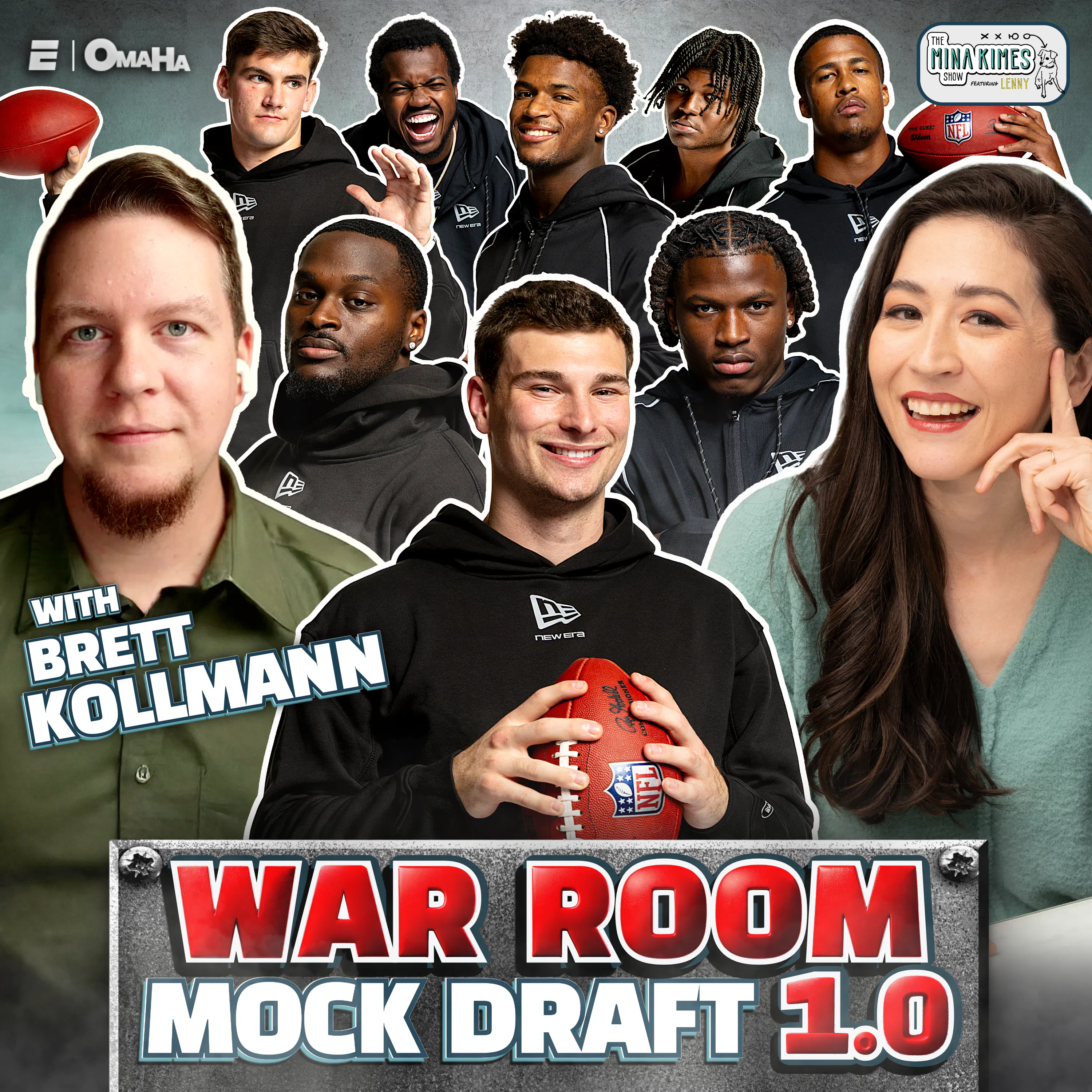
Overview of War Room Mock Draft 1.0 with Brett Kollmann
This episode is the first “War Room” mock draft of the 2026 cycle hosted by Mina Kimes with guest Brett Kollmann (Bootleg Football). The format simulates an NFL war room: Mina gives two-player options for every team (no trades in this episode), and Brett explains which player he’d pick and why. The episode runs through the first-round decisions for all 32 teams (two choices presented per team) and emphasizes roster fit, durability, scheme usage, and long-term planning more than pure “best player available.” They also preview future draft coverage and guests.
Key picks & Brett’s rationale (highlights)
Note: Mina presented two options per team; below are the notable selections Brett made and the core reasoning he used.
-
Raiders (No. 1) — Fernando Mendoza (Indiana, QB)
- Rationale: Mendoza’s size and “body armor” give Brett more confidence in him surviving an NFL workload; Simpson’s tape is NFL-ready but Brett worries about durability and only 15 college starts.
-
Jets (No. 2) — Arvel Reese (Ohio State, versatile LB/edge chess piece)
- Rationale: Reese’s versatility to play on- or off-ball and create mismatches (compared to Dante Hightower usage) fits what the Jets might want scheme-wise.
-
Cardinals (No. 3) — Francis Mauigoa (Miami, OT)
- Rationale: Cards need to build a QB-friendly destination by protecting the edge/creating stability at right tackle — priority on long-term tackle help over a defensive lineman.
-
Titans (No. 4) — Reuben Bain (edge)
- Rationale: Bain’s power, pocket-collapse ability and production project as a reliable NFL edge who can create pressure consistently.
-
Giants (No. 5) — Carnell Tate (WR)
- Rationale: Organizational objective: help Jackson Dart succeed in Year 2 with more weapons, even if Sonny Styles graded slightly higher overall.
-
Browns (No. 6) — Spencer Fano (Utah, OL)
- Rationale: Versatility. Fano can play multiple spots (guard/tackle/center competition) and helps shore up an offensive line that must protect the passing game.
-
Commanders (No. 7) — David Bailey (edge)
- Rationale: Edge rotation upgrade; better to take a pass-rusher and not use top pick on a running back like Love given roster construction and free agent additions.
-
Saints (No. 8) — Sonny Styles (LB)
- Rationale: Ultimate best-player-available pick; Styles’ athleticism and play profile make him hard to pass up despite existing LB depth.
-
Chiefs (No. 9) — Mansoor Delane (CB)
- Rationale: Durability concerns on some WR options pushed Brett to add a pro-ready corner who can start immediately and provide value for cap/roster balance.
-
Bengals (No. 10) — Interior OL (player discussion focused on guard help)
- Rationale: Protecting the offense and getting value at guard to keep expensive offensive pieces productive was prioritized over taking a defensive playmaker.
-
Dolphins (No. 11) — Makai Lemon (WR)
- Rationale: Tough, over-the-middle slot who wins contested reps and fits what Miami needs after prior moves.
-
Cowboys (No. 12) — Jeremiah Love (RB)
- Rationale: Brett called Love the best player in the draft and loved the scheme fit: pairing him with an established early-down back would create an elite RB room and help maximize offense and rookie-value production.
-
Rams (mid-first) — Kenyan Sadiq (TE)
- Rationale: Unique, athletic tight end who fits Sean McVay’s creativity and can be used in multiple roles as a weapon and blocker.
-
Ravens — Jermod McCoy (CB)
- Rationale: Instant-impact corner who could plug in opposite Nate Wiggins and ensure continuity if veteran pieces slip.
-
Bucs — Akeem Mesidor (edge)
- Rationale: Brett prefers proven, pro-ready players on rookie deals who can contribute immediately — Mesidor fits that bill.
-
Eagles — T.J. Parker (edge)
- Rationale: Brett is high on Parker’s power-rush profile and development at Clemson; he’s a plug-and-play compliment to Philly’s front.
-
Bills — Keldrick Falk (edge)
- Rationale: Falk has high upside and fits a need to add edge depth; Brett notes Falk can contribute versus the run early and may take longer to become a true pass-rush force.
-
Several teams (Lions, Vikings, Steelers, Chargers, Packers, etc.) — notable OL, DB, and power-edge picks discussed
- Rationale: Many teams prioritized offensive-line help or power edge rushers, or took long-term defensive pieces depending on roster construction.
Themes & takeaways
- Durability and “survivability” matter a lot for Brett — small QBs with limited starts (Ty Simpson) face extra scrutiny despite clean tape.
- Power-style edges (those who collapse the pocket and win with length/strength) are favored: Brett repeatedly stresses NFL data shows power rushers translate well.
- Versatility/value: players who can move around the line (multi-spot OL or hybrid LB/edge pieces) gain value for roster construction and scheme flexibility.
- Interior offensive line scarcity: many teams need OL help, but the draft has a relatively thin supply of high-end interior OTs/guards, making such prospects more valuable.
- Running back valuation is nuanced: Brett recognizes the contract-value argument against RBs in Round 1 but argues for drafting a rookie RB (Jeremiah Love) if he’s the best player and fits a rookie QB or scheme that maximizes him.
- Injury/availability concerns lower a player’s stock (Jordan Tyson repeatedly noted as talented but injury-prone).
- Day-two depth will be crucial, especially for teams that need receiver, corner, and interior line help.
Notable quotes & insights
- On QB1 debate: “Tape is good [on Ty Simpson]. Realistically, will he survive? That’s what I’m more thinking about…I more trust Fernando to survive long enough to develop.”
- On Arvel Reese: “Not a full-time edge…a movable chess piece…perfect for usage-based teams.”
- On Reuben Bain: “Power, power, power…if you can collapse the pocket you’re going to be productive.”
- On Sonny Styles: “I watched 2005 Brian Urlacher right before I watched Sonny Styles. It looked pretty similar to me as far as movement ability, size…”
- On Jordan Tyson and durability: compared to Arian Foster in being a high-injury-risk player until he fixes whatever causes soft-tissue issues.
Topics discussed (episode structure)
- How the “war room” mock works: two choices per team, Brett picks and explains, no trades in this episode.
- Quarterback debate at the top (Mendoza vs. Simpson) and why size/experience matter.
- Edge rushers: Bain, Bailey, Falk, Parker, Mesidor — a theme about power vs. twitch/athleticism and how schemes use them.
- Offensive line scarcity and the premium on versatile OL who can plug multiple spots.
- Running back valuation and when a rookie RB can be worth a high pick (fit & ecosystem).
- Injury risk/availability as a draft factor (Jordan Tyson as case study).
- Team-by-team fit justification — building “destinations” for future QBs, protecting payrolls, and maximizing rookie deals.
What’s next / action items
- Mina and Brett will continue these mock war rooms weekly up to the draft.
- Next episodes & guests:
- Next week: Daniel Jeremiah joins the war room.
- Later this week: Brett will join Nate Tice and Danny to deep-dive quarterbacks and running backs.
- Brett will start incorporating trades in future mock episodes.
- Additional content: Brett Kollmann (Bootleg Football) has more draft films and content on his channels and will publish work from the combine on edge measurements and roster makeup pieces for playoff versus rebuilding teams.
Who to follow
- Brett Kollmann — Bootleg Football channel (YouTube and podcast appearances) for more film breakdowns and draft analysis.
- Mina Kimes / ESPN War Room feed for weekly mock updates and guest analysts.
If you want a compact one-line takeaway: this mock was tilted toward “NFL-ready” traits (size, power, versatility) and long-term roster thinking (offensive-line scarcity and rookie contract value), with Mendoza emerging as Brett’s QB1 because of survivability concerns around other top QB prospects.