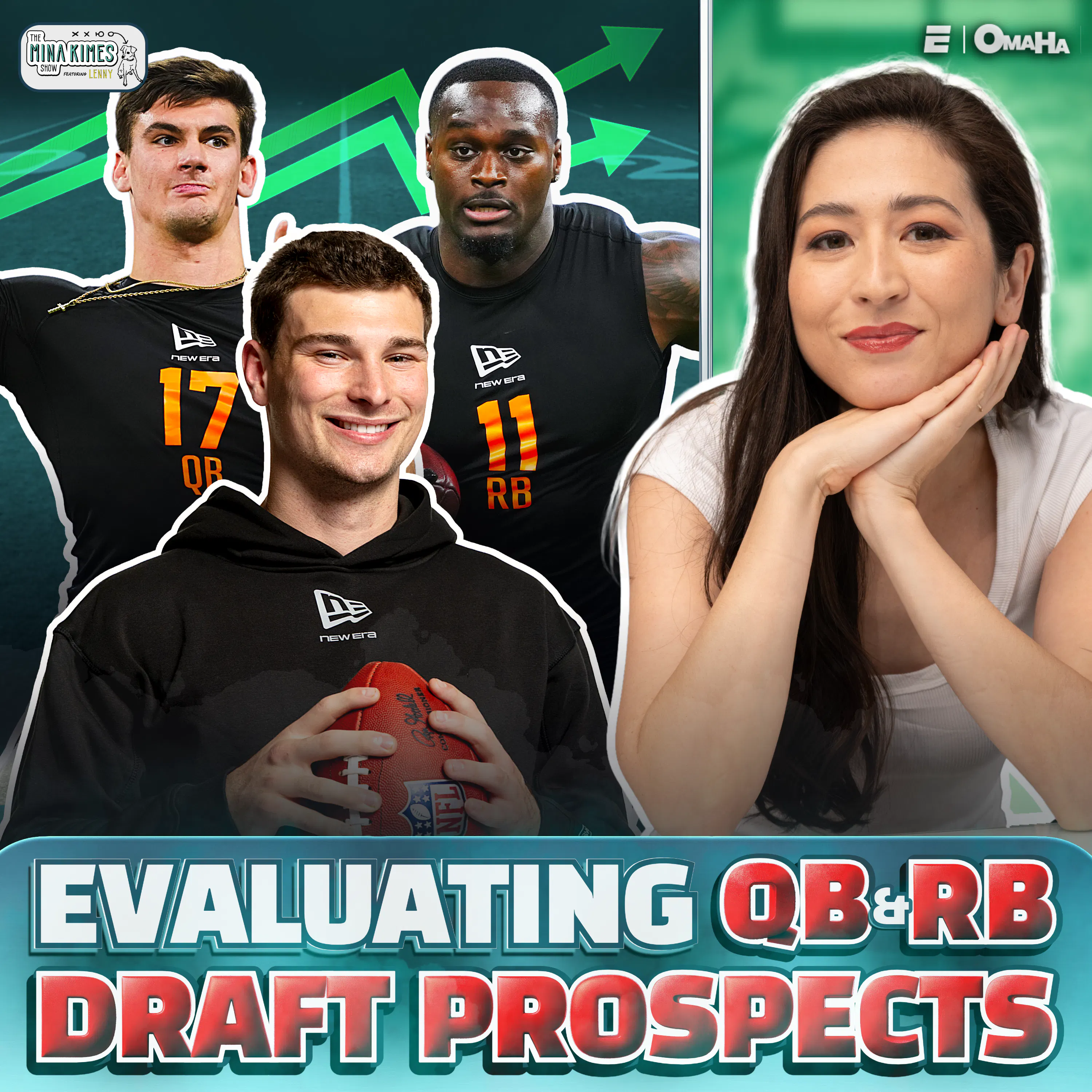
Overview of The Mendoza Line: Discussing the QBs and RBs of the 2026 Draft
This episode (ESPN / Mina Kimes, Omaha Productions) breaks down the top quarterback and running back prospects in the 2026 NFL Draft. The hosts (Mina Kimes, Danny Kelly, Nate Tice) focus heavily on QB1 Fernando Mendoza and the controversial QB prospects Ty Simpson and Garrett Nussmeier, then pivot to the running back class — led by Jeremiah Love — and the larger question of draft value and team fit for high-drafted backs.
Key topics covered
- Detailed scouting of Fernando Mendoza (QB1), Ty Simpson (QB2), Garrett Nussmeier (QB3).
- How Mendoza’s traits translate to the Las Vegas Raiders / Clint Kubiak offense.
- Size, experience and outlier-risk for Simpson and Nussmeier (medical/measurables concerns).
- Which teams could realistically take or trade for these QBs.
- Deep dive on the RB class: Jeremiah Love (top prospect), Jadairan/Jadarian Price (No.2 at Notre Dame in the transcript), Jonah Coleman (power/short-area runner), plus other mid/late-round RBs.
- Big-picture draft strategy: opportunity cost of using premium picks on running backs, and team contexts that can make RBs successful.
Quarterbacks — evaluations and takeaways
Fernando Mendoza (consensus QB1)
- Strengths: elite ball placement and accuracy (especially back-shoulder throws and timing on out routes), prototypical size (6'5"), polished operation, quick release on timed concepts, strong pocket processing on money downs. Eye test and situational stats show clutch performance on 3rd/4th down.
- Weaknesses: above-average sack rate in college; tends to drop eyes under pressure and can scramble/back up rather than step up. Not a top-of-class arm or elite athletic profile — more “polished, reliable” than spectacular.
- Projection/Fit: Good mental readiness for a pro scheme; should be able to adapt to Clint Kubiak’s under-center/play‑action-heavy offense mentally and technically, but will need coaching to reduce sacks and get comfortable turning his back in play-action. Realistic rookie expectation: not instant superstar — an average-to-above-average rookie starter is a successful result.
Ty Simpson (QB2)
- Strengths: reads zone coverage well, legitimate arm to make all throws, polished demeanor/processing, high number of “big-time” throws (PFF noted). Good anticipation on downfield timing.
- Weaknesses: size (listed around 6'1", ~208), only ~15 college starts, inconsistent season-to-season (tale of two halves), mechanical/footwork issues cause inaccuracy when out of structure. Considered a classic outlier prospect (small + limited starts) — high volatility.
- Draft outlook: Polarizing — teams must decide how much risk to pay for him. The panel leans against using a premium first-round pick on Simpson; likely more appropriate as a late-first / early-second pick for most teams.
Garrett Nussmeier (QB3)
- Strengths: quick timing, excellent throws to space, live arm for his size, good on-the-move throws, strong quick-release on RPOs and screens. Often gets the ball out and “puts balls in play.”
- Weaknesses: similar size/health concerns as Simpson; 2025 tape complicated by oblique injury; can attempt dangerous/overaggressive throws (trusting arm too much).
- Draft outlook: Viewed as a strong mid-round target (Day 2/3), frequently compared as a more comfortable dart than Simpson for many evaluators.
Other QBs (brief)
- Players like Carson Beck, Cade, Cole Payton, Taylan Green, Drew Baller and others are seen as day-3/backup candidates — tools are there but inconsistencies or scheme fits limit early-round appeal.
Scheme and team-fit discussion (Mendoza + the Raiders)
- Kubiak-style offense: under-center, heavy play-action, middle-field passing. Mendoza didn’t often operate under center in college but has the athleticism and footwork to adapt; mental processing and third/fourth-down performance should translate.
- Roster context matters: Raiders’ WR room is questionable; tight ends (Brock Bowers, Michael Mayer mentioned) could help; strong run game and line assistance would mitigate Mendoza’s sack concerns.
- Realistic expectation: coaches will aim to simplify early reads and protect him; expect development rather than instant star production.
Running backs — evaluations and takeaways
Jeremiah Love (Notre Dame) — the top RB prospect
- Strengths: elite explosiveness and home-run ability in open field, very productive per-carry (notable second-half surge), strong receiving skills and improved pass protection, finishes runs well. Big-play upside.
- Weaknesses: not a phone‑booth, between-the-tackles power dunker like Bijan — more of an open-field & zone-style home-run threat. Team fit and offensive line matter for maximizing his upside.
- Draft/value take: He’s worthy of early pick consideration by talent/ceiling, but using top-10 capital on an RB is often questioned because of positional value and long-term return on roster-building.
Jadarian Price (transcript name: RB2 from Notre Dame)
- Strengths: explosive, zone-scheme fit, great kickoff return ability, natural lane recognition and acceleration.
- Weaknesses: limited usage and sample in college (fewer receiving snaps), less proven as a three-down back. Good candidate for teams that run zone concepts and desire upside on day two/three.
Jonah Coleman (RB3)
- Profile: squatty runner (≈5'8", ~220), powerful and compact; excels in contact balance, short-area burst and pass protection; not an elite long-speed home-run threat.
- Draft/value: third- to fourth-round candidate; projects as an efficient between-the-tackles runner and solid pass protector who can be productive in the right system.
Other RBs mentioned
- Emmitt Johnson (Nebraska): shifty, short-area elusiveness (Kenny Gainwell archetype), day three dart.
- Mike Washington: ultra-fast (reported sub-4.34), mixed tape — explosiveness is real but consistency and vision are questions.
- Roman Hemby, Adam Randall and others: day‑three/intrigue pieces for zone/committee schemes.
Draft-value thesis: when to draft running backs early (and when not to)
- Opportunity cost: premium positions (edge, tackle, WR, QB) generally create a larger roster/salary impact than drafting RBs high. Examples and salary context discussed: RB salaries are, on average, lower ROI compared to premium defensive/offensive positions.
- Historical point: top RBs have flourished when paired with already-strong offensive lines and combo pieces (WR1 or strong OL). Teams drafting an elite RB without surrounding infrastructure often don’t realize the expected team-building return.
- Practical advice for GMs: unless your roster context (offensive line, weapons, scheme) aligns and you’re certain the RB fills a unique need or elite advantage, be cautious using a top-10 pick on an RB.
Notable stats & soundbites called out
- Mendoza: led Power Four QBs in outs thrown; 93% catchable on outs (reported); ~2.24s time-to-throw on outs; high EPA on 3rd/4th down; strong clutch numbers.
- Ty Simpson: tied for FBS lead with 30 “big-time” throws (PFF stat).
- Running backs: Jeremiah Love showed exceptional second-half efficiency (7.3 YPC second half cited) and elite open-field home-run rate.
Memorable analyst takes (short)
- “Mendoza is a ball‑placement/accuracy quarterback — not flashy, but polished and clutch.”
- “Simpson is an outlier: small, limited starts, and that multiplies the risk.”
- “Nussmeier often ‘puts the ball in play’ — a mid-round upside profile.”
- “A running back’s NFL success is heavily dependent on landing spot — OL and receivers matter more than people give credit for.”
Actionable conclusions / recommendations
- For NFL teams:
- Mendoza is a safe QB1 pick for teams wanting a polished, accurate, pro-ready QB — expect development and coaching to reduce sacks.
- Simpson is a high-variance prospect; be cautious about paying first-round premium unless you deeply believe the outlier will pan out.
- Nussmeier is a strong Day-2/3 option: high upside for lower risk.
- Don’t reach top-10 for an RB unless you have offensive line and receiving infrastructure to fully unlock the back’s skills.
- For fantasy players:
- Treat rookies/QBs as low-projected immediate upside unless landing spot has elite supporting cast.
- Love is the RB with the most fantasy upside in the class — but landing spot will substantially alter immediate value.
- For listeners who want a short checklist when evaluating these prospects:
- (QBs) Check measurable + starts (size, age, reps), pocket play under pressure, and play-action/under-center exposure for Kubiak-style fits.
- (RBs) Check OL quality, scheme fit (zone vs. between-tackles), pass-pro and catch usage, and whether the team already has complementary backs.
Where to look next (from the hosts)
- Follow-up episodes / pods: further team mock drafts (Danny), wide receiver/tight end/OL deep dives (Ben + Mina), plus continued draft coverage around the clock from Ringer/Ringer Fantasy draft shows.
- Final notes: the hosts stressed the importance of landing spot, coaching, and context — not just raw talent — especially for risky quarterbacks and premium running backs.