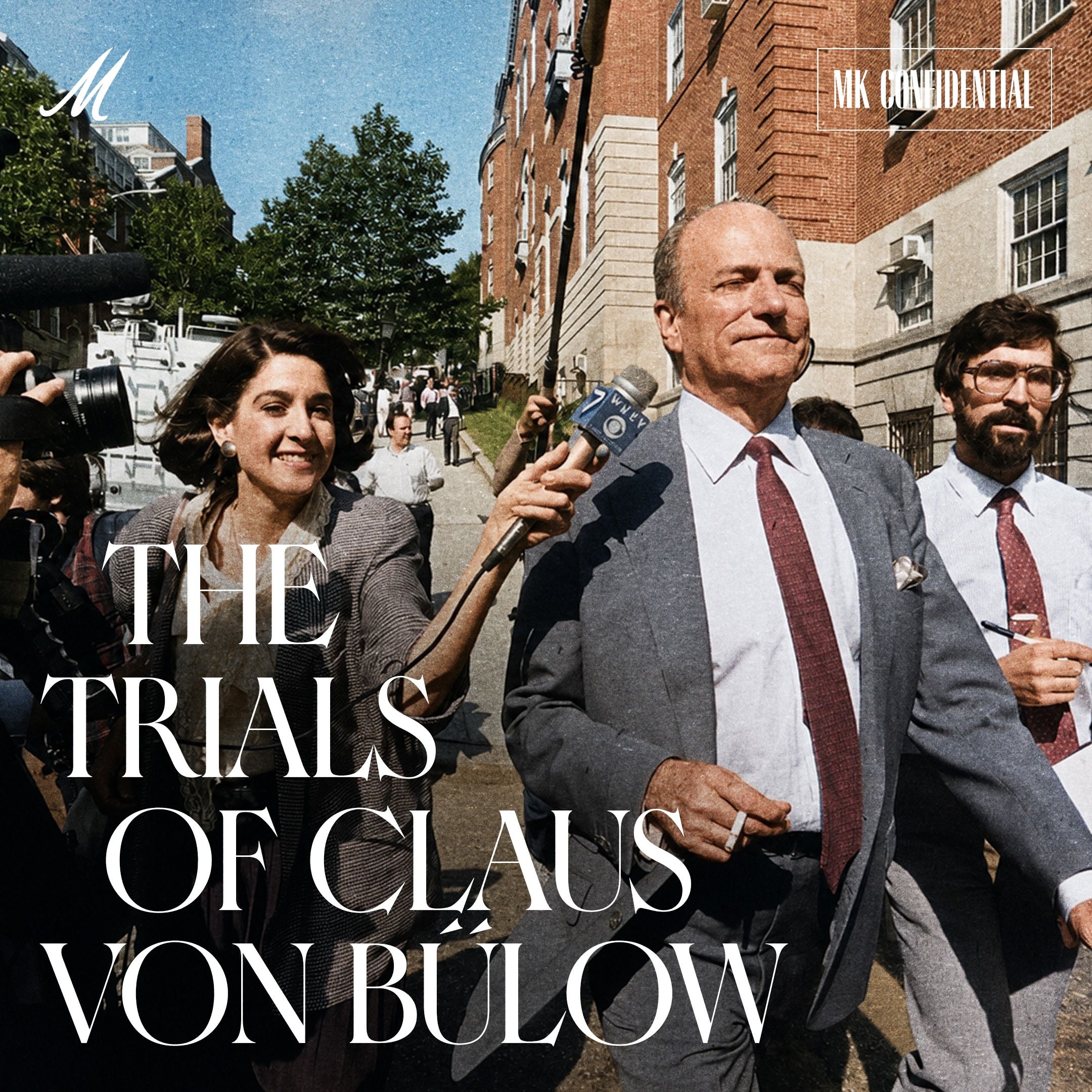
Overview of The Trials of Claus von Bülow: Was There Ever a Crime? — MK Confidential
This episode revisits the notorious Claus von Bülow case, in which wealthy socialite Claus von Bülow was twice accused of trying to murder his wife, Martha “Sunny” von Bülow, and was ultimately acquitted in the second criminal trial. The episode focuses less on courtroom theatrics and more on the long aftermath: Sunny’s decades-long coma, the family’s fractured loyalties, the civil lawsuit that followed, and the way the case became a cultural touchstone for questions of guilt, wealth, media spectacle, and whether the underlying medical event was ever intentional at all.
The central case
What happened to Sunny von Bülow
- In late 1979/early 1980, Sunny von Bülow collapsed into an irreversible coma.
- By the time of the episode’s framing, she had been bedridden for years, unable to speak or move, but kept alive with round-the-clock care.
- The case centered on whether her condition was caused by:
- an attempted murder by Claus von Bülow, or
- a self-inflicted medical crisis, possibly involving insulin and other factors.
The two trials
- Claus von Bülow was tried twice for attempted murder.
- The first trial ended in conviction.
- That conviction was later overturned.
- The second trial ended in acquittal, and that verdict stood as final.
- The episode emphasizes that the two juries did not hear the exact same case:
- the prosecution’s financial-motive theory was weakened in the second trial,
- and the defense was able to introduce medical arguments challenging the insulin evidence.
The civil case and family fallout
The $56 million lawsuit
- After the criminal acquittal, Sunny’s children from her first marriage, Alexander and Ala von Auersperg, sued Claus in federal civil court for $56 million.
- The civil case kept the accusation alive even after the criminal case ended.
- The dispute eventually settled, and Claus gave up claims to Sunny’s fortune.
Cosima’s loyalty split the family
- The episode highlights the role of Cosima, Claus and Sunny’s daughter, who stood by her father.
- Her loyalty had real consequences:
- she was cut out of part of her grandmother’s estate,
- and the family remained divided for years.
- Later, that inheritance dispute was repaired through settlement, restoring her share.
Sunny’s legacy
- Sunny’s children later helped found a victims’ advocacy organization in her name, which evolved into the National Center for Victims of Crime.
- The episode presents this as one of the most lasting legacies of the entire scandal.
Claus von Bülow’s life after acquittal
Public image and social comeback
- After being cleared, Claus did not disappear.
- He continued to appear at parties, give interviews, and move within elite social circles.
- His relationship with Andrea Reynolds, who helped shape his public image during the retrial, is described as part romance, part PR strategy.
- He and Reynolds eventually split.
Move to London
- Claus later relocated to London and lived there quietly.
- He continued to be socially accepted in certain circles, though not universally admired.
- The episode notes that his attorney, Alan Dershowitz, advised him to “disappear” from public view after the verdict.
The role of media and Reversal of Fortune
How the story became legend
- The episode argues that the case’s public memory was shaped as much by media as by law.
- Dominic Dunne’s reporting and commentary helped define one version of the story.
- The 1990 film Reversal of Fortune became the definitive pop-cultural retelling.
Why the movie mattered
- The film gave Sunny a voice by dramatizing her inner perspective.
- It also elevated the ambiguity at the heart of the case.
- Jeremy Irons won an Oscar for playing Claus von Bülow.
- The episode suggests that the movie made the case famous again, but did not answer the central question.
Main takeaway
The episode’s core argument is that the von Bülow case remains unresolved in any deeper moral sense, even though the legal system delivered a final acquittal. The evidence never produced a universally accepted truth about whether Claus tried to kill Sunny, or whether Sunny’s coma was self-inflicted or otherwise explained. What remains is a case defined by:
- wealth and social power,
- conflicting trial records,
- family loyalty and betrayal,
- and a woman who could never speak for herself.
Bottom line
This episode treats the Claus von Bülow saga as both a true-crime mystery and a study in ambiguity: one family’s tragedy became a national obsession, but the central question—crime or not?—was never conclusively answered.