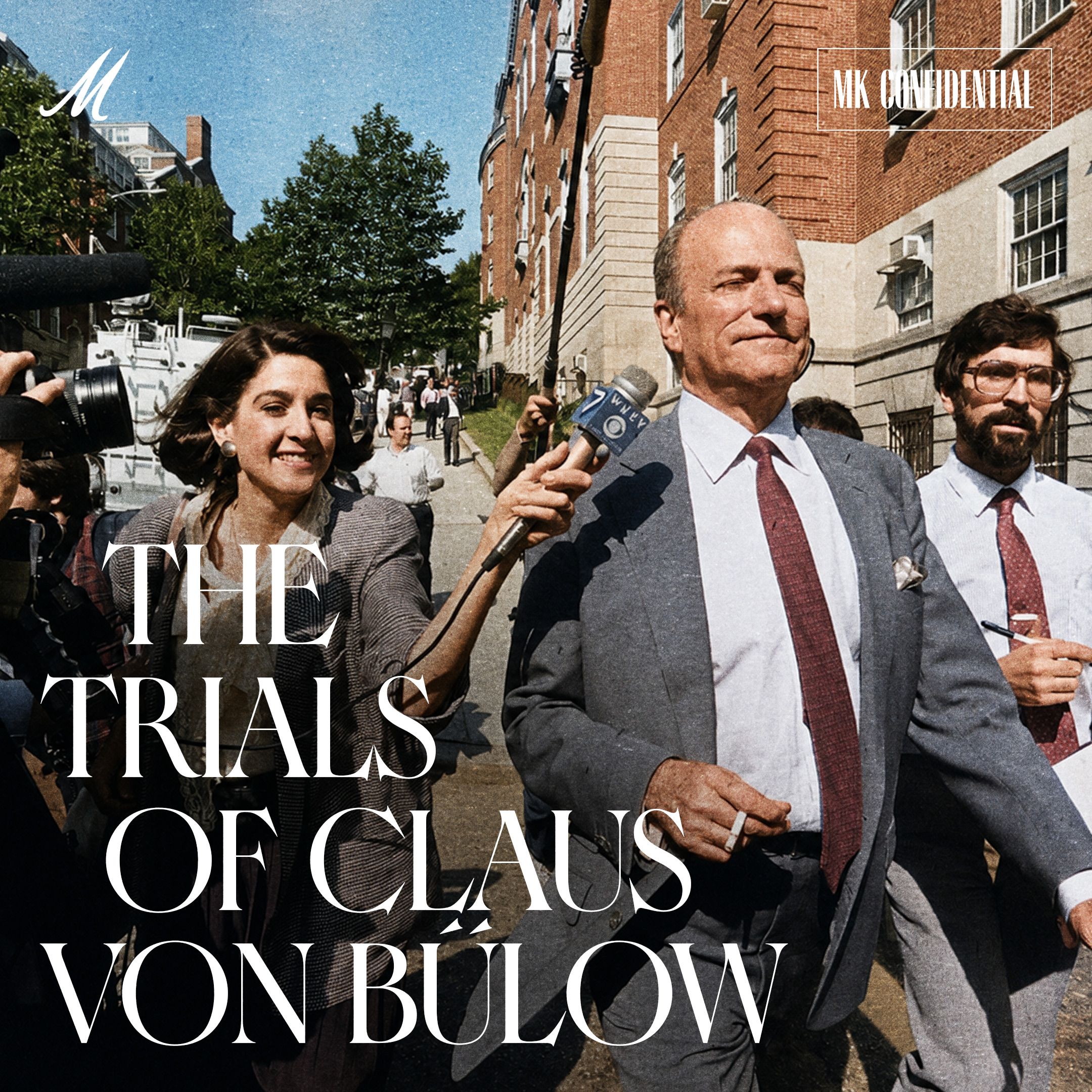
Overview of The Trials of Claus von Bülow: The Professor — Ep. 3 | MK Confidential
This episode focuses on Alan Dershowitz’s role in the Claus von Bülow case, told largely in Dershowitz’s own words. It traces how a seemingly impossible appeal became one of the most famous reversals in American legal history, built on a mix of courtroom strategy, scientific evidence, student labor, and a relentless fight over what really happened to Sunny von Bülow.
How Dershowitz Took the Case
- The story begins on April Fool’s Day, 1982, when Dershowitz gets a call from Claus von Bülow after his conviction for attempted murder.
- At first, Dershowitz thinks it may be a prank, but he agrees to take the case because:
- he loves difficult challenges,
- the case had enormous stakes,
- and everyone told him he could not win.
- Dershowitz says Claus treated the case like a “capital case” in the sense that he was determined not to go to prison and had even suggested he might kill himself if the conviction stood.
Building the “Dream Team”
- Dershowitz assembled a Harvard-based legal and student team, including law students and even medical students.
- He divided them into specialty rooms and used the case as a teaching exercise in law, science, and medicine.
- He contrasts this with the O.J. Simpson defense team, which he calls a “nightmare team” because of internal fighting.
The Core Legal Strategy
The Notes That Changed Everything
- A key breakthrough came from the notes of the family lawyer, referred to as Dick Q.
- Dershowitz suspected the notes would show that the children and others had not actually seen evidence of insulin, despite the prosecution’s theory.
- When the lawyer refused to turn them over, Dershowitz saw it as a major warning sign.
- Once the notes were ordered released, they became crucial exculpatory material:
- they did not support the state’s claim that insulin had been found in the way the prosecution suggested,
- and they helped undermine the original narrative.
The Needle and the Science
- The defense argued that the needle evidence had been manipulated or misunderstood.
- Dershowitz explains that if a needle had truly been injected into a human body, insulin residue would appear differently.
- Their testing suggested the needle had been dipped into insulin, not used to inject it into Sunny von Bülow.
- They also challenged the lab results by sending in needles with different substances and finding false positives for insulin.
What Dershowitz Believed Happened
- Dershowitz says he moved from thinking Klaus was almost certainly guilty to believing there may have been no crime at all.
- His theory is that Sunny von Bülow:
- had a history of self-destructive behavior,
- had been told to avoid certain sweet drinks,
- drank them anyway on Christmas Eve,
- and may have fallen into a self-induced coma.
- He emphasizes that the defense did not have to prove innocence—only create reasonable doubt.
The Public Battle and Media War
- The trial was highly public and televised, so the case became a media battle as much as a legal one.
- The episode highlights Andrea Reynolds, a forceful public-relations figure who worked aggressively to influence coverage and push back against what she saw as unfair reporting.
- Dershowitz also discusses how the 1990 film Reversal of Fortune dramatized the case, including the famous line:
- “You have no idea.”
- He says he liked the movie because it left viewers arguing afterward about whether Klaus did it.
Morality vs. Legal Victory
- Dershowitz makes a sharp distinction between legal vindication and moral certainty.
- Even after winning the appeal, he told Klaus:
- legally, the conviction had been overturned,
- but morally, Klaus was on his own.
- He says he could not honestly tell the public that he was certain Klaus was innocent.
- His broader point: defense lawyers are not the client’s priest or mother—they are there to fight the case ethically and effectively.
Outcome and What It Means
- In 1984, the Rhode Island Supreme Court reversed the conviction on two grounds:
- the family lawyer’s notes had been mishandled,
- and the black bag evidence had been searched without a warrant.
- Because the reversal was based on Rhode Island state law, it was beyond the reach of the U.S. Supreme Court.
- But the reversal was not an acquittal:
- Klaus was not free in the moral or legal sense,
- and Rhode Island still intended to retry him.
- The episode ends by setting up the next chapter: the defense will now try not just to reverse the conviction, but to prove there was never a crime at all.