Overview of She Let AI Take Over Her Life For a Year
This live Journal interview from the Wall Street Journal’s Future of Everything event features tech journalist Joanna Stern discussing her year-long experiment letting AI and robots play major roles in her life, which became the basis for her book I Am Not a Robot. The conversation explores where AI is already genuinely useful, where it falls short, and the bigger social questions it raises about work, health care, education, privacy, parenting, and human relationships.
Key Takeaways
- Joanna Stern expanded her definition of AI beyond chatbots to include:
- generative AI tools
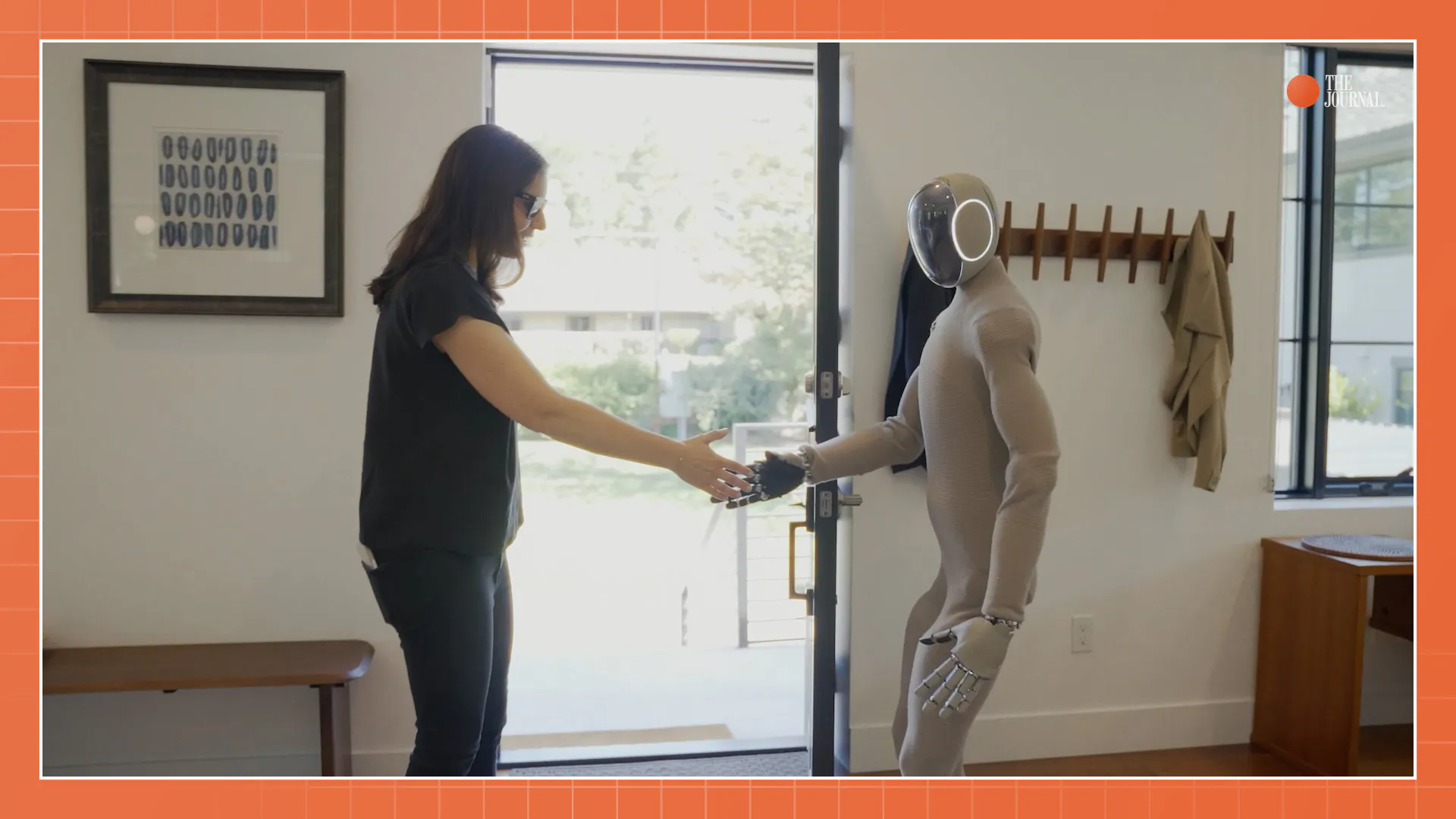
- humanoid robots
- self-driving cars
- AI wearables and ambient assistants
- Her biggest practical win with AI was as a work assistant, where it helped with speed, efficiency, and organization.
- AI wearables were both creepy and useful:
- they passively record conversations
- transcribe and summarize them
- turn spoken thoughts into reminders and to-do items
- AI was especially impressive in medical imaging, where it can act as a second set of eyes for radiologists.
- The biggest concern was not that AI is bad at everything, but that it is very good at the things humans should still do themselves, especially:
- writing
- thinking
- learning
- judgment
- Stern’s main fear is that younger generations may become overly dependent on AI and lose important cognitive skills before they fully develop.
AI in Daily Life: What Worked and What Didn’t
What AI Did Well
- Work support and productivity
- Helpful for drafting, organizing, and managing tasks
- Improved efficiency and performance
- Passive note-taking / memory support
- AI wearables captured promises, reminders, and meeting notes
- Useful for personal accountability and even resolving disputes
- Medical imaging
- In breast cancer screening, AI helped flag suspicious areas
- Radiologists used it as a powerful second opinion
What AI Did Poorly
- Household robots
- Many were still clumsy or too limited
- Example: a laundry robot that could only fold T-shirts
- Automatic replies
- AI-generated texts could be socially disastrous
- Demonstrated how easy it is to create awkward or harmful messages if you let AI speak for you
- Love / emotional intimacy
- Stern viewed AI as especially dangerous when it tries to simulate relationships too well
Medical AI and Breast Cancer Screening
One of the most serious parts of the conversation focused on AI in health care:
- Stern tracked illnesses and symptoms over the year and asked ChatGPT to diagnose them.
- She also explored how AI is already being used in radiology, especially for:
- mammograms
- ultrasounds
- image recognition at a pixel level
- At Mount Sinai, her imaging was read with AI assistance.
- She argued that AI can improve care by:
- catching things humans miss
- making doctors more confident
- serving as a second opinion rather than a replacement
- She connected this to her family history, noting that AI could have potentially reduced missed findings or unnecessary treatment in her mother’s breast cancer experience.
Biggest Concerns: Education, Thinking, and the Future of Work
AI and Cognitive Atrophy
Stern said one of her deepest fears is that students may outsource too much thinking to AI:
- AI can write essays, answer questions, and complete homework
- That convenience may weaken:
- critical thinking
- argument structure
- curiosity
- learning through struggle
AI and Jobs
- Entry-level jobs may be especially vulnerable as AI takes over routine tasks.
- She worries new workers may arrive in jobs without having built the mental habits those jobs require.
- Her broader point: if AI does the hard thinking for us, we may lose the chance to grow through challenge.
Parenting and AI Literacy
Stern’s experiences with her children showed both the power and danger of AI.
Lessons Her Kids Learned
- A ChatGPT-generated diagnosis told her son a praying mantis was pregnant, which turned out to be false.
- That became a vivid example of AI hallucinations and false confidence.
- Her children also became more skeptical of AI-generated video content and learned to question what they see.
Her Parenting Concern
- She wants kids to learn:
- not to trust AI blindly
- not to assume that every image or video is real
- that digital literacy now includes knowing when AI may be misleading
The Most Disturbing Possibility: AI and Relationships
Stern’s strongest warning came around the idea of AI as a romantic or emotional partner:
- Human relationships require friction, compromise, and discomfort.
- AI tends to mirror, flatter, and pander.
- If children grow up expecting relationships to always be frictionless and validating, that could distort their expectations of real human connection.
- For Stern, the idea of a child’s “first love” being a machine designed to satisfy every need was the most unsettling part of the future she explored.
Bottom Line
Joanna Stern’s year with AI suggests the technology is already powerful in practical, everyday ways—especially for productivity and medicine—but it also reveals a major tradeoff: the more AI takes over tasks we dislike, the more it may tempt us to give up the tasks that make us smarter, more capable, and more human.
Notable Insight
- Stern’s core message is not anti-AI; it is a warning against passive adoption.
- Her experiment argues for using AI as a tool, not a substitute for:
- judgment
- memory
- thinking
- relationships
- responsibility