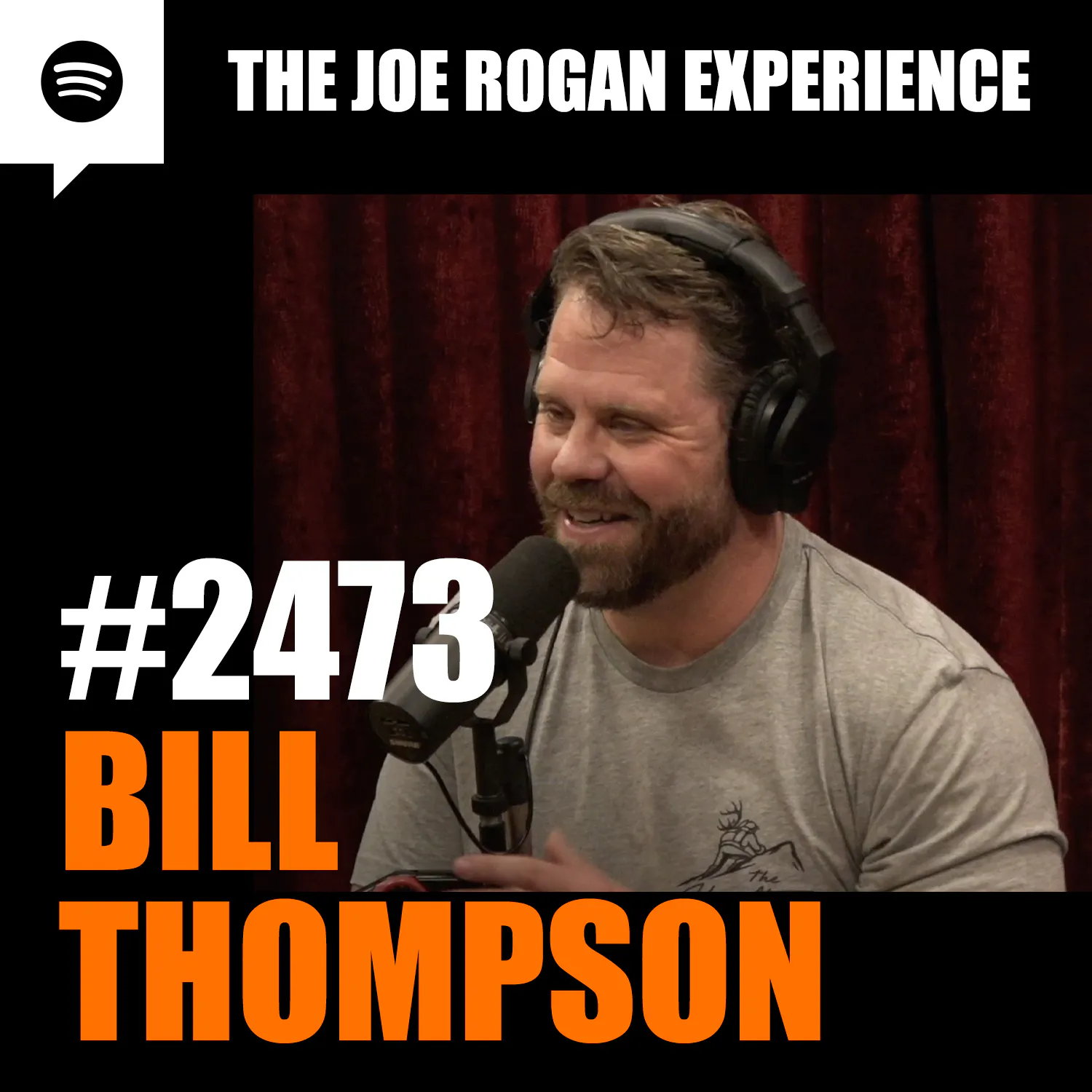
Overview of The Joe Rogan Experience — Episode #2473 (Bill Thompson)
Bill Thompson, a former U.S. Army signals/intelligence specialist, entrepreneur and outdoorsman, joins Joe Rogan for a wide-ranging conversation. Topics include Thompson’s background (rendezvous reenactments, brain‑tanning, handcrafted knife gift), his military/cyber career (signals intelligence, offensive/defensive cyber, media forensics), views on politics and culture (discipline, rites of passage, federalism), tech/privacy (phones, Pegasus, Huawei, rooting/GrapheneOS), and skepticism about AGI. The episode mixes personal stories, practical security advice, and political/philosophical reflections.
Guest background & personal details
- Grew up doing 19th‑century “rendezvous” reenactments: traditional skills like brain‑tanning hides, traditional archery, tomahawk work; presented Rogan with a handcrafted knife using bear jaw, porcupine quills, buffalo brain‑tan, beaver hide, etc.
- Military career: enlisted as signals/intelligence specialist (radar, SIGINT), later communications intelligence and computer network operations; advised senior officers and worked on offensive cyber development.
- Deployments and operations: Iraq, Afghanistan, northern Africa, and counter‑insurgency activities in southern Philippines (e.g., against Abu Sayyaf and related actors).
- Entrepreneur: founder of SpartanForge.ai — an outdoors/hunting app focused on conservation and enabling responsible hunting.
Main topics discussed
- Rendezvous culture and traditional skills
- Multi‑week primitive encampments (pre‑1840 authenticity), coming‑of‑age rites, community and intergenerational teaching.
- Traditional tanning (brain tanning)
- Process: grind animal brains, mix with water, repeat soak/stretch cycles, yields soft, supple leather.
- Military & cyber experience
- Transition from radar SIGINT to communications intelligence as phones/networking became central.
- Built early Army offensive/defensive cyber capability and ethical hacking/red‑team work.
- Media forensics: extracting intelligence from seized phones/computers to support follow‑on operations.
- Overseas operations (Philippines)
- Counter‑insurgency/CT efforts on Sulu and surrounding islands; working with local forces and special operations.
- Tech, privacy, and device security
- Concerns about big tech using free services to collect training data for AI.
- Pegasus and implants: evolution from click‑to‑exploit to zero‑click attacks; nation‑state sophistication.
- Differences between Apple and Android approaches (openness, forensic visibility); Android (AOSP) allows deeper forensic inspection and rooting; GrapheneOS / custom ROMs and bootloader unlocking as higher‑security options for advanced users.
- Practical privacy recommendations (see Actionable tips).
- Politics, culture, and institutions
- Emphasis on discipline, rites of passage, and the role of fathers/military in forming men.
- Federalism: favor change that is incremental and tested by states; criticism of centralized power growth (17th Amendment, federalization).
- Critique of modern identity/policy politics, bureaucracy incentives, and the disconnect between intentions and outcomes in social engineering.
- AI / consciousness
- Skeptical of claims that current neural networks are AGI: describes modern models as “consciousness projection” (clever math trained on human‑produced data), not true knowing or subjective consciousness.
Key takeaways
- Traditional skills and rites of passage matter for community, identity and male development; rendezvous provided structure, skills and mentorship.
- Cyber/Signals reality: communications and devices are decisive in modern conflict and intelligence; exploiting or defending networks requires ongoing adaptation.
- Privacy and data tradeoffs: free services are rarely free—data fuels AI and business models; companies collect data to train models and build competitive advantage.
- Government and institutions have self‑expanding incentives; budget execution and bureaucracy often reward spending over efficiency or mission outcomes.
- Political complexity: Thompson rejects simple left/right labels — favors pragmatic, slow, local experiments (federalism) and values discipline, individual responsibility, and truth as decision criteria.
- AGI caution: current LLMs are powerful pattern/mapping systems but lack consciousness or intrinsic values; training data and compute are central to capability, not awareness.
Notable quotes / lines
- “Every animal has the exact amount of brain needed in order to tan the hide.”
- “If the product’s free, you are the product.”
- “There are no answers, there are only tradeoffs.” (on security vs. convenience)
- “If you give up your individual rights in the name of security, you deserve neither.” (echoing Franklin)
- On outsider leaders: “They’ll be happier when we leave.” (about savior/outsider pattern)
Practical/security recommendations (actionable)
- Reduce attack surface: avoid gratuitously uploading private photos/data to free cloud services if you value privacy.
- Make yourself a harder target:
- Don’t answer password‑reset questions honestly; record/reserve consistent decoy answers in a physical journal.
- Use VPNs like WireGuard; consider routing phone traffic through a home endpoint (Raspberry Pi + WireGuard) for added control.
- For advanced users worried about device compromise:
- Consider an Android device with an unlockable bootloader and custom OS (GrapheneOS) to reduce closed‑source risk.
- Use tools (e.g., Cellebrite, FTK) and forensic workflows to inspect devices if needed — but these are specialist tools.
- For journalists/high‑risk operatives: use device lockdown modes (Apple’s lockdown mode or equivalent) and follow strict operational security (OPSEC) practices.
- General: prefer paid, reputable services for critical tasks and be mindful of terms of service; use strong, unique secrets and hardware protections when possible.
Resources & mentions
- SpartanForge.ai — Bill Thompson’s outdoors/hunting app/company (focus: enabling outdoor pursuits, conservation, e‑scouting).
- Tools/terms referenced:
- WireGuard (VPN)
- GrapheneOS / AOSP (Android Open Source Project)
- Cellebrite, Forensic Toolkit (FTK) — forensic extraction tools
- Pegasus (NSO Group exploit referenced)
- Historical/political references:
- Federalist Papers, 17th Amendment, Marbury v. Madison — used to argue about federalism and judicial power.
Episode structure / notable segments (high level)
- Intro & knife gift / rendezvous description (traditional skills) — opening ~10–20 minutes
- Discussion of brain tanning, ritual culture, rites of passage — first third
- Military career, SIGINT, deployments, Philippines operations, media forensics — middle portion
- Political/cultural views: discipline, family, federalism, bureaucracy — extended section
- Tech/privacy deep dive: phones, Pegasus, Huawei, rooting, GrapheneOS, AI skepticism — later segment
- Wrap up: SpartanForge plug, brief on AI concerns and next potential episode topic
Who should listen
- Listeners interested in: military/intel tradecraft, cyber security/privacy, hunting/outdoors culture, political theory (federalism vs. centralization), and practical device security tips from someone with operational experience.
If you want to explore further: check SpartanForge.ai for Bill’s app/company, and read up on AOSP/GrapheneOS, WireGuard, and public analyses of Pegasus for deeper technical context.