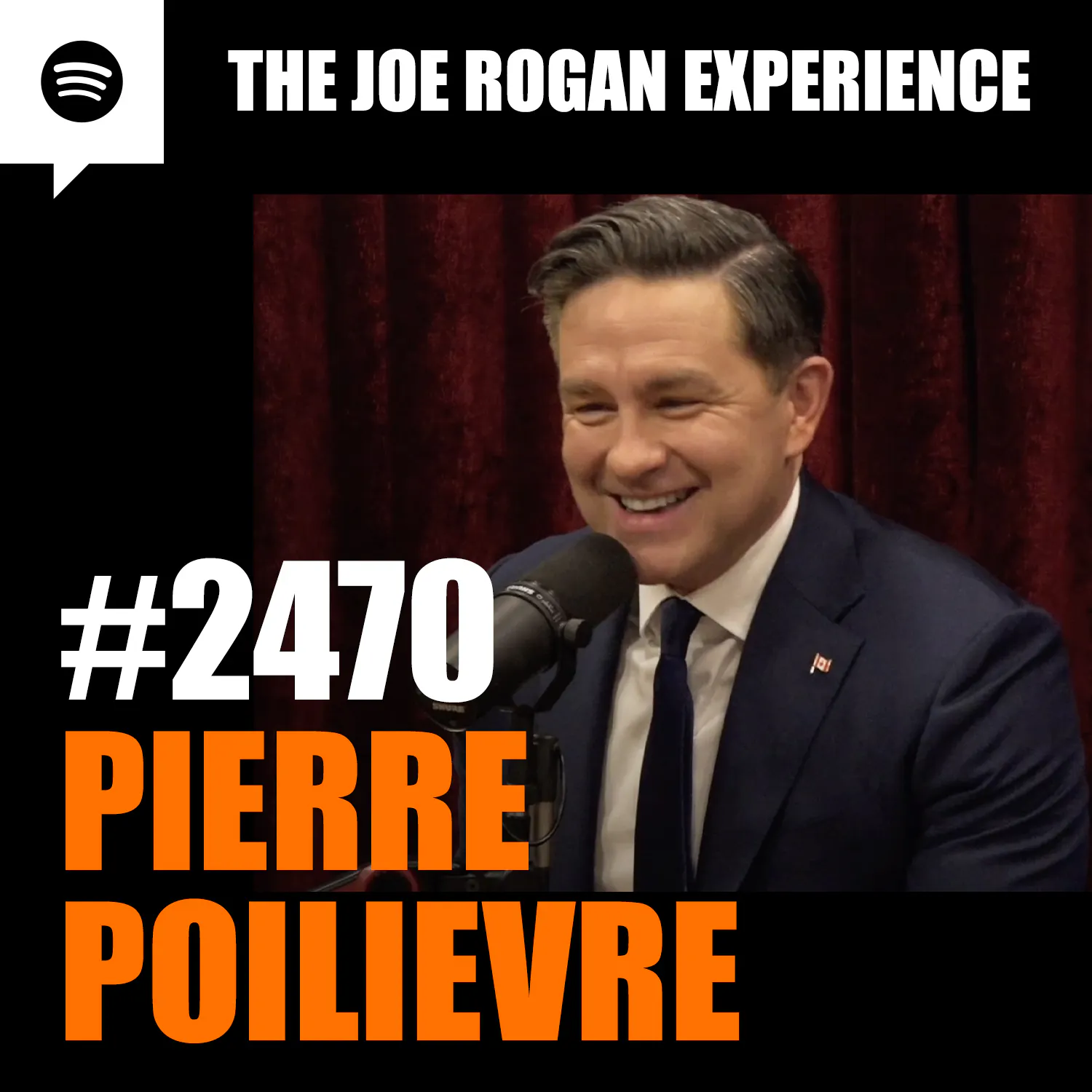
Overview of The Joe Rogan Experience — Episode #2470: Pierre Poilievre
Joe Rogan interviews Pierre Poilievre, leader of Canada’s Conservative Party and former MP, covering Poilievre’s personal background, political philosophy, policy priorities if elected prime minister, and broader cultural topics (fitness, diet, opioids, MMA). The conversation moves between detailed policy prescriptions (fast permits, resource development, fiscal discipline, law-and-order reform) and informal, personal anecdotes (kettlebells, apples, martial arts memories). Poilievre frames his platform around maximizing individual freedom, shrinking bureaucratic friction, and restoring economic opportunity for working people.
Key topics & main takeaways
-
Political philosophy
- Core mission: “Make Canada the freest country on earth” — maximize personal, financial, religious freedom and minimize unnecessary government interference.
- Emphasis on empowering ordinary people (farmers, trades, mechanics) rather than distant “experts.”
- Government’s role should be narrow: roads, military, borders, police, basic safety net.
-
Economic policy & resource development
- Unblock Canadian natural resources (oil, gas, uranium, potash, minerals) with faster permitting, lower taxes on production, and pre-approved project sites to scale exports and jobs.
- Remove tariffs with the U.S. (auto pact, lumber/aluminum) to improve affordability and cross-border supply.
- Create strategic stockpiles of critical minerals and increase manufacturing linked to those resources.
- Cut bureaucracy, consultants, foreign aid, and corporate welfare to reduce spending and speed projects.
-
Inflation & fiscal discipline
- Blames monetary expansion and fiscal profligacy for long-term inflation and erosion of working-class purchasing power.
- Proposes a pay‑go rule (every dollar of new spending matched by cuts/savings), balanced-budget discipline similar to 1990s U.S. approach.
- Advocates “hard money” comparisons to Switzerland (low deficits, low inflation).
-
Regulatory reform & environment
- Argues environmental reviews can be done quickly and responsibly (fixed timelines, single-review processes, pre-cleared sites) — cites Germany building an LNG terminal quickly as an example.
- Claims Canadian resource extraction is among the most responsible in the world and highlights First Nations partnerships that lift communities economically.
-
Healthcare, assisted dying (MAID) & mental health
- Supports choice for terminally ill, but strongly opposes extension of MAID to children or solely for mental illness; argues frontline public servants should not be offering MAID as an option to people calling for help.
- Stresses fitness, community, meaning (Viktor Frankl) and access to treatment as essential for mental health.
-
Opioid crisis & recovery
- Describes opioid epidemic as catastrophic (many deaths); calls for large-scale treatment and recovery programs, abstinence-based treatment, community reintegration.
- Mentions novel treatments (ibogaine) as promising options to explore for addiction recovery.
-
Law & order
- Proposes tougher bail/repeat-offender rules to keep chronic offenders off the street; emphasizes public safety and treating repeat offenders distinctly.
-
Immigration & population growth
- Supports welcoming immigration but criticizes surges (e.g., international students/temporary workers) that strained housing and services; calls for orderly, lawful immigration streams and distinguishing genuine refugees from others.
-
Culture, health & fitness
- Strong champion of kettlebell training (Pavel Tsatsouline / StrongFirst), community fitness, and “eat real food” guidance: cut processed foods, sugar, seed oils; increase movement and community sport participation to prevent chronic illness.
- Concern about food processing practices (glyphosate use, ultra-processed foods) and their health impacts.
Notable quotes & memorable lines
- “Make Canada the freest country on earth.” (Poilievre’s campaign slogan/goal)
- “If you cannot trust a man to govern himself, how can you trust him to govern for others?” (argument for personal freedom over paternalistic governance)
- “Mind your own damn business party.” (tongue-in-cheek summary of his small‑government preference)
- Emphasis on simplicity: “Simplicity is a virtue” — govern less, do fewer things well.
Policy proposals (concrete ideas he says he'd implement)
- Fast-track permitting: fixed timelines (months not decades), one consolidated environmental review per project, pre-cleared project zones with guaranteed permits if conditions met.
- Resource-first agenda: expedite oil/gas/minerals production, reduce producer taxes, build strategic stockpiles, expand exports (esp. to U.S.).
- Trade measures: remove tariffs (softwood, aluminum), re-establish tariff-free automotive trade (auto pact).
- Fiscal rule: introduce pay‑go budgeting to force matching savings for any new spending.
- Public safety: tighten bail rules for repeat offenders; target the small group responsible for disproportionate crimes.
- Health/addiction: large-scale investment in treatment and recovery (include exploring ibogaine and other new modalities); emphasize prevention, exercise, community support.
- MAID safeguards: prohibit automatic offering by public servants; oppose MAID for minors or only-mental-illness cases.
Personal background & anecdotes Poilievre shared
- Childhood and origins: adopted; raised in southern Calgary; parents were teachers; early life in a working-class suburban neighborhood.
- Entry into politics: boredom from a long athletic injury (shoulder tendinitis) drove him to attend local political meetings; inspired by Preston Manning and conservative philosophy (Milton Friedman).
- Athletic/fitness life: big kettlebell fan — discussed history of kettlebells (Russian farmer-market origins, Pavel) and benefits vs. dumbbells. Wrestled and did Taekwondo; later trained jiu-jitsu; multiple knee surgeries.
- Viral “apple” moment: a casual filmed walk/eating an apple went viral and became part of his public persona.
- Martial arts & MMA: big respect for GSP, TriStar gym, and Canadian martial arts tradition; talked fighters he admires (Ilya, Volkanovsky, Alex Pereira), MMA training philosophy (wrestling as foundation).
Health, diet & fitness highlights
- Strong advocacy for movement and community-based exercise as primary prevention/treatment for mental illness and chronic disease.
- “Eat real food” guidance: minimize processed foods, sugar, industrial seed oils; favor whole foods, meat, fish, vegetables.
- Views on obesity differ by culture (cites Japan’s low obesity, workplace interventions there).
- Discussed food system problems: processed food marketing, glyphosate on wheat, nutrient downgrades and engineered food addictions.
MMA / martial arts discussion (themes & mentions)
- Poilievre is personally engaged with kettlebells and martial arts; admires Georges St-Pierre and TriStar.
- Discussed evolution of MMA: need for cross-training (wrestling, striking, jiu-jitsu); praised fighters like Ilya Topuria, GSP, Jon Jones, Alex Pereira.
- Talked training philosophies (conditioning, sparring realism, balancing head trauma risk with readiness).
Actionable takeaways for listeners
- Civic/political: understand that platform priorities include resource development, fiscal restraint, regulatory simplification, and law-and-order reforms—watch how these arguments are framed if you follow Canadian politics.
- Personal health: prioritize community exercise, limit processed foods and sugar, and adopt simple daily habits (20–30 minute walks, strength/bodyweight work).
- Addiction response: support treatment-first policies and expansion of recovery programs; be open to evidence-based novel therapies (ibogaine discussed as promising).
- If interested in international trade/policy: consider the practical trade-offs Poilievre highlights (tariffs, supply chains, minerals).
Quick context & episode tone
- Tone: conversational, pragmatic, sometimes combative when discussing political opponents or bureaucratic inertia; mixes policy detail with informal banter (kettlebells, maple syrup, apple anecdote).
- Poilievre presents a consistent small-government, pro-resource, pro-market platform with populist messaging aimed at the working class.
- Joe Rogan offers favorable framing and often agrees on fitness, personal freedom, and skepticism of heavy-handed pandemic policies.
Recommended follow-ups (mentioned during episode)
- Read Viktor Frankl’s Man’s Search for Meaning (discussed as foundational for meaning-based mental health).
- Look into StrongFirst / Pavel Tsatsouline for kettlebell training.
- Research ibogaine and local/regional pilot programs for addiction treatment (Rick Perry mentioned as involved in U.S. initiatives).
(Ads and brief sponsor reads were interspersed in the conversation — standard for The Joe Rogan Experience.)