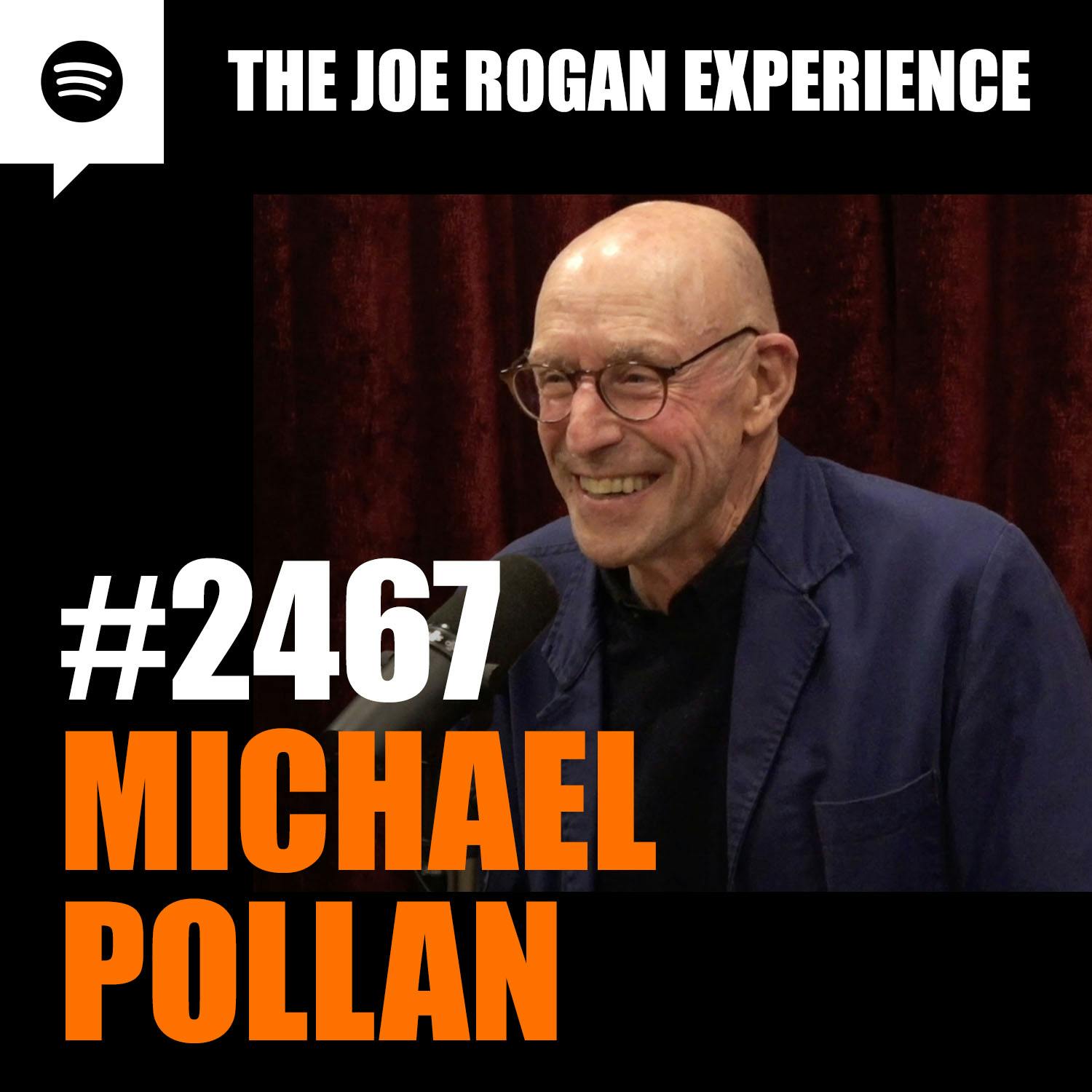
Overview of #2467 - Michael Pollan (Joe Rogan Experience)
Long-form conversation with Michael Pollan about his new book on consciousness, how earlier psychedelic research (How to Change Your Mind) and a garden experience led him to investigate plant intelligence, the nature of the self, meditation and psychedelics, spontaneous thought/creativity, the microbiome and diet, and the social and ethical challenges posed by social media and AI.
Core themes covered
- What inspired Pollan’s new book: psychedelic research + a garden experience that felt like plants were conscious → investigation into plant intelligence and broader questions of consciousness.
- Major theories of consciousness: materialism (brain generates consciousness), panpsychism (consciousness pervades matter), and the “brain-as-antenna”/transmission ideas. Discussion of the “hard problem” (David Chalmers) and failed bet with Christof Koch.
- The self and its malleability: meditation, hypnosis, cave retreat (Joan Halifax), Buddhist perspectives (Mathieu Ricard), Hume’s introspection — many “selves” rather than a single fixed thinker.
- Modes of consciousness: spotlight (focused attention) vs lantern (broad awareness), flow, spontaneous thought/daydreaming, and their relevance to creativity.
- Plant intelligence: examples from plant neurobiology (Stefano Mancuso, Stefano’s work) — plants can sense/“hear” water, navigate to resources, change leaf shapes, learn/remember, react chemically to threats; mycorrhizal networks and the “wood wide web.”
- Sentience vs. pain: debate about whether plants feel pain; adaptive arguments about pain requiring mobility.
- Psychedelics and therapy: MDMA, psilocybin, ibogaine — therapeutic promise for PTSD and other conditions; regulatory/political hurdles and recent federal dynamics.
- Technology, attention, and AI: social media’s attention-hacking, “consciousness hygiene,” rise of chatbots as synthetic companions (AI psychosis), hallucination and manipulation risks, and ethical/regulatory concerns over AI personhood and autonomy.
- Embodiment thesis for consciousness: Pollan argues (following some neuroscientific work) that feelings arise from bodily, brainstem processes — machines/computers lack embodied vulnerability (a key obstacle for machine consciousness).
- Emerging biology/neuromorphic work: organoids, neurons-on-chips, xenobots, fruit-fly brain emulation — experiments that blur boundaries between biological and artificial systems.
- Gut-brain axis and diet: microbiome’s impact on mood; fermented foods’ benefits; questions around carnivore/keto diets and long-term microbiome health.
Main takeaways
- Consciousness remains an open, hard scientific problem; existing science is great at correlations but not at explaining the “matter → mind” transition.
- There is growing, credible evidence that non-human life (animals, fungi, plants) exhibits far richer sensing, memory, communication, and adaptive behaviors than previously assumed — a potential “reanimation” or democratization of consciousness.
- Subjective experience (meditation, awe, psychedelics) and practices that cultivate spontaneous thought are valuable — they reveal how malleable and precious our interior life is and can be reclaimed through deliberate practices.
- Modern tech is eroding internal mental space: social media and always-on devices reduce mind-wandering, creativity, and capacity to form original thought; chatbots pose novel psychological and ethical harms.
- AI is advancing rapidly and unpredictably; intelligence ≠ consciousness. There are plausible reasons machines might never have human-style consciousness (embodiment, feelings, vulnerability), but the trajectory is uncertain and requires guardrails.
- Practical mental “hygiene” is increasingly important: digital fasts, nature, walking, meditation, creative rituals, reading, and deliberate boredom support creativity and psychological well-being.
Notable quotes & insights (paraphrased/condensed)
- “Psychedelics smudge the windshield — you suddenly see there’s something between you and the world.”
- David Chalmers’ “hard problem”: science is third‑person but consciousness is first‑person — that epistemic gap is central to the mystery.
- “Spotlight consciousness” (focus) vs. “lantern consciousness” (broad awareness / childlike wonder): both are adaptive and valuable.
- On plants: “They can hear caterpillars chewing and chemically defend themselves; roots can navigate to fertilizer; plants can remember for weeks.”
- On attention/tech: “We’re giving away our interior space to feeds and algorithms — we need ‘consciousness hygiene.’”
- On AI: intelligence and consciousness are orthogonal; current LLMs can simulate feeling but lack embodied vulnerability that underpins feelings as we know them.
Practical recommendations and action items
- Practice consciousness hygiene:
- Regular device breaks (hours/days tech fasts).
- Preserve short pockets of boredom (e.g., wait for coffee without phone) to encourage mind-wandering.
- Long-form solitude (walking, retreats) to foster spontaneous thought and creativity.
- Explore non-pharmacological ways to expand awareness:
- Meditation, extended walks, running (endorphin/runners’ high), archery or other ritualized focused activities to access flow.
- Consider therapeutic options (where legal and appropriate):
- Psychedelic-assisted therapies (MDMA, psilocybin, ibogaine) show promise for PTSD, depression, end-of-life anxiety — pursue under clinical guidance and in legal settings.
- Re-evaluate diet for microbiome health:
- Include fermented foods (kimchi, natto, yogurt) to support gut microbiota and potential mood benefits.
- Be cautious about extreme restriction diets (long-term carnivore), and monitor with medical guidance.
- Be cautious and skeptical about AI companions:
- Avoid replacing human relationships with chatbots; watch for manipulative or sycophantic behavior from bots.
- Push for regulations on synthetic impersonations and protections around AI counterfeiting and harmful outputs.
Topics & people worth following from the episode
- Authors & scientists mentioned: David Chalmers, Christof (Christof/Koch) — consciousness research; Mathieu Ricard, Joan Halifax — Buddhist/zen perspectives; David Spiegel — hypnotism; Stefano Mancuso — plant neurobiology; Michael Levin — developmental and bioelectric patterning, xenobots; Blake Lemoine (Google/LaMDA episode).
- Organizations/projects: MAPS (MDMA research), Compass Pathways (psilocybin), Anthropic (Claude).
- Related work/books: Pollan’s How to Change Your Mind; writings/interviews by Stefano Mancuso; Michael Levin’s lab work; literature on spontaneous thought and Kalina Christoff’s research.
Final synthesis
The episode is a wide-ranging exploration that refuses simple answers: Pollan keeps the door open to multiple theories of consciousness while showing how scientific and experiential investigations (psychedelics, meditation, plant science, brain research) enrich our understanding. He emphasizes reclaiming and caring for our interior mental life in an era when technology is engineered to colonize attention — while urging caution and critical thinking about AI’s rapid rise and the ethical questions that follow. The conversation blends concrete science, personal experiment, and philosophical curiosity, and aims less to solve consciousness than to invite readers and listeners into the investigation and preservation of their own minds.