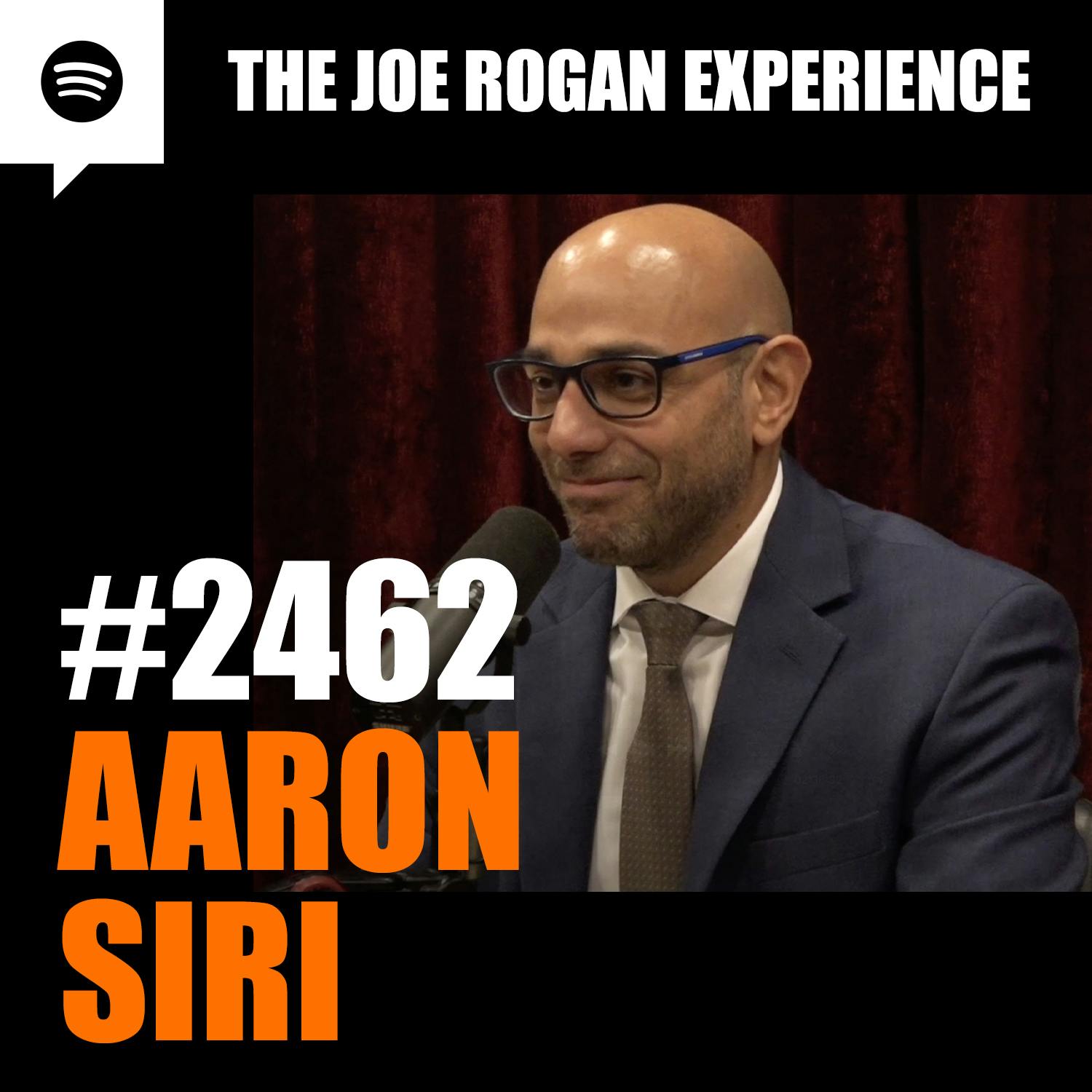
Overview of #2462 - Aaron Siri (The Joe Rogan Experience)
This episode features attorney Aaron Siri in a wide-ranging conversation with Joe Rogan about vaccines, public health policy, regulatory and legal structures, censorship during COVID, and broader cultural and economic forces. Siri — who has litigated vaccine-injury and FOIA cases and wrote a book about vaccines — argues that the U.S. vaccine system is uniquely insulated from market and legal pressures, and he presents legal, historical, and epidemiological claims to support his critique. The discussion mixes legal anecdotes, policy arguments, contested scientific claims, and cultural commentary about trust, censorship, and institutional incentives.
Key topics discussed
- The National Childhood Vaccine Injury Act of 1986 and its legal consequences (liability shield for manufacturers).
- How liability (or lack of it) changes market incentives for product safety.
- Differences between typical drug licensure (multi-year, placebo-controlled) and vaccine licensure (Siri’s claim: many licensed with brief safety windows and without placebo controls).
- Historical mortality statistics and interpretation (measles, influenza, general infectious-disease decline pre-vaccine).
- The effect of childhood infections (measles, mumps, chickenpox) on long-term health — cited studies claiming reduced cardiovascular/cancer mortality among those who had natural infections.
- Autism claims and vaccines: FOIA litigation, discovery from CDC/FDA, and the contention that there are few or no placebo-controlled studies showing early infant vaccines do not cause autism.
- Vaccine Injury Compensation Program (VICP) and how vaccine injury claims are adjudicated.
- How public health mandates, censorship, and government messaging during COVID changed public trust; discussion of social-media moderation and the purchase of Twitter (X).
- Regulatory capture and the revolving door between agencies (CDC/FDA) and industry.
- Broader cultural issues: groupthink, the role of media and advertising in shaping narratives, and the influence of finance and stock markets on corporate behavior.
- AI, search personalization, and perceived bias in online information discovery.
Main takeaways (summary of Siri’s arguments)
- Vaccines are treated differently from other products in U.S. law because of the 1986 Act: manufacturers have substantial liability protection, which removes a major economic incentive to minimize risk.
- According to Siri, many routine childhood vaccines were licensed without long-term, placebo-controlled safety trials; he claims the COVID pediatric vaccine was an exception that used a placebo-controlled trial.
- He argues that improvements in sanitation, nutrition, and acute medical care drove large declines in mortality from many infectious diseases well before vaccine introduction; therefore, the public-health benefits commonly attributed solely to vaccines are, in his view, overstated.
- He cites studies (and anecdotal/clinical observations) that natural childhood infections can confer broader long-term health benefits (e.g., reduced cardiovascular mortality in some cohorts).
- Siri reports suing the CDC under FOIA for records related to vaccine safety and claims the CDC could not produce peer-reviewed trials demonstrating that vaccines given in the first six months of life do not cause autism; he says this led to a settlement/ court stipulation listing studies (many not directly relevant).
- He emphasizes that mandatory public-health measures and censorship (during COVID) created a breakdown in public trust and civil liberties.
- He calls for transparency, primary-source review, and market/regulatory reforms that align economic incentives with safety.
Notable claims and evidence cited (as presented in the episode)
(These are claims made by Aaron Siri on the podcast — many are contested or require independent verification.)
- National Childhood Vaccine Injury Act (1986) gave vaccine manufacturers near-immunity from civil suits for design-defect claims; vaccine claims are instead handled through the federal VICP.
- In 1986 a child following the CDC schedule received about three vaccine injections by their first birthday; by early 2025 that number rose (Siri states figures: from 3 to 29 by first birthday historically, later down to 19 after recent changes).
- Many routine childhood vaccines were licensed on short safety-review windows (days or weeks) and often without placebo-controlled trials; he asserts that no routine injected childhood vaccine was licensed based on a placebo-controlled trial except the pediatric COVID vaccine.
- Measles mortality pre-vaccine in the U.S.: about 400 deaths per year (Siri cites CDC mortality data); he argues measles mortality fell over the first half of the 20th century due to non-vaccine public-health improvements.
- Claims of long-term health benefits among people who had childhood measles/mumps: cites a 22-year Japanese prospective study (~100,000 people) showing reduced cardiovascular mortality for those who had measles/mumps; other cited associations with reduced ovarian cancer and lower lymphoma rates.
- FOIA litigation against CDC: Siri states he sued for the studies that allegedly show early infant vaccines do not cause autism; claims the CDC produced 20 studies many of which did not address vaccines given in the first six months of life; says the only hep B study in peer-reviewed literature that addressed timing showed a 3x association (Gallagher & Goodman — cited by Siri).
- VICP has paid out about $5 billion in awards over the years (Siri cites this figure).
- He references depositions of prominent vaccinologists (e.g., Stanley Plotkin, Catherine Edwards) and states their testimony revealed gaps between public statements and underlying evidence.
- He argues censorship of COVID-related dissent (removal of posts/accounts) negatively affected public discourse, and that changes in platform moderation (e.g., after Elon Musk’s Twitter purchase) exposed different views.
Notable quotes from the episode
- "Vaccines...they really sit in their own little universe. They're unlike any other medical product."
- "The only product in America where you cannot sue to say, had you made that product safer, my child wouldn't be dead — vaccines."
- "When government gets it wrong, they always, always double down."
- "The moment somebody says, 'no, we need to stop, you can't discuss, you can't debate that' — that's when you know you're dealing with a religion, not science."
Recommendations / suggested actions Siri encourages for listeners
- Look at primary sources (FDA licensure documents, court filings, depositions, peer-reviewed studies) rather than relying only on media summaries or official talking points.
- Read Siri’s book (referenced in the episode) and the deposition transcripts / court documents he cites if you want the full legal record he discusses.
- If concerned about mandates or medical-liberty issues, stay informed of local/state policy and legal challenges (and understand the VICP process).
- Maintain skepticism of single-narrative messaging; seek multiple viewpoints and verify claims with primary literature when possible.
Potential controversies and items to fact-check (important to verify independently)
- The claim that "not a single routine injected childhood vaccine was licensed based on a placebo-controlled trial (except pediatric COVID vaccine)" — check FDA licensure documents and primary trial reports.
- The numbers on vaccine doses by a child's first birthday (Siri cites 3 in 1986 → 29 by 2025 → 19 after recent changes). Verify CDC immunization schedules/history.
- The Gallagher & Goodman hep B–autism association and the magnitude of that finding — consult PubMed and the original publication.
- The FOIA settlement specifics Siri references (what studies were produced, their relevance) — review the court docket and settlement text.
- The interpretation of measles mortality decline (percent reductions and causation by sanitation vs vaccine) — review CDC historical mortality data and epidemiologic literature.
- Siri’s characterization of depositions of major vaccinologists (quotes and context): review deposition transcripts where available.
- VICP payouts and limits: verify program totals, typical awards, and statutory caps.
Useful resources to consult (where to verify primary documents)
- Vaccine Injury Compensation Program (VICP) — U.S. Health Resources & Services Administration (HRSA) website.
- National Childhood Vaccine Injury Act (1986) — statutory text and legislative history.
- FDA vaccine approval/licensure documents (Biological License Applications, briefing documents) — FDA.gov.
- CDC historical mortality data (e.g., National Vital Statistics Reports) — CDC WONDER, NCHS.
- PubMed / MEDLINE — for studies cited (search Gallagher & Goodman; measles long-term cohort studies; teratogenicity/epidemiology papers).
- Court dockets (Southern District of New York, FOIA litigation) — PACER for filings; many documents may be publicized on attorney/organization sites.
- Depositions and transcripts sometimes posted by parties (Siri references depositions of Stanley Plotkin and others).
- Independent reviews/meta-analyses (Institute of Medicine / National Academies reports on vaccines).
Summary note: this episode mixes legal argument, policy critique, scientific claims, and cultural commentary. Many of the empirical claims Aaron Siri makes are controversial and contested by mainstream public-health authorities; if you want to draw conclusions, review the cited primary sources (FDA licensing docs, published trials, peer-reviewed studies, and court records) before forming a definitive view.