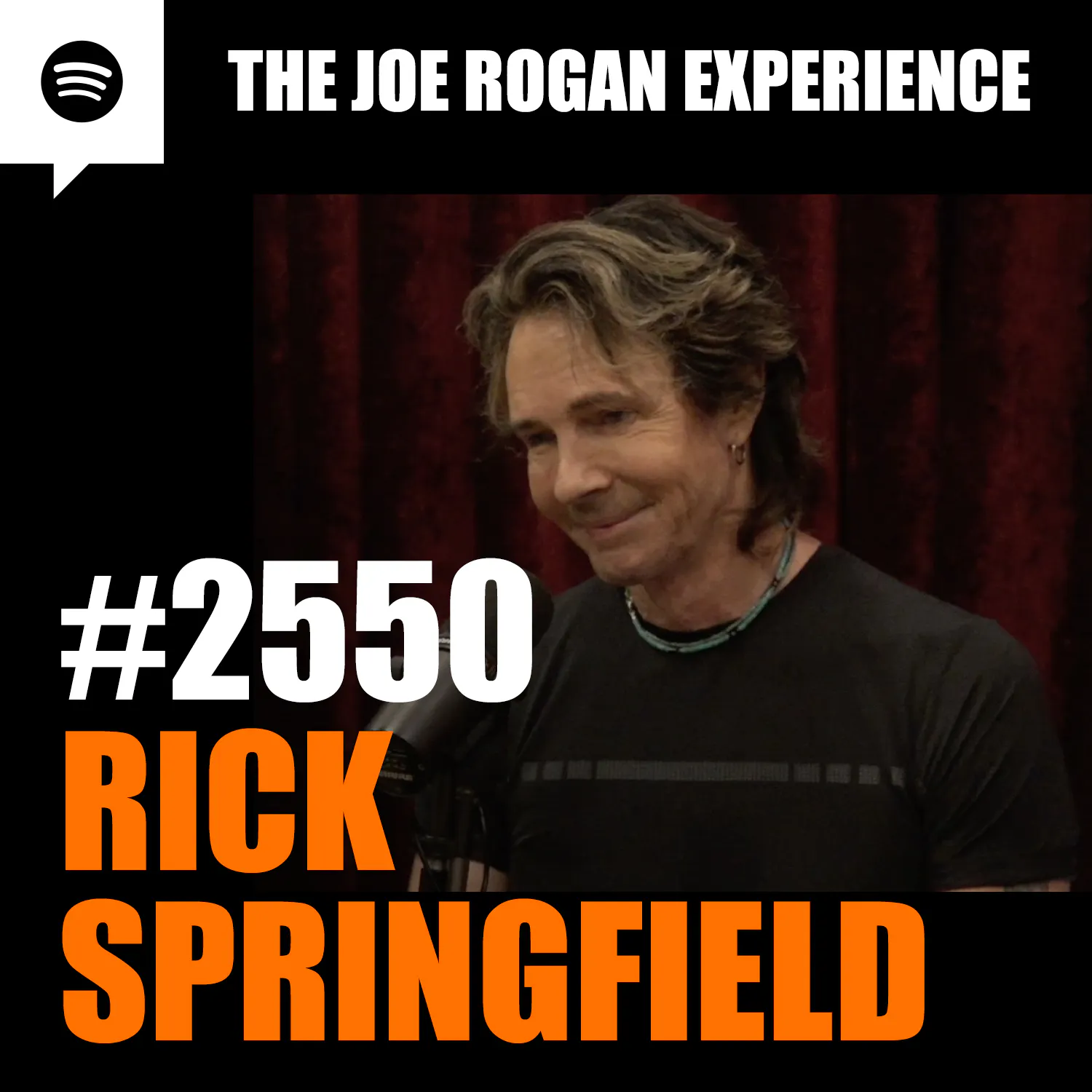
Overview of #2550 - Rick Springfield
Joe Rogan sits down with rock legend Rick Springfield for a wide-ranging conversation about music, fame, aging, health, and the strange path that led Springfield from a teenage guitar player in Australia to a decades-spanning career in the U.S. The episode mixes career history with personal reflection: Springfield talks about his early love of guitar, his time performing in Vietnam during the war, the unlikely rise of “Jessie’s Girl,” his stint on General Hospital, and how he’s stayed passionate and physically active well into his late 70s.
Key Takeaways
-
Springfield has been driven by music since childhood.
- He first picked up guitar around age 11 and started performing by 15.
- He says writing became the thing that gave him direction and purpose, not just playing.
-
His Vietnam experience was intense and deeply formative.
- As a young musician, he toured Vietnam for several months during the war.
- He describes being in active combat zones, getting shot at, hearing mortars, and living with constant fear.
- One moment still weighs on him: throwing mortars and later being told one likely killed someone.
-
“Jessie’s Girl” took time to break, but once it did, it changed everything.
- The song wasn’t an instant smash; it climbed slowly.
- He credits DJs and radio tastemakers for helping the track become a hit.
- The song came from a real girl he saw at a stained-glass class, though he never learned her name.
-
He’s still passionate about performing.
- Rogan repeatedly notes that Springfield performs like someone much younger.
- Springfield says audience energy still fuels him, and he tries to give fans a powerful live experience.
-
He sees live music as a uniquely positive communal experience.
- He compares concerts to a kind of secular church: a place where people gather, feel connected, and leave energized.
- For him, a show is about giving the audience a break from daily stress.
Music Career and Fame
Early years and first success
- Springfield moved around a lot as a kid: Australia, then England, then back to Australia.
- He credits those moves with shaping his accent, worldview, and musical influences.
- His early solo track “Speak to the Sky” helped establish him in the U.S. before “Jessie’s Girl” made him a star.
General Hospital and unexpected crossover fame
- Springfield landed a role on General Hospital partly because he needed income while his music career was still unstable.
- The soap opera became a cultural phenomenon, and his presence on the show boosted his visibility.
- He describes the sudden public recognition as surreal, especially since it happened before MTV-style celebrity exposure.
Live performance and longevity
- Rogan praises how Springfield still performs with charisma and intensity.
- Springfield says staying healthy, loving the craft, and caring about the audience all contribute to his longevity.
- He admires older performers like Mick Jagger and Paul McCartney for continuing to push themselves.
Vietnam War Stories and Psychological Impact
What he saw
- Springfield’s war stories are among the most dramatic parts of the episode:
- touring from Saigon to Da Nang,
- staying in military bunkers,
- playing for troops under fire,
- and seeing firsthand how chaotic and absurd the war could be.
What it left behind
- He says the experience changed him permanently.
- One specific memory still sits heavy with him: being told that a mortar he threw likely hit a person.
- He reflects on how young and naive he was, comparing his mindset then to “John Wayne time.”
Health, Fitness, and Aging
His longevity routine
Springfield attributes his good condition to consistent habits:
- Regular workouts: about six days a week
- Clean eating: mostly meat and fermented vegetables
- Skin care: he takes it seriously and has tried advanced regenerative treatments
- Monitoring his health: blood tests, body scans, and being proactive about medical checkups
Biohacking / recovery discussion with Rogan
- Rogan shares advice on:
- creatine for cognitive performance and recovery,
- sauna use for longevity and cardiovascular benefits,
- cold plunge therapy,
- hyperbaric oxygen chambers,
- and other regenerative treatments.
- Springfield says he struggles with sleep and is open to trying more recovery strategies.
Staying active
- He says he used to run regularly until his knees stopped cooperating.
- He’s interested in maintaining mobility and function rather than simply “getting old.”
Writing, Books, and Creative Identity
- Springfield says he sees himself as a writer first and performer second.
- He has written:
- an autobiography,
- two novels centered on a plague scenario,
- and he is working on new material.
- He says songwriting is where he channels emotion, but prose gives him another creative outlet.
- He also collects handwritten music and memorabilia, especially Beatles-related items.
Notable Reflections
-
On fame:
He seems to view fame as something that arrives when preparation meets opportunity, not just luck. -
On aging rock stars:
He points to the Rolling Stones, Jagger, McCartney, and even Bowie as proof that longevity in music depends on passion and discipline. -
On creativity:
He repeatedly returns to the idea that art comes from having to express something—not from chasing approval. -
On live music:
He and Rogan agree that concerts provide a rare shared emotional high that’s hard to replicate anywhere else.
Bottom Line
This episode is part career retrospective, part war memoir, part longevity conversation. Rick Springfield comes across as thoughtful, disciplined, and still genuinely excited by music. The biggest themes are survival, passion, and staying engaged with life—whether through performing, writing, or taking care of his body well into his 70s.