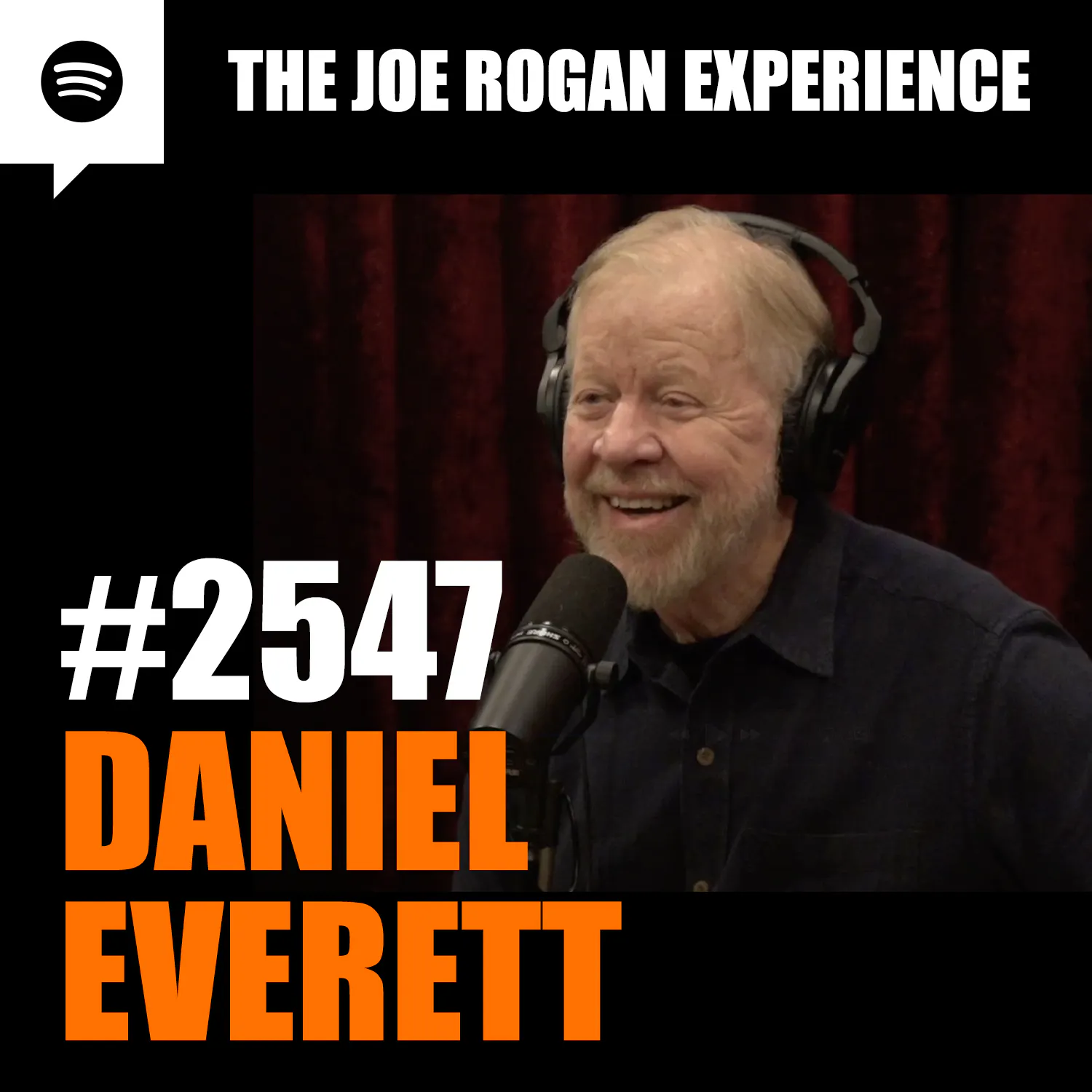
Overview of The Joe Rogan Experience #2547 with Daniel Everett
Joe Rogan talks with linguist and former missionary Daniel Everett about his decades living among the Pirahã people in the Amazon, how that experience changed his religious beliefs, and why their language and culture challenged major assumptions in linguistics, anthropology, and Christianity. The conversation moves from jungle survival and Indigenous lifeways to the deep controversy around Noam Chomsky’s theories, the limits of universal grammar, and the social consequences of modernization for isolated peoples.
Daniel Everett’s Journey: From Missionary to Atheist Linguist
From counterculture to Bible school
- Everett describes a surprising path from a nonreligious, rebellious youth in the 1960s to becoming a Christian missionary.
- He says meeting a missionary family from Brazil and hearing jungle stories deeply influenced him.
- He later attended Bible college, studied theology, became an ordained minister, and trained in linguistics to become a Bible translator.
Jungle training and survival
- Before reaching the Amazon, he underwent intense missionary jungle training in southern Mexico.
- The training included:
- surviving alone in the jungle for about a week or more,
- finding water from vines,
- making fire with very limited matches,
- hunting and fishing with improvised tools.
- He says this harsh preparation made Amazon fieldwork feel familiar rather than shocking.
Loss of faith
- Everett explains that over years of living with the Pirahã, his faith gradually eroded.
- He says the Pirahã’s worldview, practical intelligence, and emotional steadiness made him question Christian claims.
- By around 2000–2001, he says he no longer believed and told his wife, which contributed to their divorce.
Life with the Pirahã
Who they are
- Everett lived with the Pirahã for about eight years total, returning repeatedly over roughly 40 years.
- He describes them as:
- highly adaptable,
- extremely skilled hunters and fishers,
- socially cooperative,
- generally cheerful and low-anxiety,
- deeply rooted in immediate experience rather than abstract belief systems.
Daily life and survival
- Their lifestyle is largely hunter-gatherer subsistence:
- fish are a major food source,
- jungle nuts, game, and plants supplement the diet,
- food is shared rather than stored long-term.
- Everett emphasizes how little time they spend working compared to industrial societies.
- He says they are often seen laughing, joking, and spending time with family around the fire.
Physical toughness and danger
- He recounts frequent jungle hazards:
- snakes,
- jaguars,
- malaria,
- typhoid,
- cuts, injuries, and infections.
- He says Pirahã hunters are extraordinarily skilled with bows and arrows, capable of defending themselves against jaguars.
- He also discusses their tolerance for pain and their habit of building toughness by going hungry or sleeping less.
Clothing, names, and identity
- Pirahã clothing is minimal and practical, not modesty-based.
- Everett describes a flexible naming system:
- people often change names during life,
- old names may be treated as no longer valid,
- identity is seen as situational rather than fixed.
- He uses this to illustrate a very different sense of self than in Western culture.
Language, Thought, and the Chomsky Debate
Pirahã language basics
- Everett explains that Pirahã is a tone language, where pitch changes meaning.
- He argues it was difficult to learn because early written word lists did not mark tone.
- He learned the language by:
- pointing at objects,
- recording responses,
- gradually building a vocabulary and grammar from direct fieldwork.
The controversy over recursion
- The biggest academic controversy in the conversation is Everett’s challenge to Noam Chomsky’s claim that all human languages have recursion.
- Everett argues Pirahã lacks recursion, and that other languages may also lack it.
- He says this sparked strong backlash because it challenged a core theoretical assumption in linguistics.
Why the dispute mattered
- Everett says many critics attacked his credibility rather than testing his claims scientifically.
- He argues the proper response should have been:
- design experiments,
- test the claims,
- accept corrections if necessary.
- He says several outside researchers from places like MIT, Stanford, and Columbia came and found his findings credible.
Broader linguistic lesson
- Everett argues that there are around 8,000 languages in the world, and linguists cannot assume universal rules based on a tiny sample.
- He stresses that fieldwork is crucial and that many theories are built too much from armchair speculation rather than real-world linguistic data.
Religion, Myth, and Worldview
Why the Pirahã rejected Christianity
- Everett says the Pirahã were not interested in his Christian message because:
- they did not see evidence for Jesus,
- they did not know any Brazilians who believed in Jesus,
- they preferred direct, lived evidence over testimony.
- He describes them as having a high standard of evidence.
Spiritual beings and shapeshifting
- The Pirahã believe in various beings and entities, including ones that can appear human or animal.
- Everett discusses a shape-shifting figure/entity he transliterates as something like Igagai.
- He presents these beliefs as part of a worldview that explains unusual or ambiguous experiences.
Rejecting Western categories
- The Pirahã do not organize the world the way Western societies do:
- no fixed number system,
- no left/right in the Western sense,
- less emphasis on abstract categories,
- stronger emphasis on direct perception and context.
- Everett sees this not as primitiveness, but as a different cognitive and cultural system.
Modernization and Its Consequences
Environmental disruption
- Everett says Brazilian dam construction severely disrupted the Pirahã’s ecosystem.
- The changes reduced fish populations and forced some people to hunt farther and adapt to new conditions.
- He frames this as a major threat to their self-sufficient way of life.
Contact with the outside world
- External goods brought in by riverboats and government contact have changed the culture:
- sugar,
- soda,
- alcohol,
- guns,
- canned foods,
- Portuguese language influence.
- He says these introduced goods often create new problems:
- addiction,
- dental issues,
- obesity,
- social instability.
Health and nutrition
- He argues their traditional diet is healthier than an industrial one:
- no processed sugar,
- lots of fish and lean protein,
- very low obesity rates,
- few cavities before sugar was introduced.
- He contrasts this with the harm caused by dependence on imported starches and sweets.
Key Takeaways
- Fieldwork matters: Everett argues that real linguistic and anthropological knowledge requires long-term immersion, not short visits.
- Human societies are diverse: The Pirahã challenge assumptions about language, religion, morality, and cognition.
- Intellectual ego can distort science: The debate with Chomsky becomes a case study in how authority and prestige can suppress evidence.
- Religion is not the only source of ethics or peace: Everett sees the Pirahã as living with strong social cohesion, low anxiety, and deep mutual trust without Christian doctrine.
- Modernization can be destructive: External development, dams, trade goods, and cultural pressure have made life harder for the Pirahã.
Notable Insights
- Everett repeatedly returns to the idea that the Pirahã are not “primitive” but highly adapted to their environment.
- He suggests that the biggest differences between cultures are often not superficial, but rooted in how people interpret reality itself.
- His experience led him to conclude that intelligence is no antidote for stupidity, especially when ego and ideology take over.
Suggested Reading
- Don’t Sleep, There Are Snakes — Daniel Everett
- How Language Began — Daniel Everett
- Born of the River — mentioned as an upcoming book in the conversation