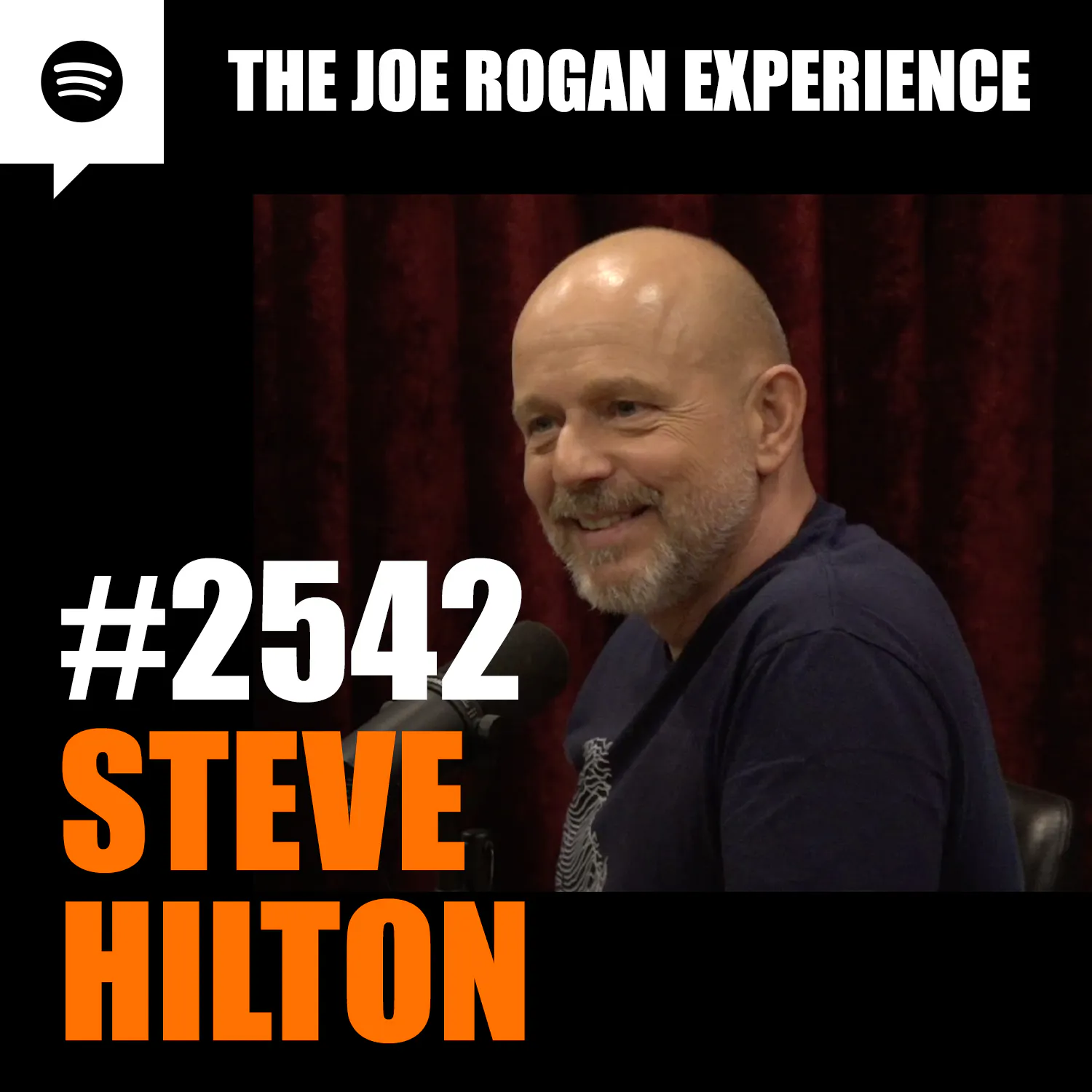
Overview of #2542 - Steve Hilton
Joe Rogan and Steve Hilton spend most of this episode in a wide-ranging political and cultural conversation centered on California’s collapse, the influence of social media and AI, and Hilton’s campaign to become governor. The tone is part personal reunion, part policy debate: they reminisce about meeting years ago, then move into a blistering critique of bureaucracy, corruption, and the incentives driving modern politics.
Opening: Friendship, First Podcast, and How Long They’ve Known Each Other
A long history
- Rogan and Hilton talk about how they met in Hawaii while their young children were playing on the beach.
- They reflect on Hilton’s first appearance on the podcast back in 2014, when neither of them really understood how big podcasting would become.
- Hilton notes that he was then a relatively private policy guy and had no idea how open-ended and uncensored the conversation would be compared to traditional media.
Early impressions
- Hilton jokes that Rogan’s style felt shocking at the time because he was so direct and willing to talk about anything.
- Rogan says the key to surviving public criticism is to ignore bad-faith online commentary and keep moving.
Social Media, Bots, and the Attention Economy
X, Instagram, TikTok, and manipulation
- They compare platforms:
- X is best for news but polluted by bots and coordinated propaganda.
- Instagram is more visual and can be filled with disturbing or addictive content.
- TikTok is the most compulsive and engineered for endless consumption.
- Rogan argues that a large share of online engagement is artificial and that bot networks heavily shape political discourse.
- They discuss how the Chinese version of TikTok is curated toward educational and athletic content, while the U.S. version is optimized for addiction.
Big takeaway
- Both agree that social media is not just a communications tool; it’s an attention-harvesting system with major political and psychological consequences.
California Politics: Taxes, Bureaucracy, and Decline
Hilton’s central theme
- Hilton presents California as a case study in what happens when one party controls everything for too long.
- He argues that the state is overregulated, overtaxed, and dominated by a bureaucracy that serves insiders rather than ordinary people.
Repeated points of criticism
- Housing, homelessness, and crime have worsened despite enormous spending.
- Businesses are leaving because the state is hostile to growth.
- Taxes are too high, especially gas taxes and hidden regulatory costs.
- One-party rule has made legislators and agencies unaccountable.
“Doom loop” framing
- Hilton says Democrats respond to California’s problems by raising taxes and expanding welfare, which often increases costs instead of solving the underlying issues.
- He argues the state should cut waste, reduce bureaucracy, and make work affordable instead of endlessly redistributing money through layers of government.
Homelessness, Nonprofits, and the “Homeless Industrial Complex”
Key claims
- Hilton repeatedly attacks what he calls the homeless-industrial complex:
- large sums of public money flow to nonprofits and developers,
- little of it reaches people in need,
- and the problem gets worse rather than better.
- He cites billions spent on homelessness with no meaningful improvement.
Law enforcement and public order
- He argues California should enforce existing laws, especially around encampments and public camping.
- Rogan agrees that crime, home invasions, and downtown disorder are destroying quality of life and business activity.
Social Safety Nets, Minimum Wage, and Work Incentives
Nuanced disagreement
- Both men acknowledge that some safety nets are necessary.
- But Hilton argues welfare often traps people in dependency if the system is structured badly.
Living wage vs. minimum wage
- Hilton says a true living wage should be geographically adjusted.
- He also suggests businesses should pay workers enough directly so government doesn’t have to redistribute the money back in benefits.
- Rogan adds that low-wage work should still exist as a path for young people to learn responsibility.
Public Health, SSRIs, and Lifestyle
Medication overuse
- Rogan and Hilton criticize the overprescription of antidepressants and other psychiatric drugs.
- They say the “chemical imbalance” narrative has been oversold and is not supported in the simplistic way many people believe.
Their preferred alternative
- Both emphasize:
- exercise,
- nutrition,
- sleep,
- hydration,
- and community.
Cautionary note
- They acknowledge that psychiatric medication can help some people, but argue it is far too heavily prescribed and often paired with weak lifestyle advice.
AI, Regulation, and Human Meaning
The AI doom debate
- They discuss AI leaders like Dario Amodei of Anthropic and Sam Altman of OpenAI, noting the tension between warning about AI dangers while also building the technology.
- Hilton is skeptical of heavy-handed government regulation, warning that bureaucrats will make things worse.
Broader concern
- They worry AI could deepen dependency, weaken purpose, and intensify the same attention and addiction problems already seen with phones and social media.
Open Borders, Migrant Children, and HHS
A major accusation
- Hilton makes a strong case that Javier Becerra, as HHS secretary, failed catastrophically in overseeing unaccompanied migrant children.
- He cites claims that hundreds of thousands of children were lost in the system and that some were exposed to trafficking and abuse.
Political point
- Hilton frames this as a major moral scandal that has not received enough public attention.
- He argues Becerra is unfit to govern because he prioritized optics and speed over child safety.
Elections, Voter ID, and California’s Political Machine
Election integrity concerns
- The episode includes a lengthy discussion of mail ballots, voter ID, and allegations of election manipulation.
- Hilton says California’s system makes it too easy for insiders to shape outcomes and too hard to challenge the machine.
His strategy
- He argues the only way to beat entrenched power is to mobilize enough voters to make the race “too big to rig.”
- He says the state’s one-party dominance has created arrogance, corruption, and a belief that no one can stop them.
Energy, Gas Prices, and Climate Policy
California’s high costs
- Hilton says California’s gas and electricity prices are driven up by taxes, regulations, and ideology.
- He argues state leaders are more interested in climate posturing than actual climate results.
Wind, solar, and bureaucracy
- He criticizes:
- offshore floating windmill projects,
- hidden fuel taxes,
- and regulations that force consumers into more expensive energy choices.
- Rogan pushes back on some of the climate logic but agrees the burden always falls on ordinary people.
Tires, Technical Regulation, and Micromanagement
A bizarre example
- They spend time on California’s proposed tire regulations, which would limit many replacement tires based on energy-efficiency standards.
- Hilton uses it as an example of bureaucrats micromanaging daily life with little voter input.
Why it matters
- The tire discussion becomes a symbol of how California’s government creates costs and complexity in the name of virtue, while real-world consequences are ignored.
Comedy, Free Speech, and the Culture War
Why comedy matters
- The conversation also turns into an appreciation of comedy as a truth-telling art form.
- Rogan and Hilton talk about how modern culture has become too ideologically rigid for the kind of free, edgy comedy that used to be normal.
Shared view
- They argue that comedy should be judged by what is funny, not by whether it conforms to a political doctrine.
- Rogan connects this to the death of a certain era of movie comedy and the narrowing of acceptable speech.
Standout Takeaways
- California is the main case study: Hilton argues the state shows what happens when bureaucracy, ideology, and one-party rule go unchecked.
- Social media is corrosive: both men see bots, outrage, and addiction as major forces shaping politics and mental health.
- Government overreach is the common thread: from homelessness to tires to AI, they see micromanagement as the problem, not the solution.
- Mental health needs a broader lens: exercise, diet, sleep, and community are repeatedly emphasized over medication-first thinking.
- Hilton positions himself as a reformer: his campaign message is essentially anti-corruption, anti-bureaucracy, and pro-common-sense governance.
Bottom Line
This episode is less a standard interview than a long-form political and cultural diagnosis. Rogan and Hilton use California as a cautionary tale about what happens when institutions become captured, costs spiral, and public policy becomes performative instead of practical. At the same time, they keep returning to a more personal theme: people are not powerless, and common sense still has political value if enough voters are willing to demand it.