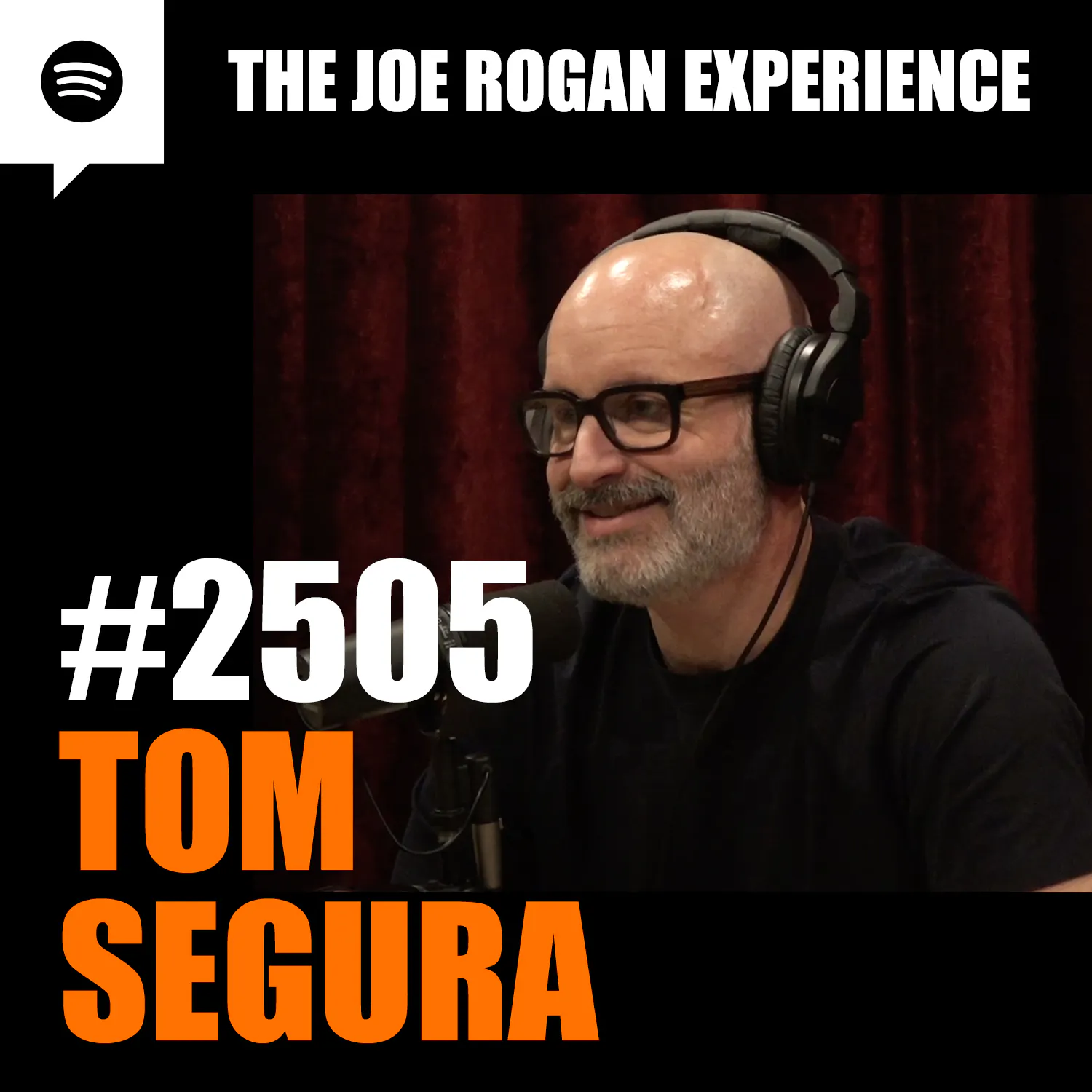
Overview of #2505 - Tom Segura
Joe Rogan and Tom Segura cover a wide range of topics, but the conversation centers on Segura’s new Netflix project and then spirals into hunting, wild boars in Texas, violent dictators, AI, religion, comedy, and social/political commentary. The tone is mostly playful and loose, but it repeatedly turns serious when they discuss power, corruption, sadism, and the speed at which technology and culture are changing.
Tom Segura’s New Netflix Season
- Rogan praises Segura’s new season as absurd, original, and very “Tom.”
- They talk about how much freedom Netflix gave him to make the show exactly as he wanted.
- Segura says the dance episode took multiple rehearsals and was much harder than it looked.
- Rogan highlights how the show feels like a true expression of one person’s comedic mind.
- They mention several episodes/scenes that were especially outrageous, including the Kevin Nealon episode and the “Freaky Friday” setup.
Key takeaway
The new season is framed as a rare example of a comedian being allowed to fully execute his own weirdness without corporate restraint.
Hunting, Wild Pigs, and Texas Food
- The conversation shifts into hunting, especially hog hunting in Texas.
- Rogan explains that Texas has an enormous wild pig problem, with millions of feral pigs destroying land and ecosystems.
- They discuss how hog hunting is legal year-round, often at night with thermal or night vision gear.
- Rogan describes how wild pigs eat anything, including dead animals, making them important to cook thoroughly.
- He recommends chef Jesse Griffiths and his restaurant Dai Due, which features Texas wild game and a strong hunting-to-table philosophy.
- Segura is interested in the idea of learning to hunt, butcher, and cook what he shoots.
Key takeaway
Hunting is presented not just as sport, but as a practical, environmental, and culinary experience.
Violence, Dictators, and Uday Hussein
- Rogan and Segura dive deep into the brutality of Uday Hussein, Saddam Hussein’s son.
- They recount stories of extreme sadism: torture of athletes, killings at parties, random executions, and punishments for minor offenses.
- Rogan notes how Uday’s violence seems tied to childhood rejection, neglect, and a complete lack of restraint.
- They compare Uday to other infamous rulers like Idi Amin, Mussolini, Stalin, and Vlad the Impaler.
- The discussion emphasizes how unchecked power can turn a damaged person into a monster.
Key takeaway
The segment becomes a meditation on how trauma, power, and impunity can create horrifyingly violent leaders.
AI, Job Disruption, and the Future
- The conversation shifts to AI and whether young people are justified in fearing it.
- Rogan argues that rejecting AI outright is unrealistic because it’s already too powerful and too embedded.
- They discuss the possibility that AI will replace many jobs, especially white-collar work like coding, law, and admin tasks.
- Rogan brings up examples of AI blackmail and AI-generated OnlyFans accounts making huge money.
- They agree that people need to learn AI rather than pretend it won’t matter.
- A key concern is that college students may take on massive debt for careers that AI could hollow out.
Key takeaway
AI is framed as an unavoidable force that may radically reshape work, education, and identity.
Religion, Mysticism, and Ancient Flood Myths
- Rogan and Segura get into a long, odd tangent on Kabbalah and Jewish mysticism.
- They look up ideas about masturbation, seed loss, and demon lore tied to more mystical traditions.
- This leads into a broader conversation about religion as a system of control, storytelling, and moral instruction.
- They also discuss the Noah’s Ark site in Turkey and whether there’s any legitimacy to claims that the Ark was found.
- That becomes a jump-off point into flood myths across cultures and the Younger Dryas impact theory.
Key takeaway
They speculate that flood myths may preserve memory of real ancient catastrophes, even if the religious narratives around them are embellished.
Comedy, Career Pressure, and Creative Freedom
- The two talk about how comedy careers are often dismissed by outsiders, especially in the early years.
- Rogan shares stories of people doubting his career path and other comedians being told they “don’t have it.”
- They discuss how many comics stall because they don’t evolve, work hard enough, or adapt their act.
- Rogan praises acts that find a real artistic identity, like:
- Bobcat Goldthwait
- Carrot Top
- Jeff Dunham
- Ari Shaffir’s themed show
- They also talk about how Netflix’s willingness to take risks is increasingly rare.
Key takeaway
The episode repeatedly returns to the idea that comedy works best when creators are free to be weird, specific, and fearless.
Cars, Driving, and Personal Favorites
- A long stretch of the conversation turns into car talk.
- They compare Porsche, Mustang, and Ferrari models, with a lot of affection for older 911s and modern performance builds.
- Rogan reminisces about a 2012 Shelby GT500 convertible he loved for its sound, torque, and raw driving feel.
- They talk about carbon fiber builds, especially custom classic Mustangs and Cobras.
- The theme is that fun and character matter more than raw speed alone.
Key takeaway
Both guests prefer cars that feel alive and emotional, not just technically fast.
Crime, Corruption, and Government Overreach
- Rogan and Segura discuss:
- police quotas and petty traffic stops
- corrupt prosecutors
- FBI informants in sting operations
- the Whitmer kidnapping case
- alleged agent provocateurs around January 6
- Rogan argues that institutions often create crime or amplify it for career advancement, optics, or political goals.
- They also talk about insider betting and how public figures or insiders can exploit non-public information.
Key takeaway
The broader critique is that systems meant to enforce order often create incentives for abuse.
Canada, Assisted Suicide, and “MAID”
- They talk about Canada’s MAID program, or medical assistance in dying.
- Rogan highlights how widespread assisted death has become there, including cases that seem ethically troubling.
- One example discussed is a young man with depression and other conditions who was euthanized despite not being terminally ill.
- The segment is presented as evidence of a culture that has become too comfortable with giving up on people.
Key takeaway
Rogan sees Canada’s assisted-dying system as a dangerous normalization of death over help and recovery.
Strange Viral Moments and Pop Culture
- They discuss Ray J getting knocked out in an event and then claiming there was some kind of deal.
- Rogan brings up a memorable Cam Newton interview with Ray J that became unexpectedly bizarre and funny.
- They also mention internet culture, AI-generated content, and how hard it is to tell what’s real online now.
Key takeaway
The internet has made performance, fraud, and absurdity harder to distinguish from reality.
Final Thoughts
- The episode is less a structured interview than a free-flowing conversation that keeps finding new rabbit holes.
- Segura’s show is the anchor, but the rest of the episode becomes a mix of:
- comedy industry reflection
- hunting and food culture
- political corruption
- AI anxiety
- ancient myths
- violent rulers
- personal stories about cars and careers
Main takeaway
It’s a classic Rogan-Segura conversation: funny, scattered, occasionally dark, and packed with strong opinions about creativity, power, and the weird state of modern life.