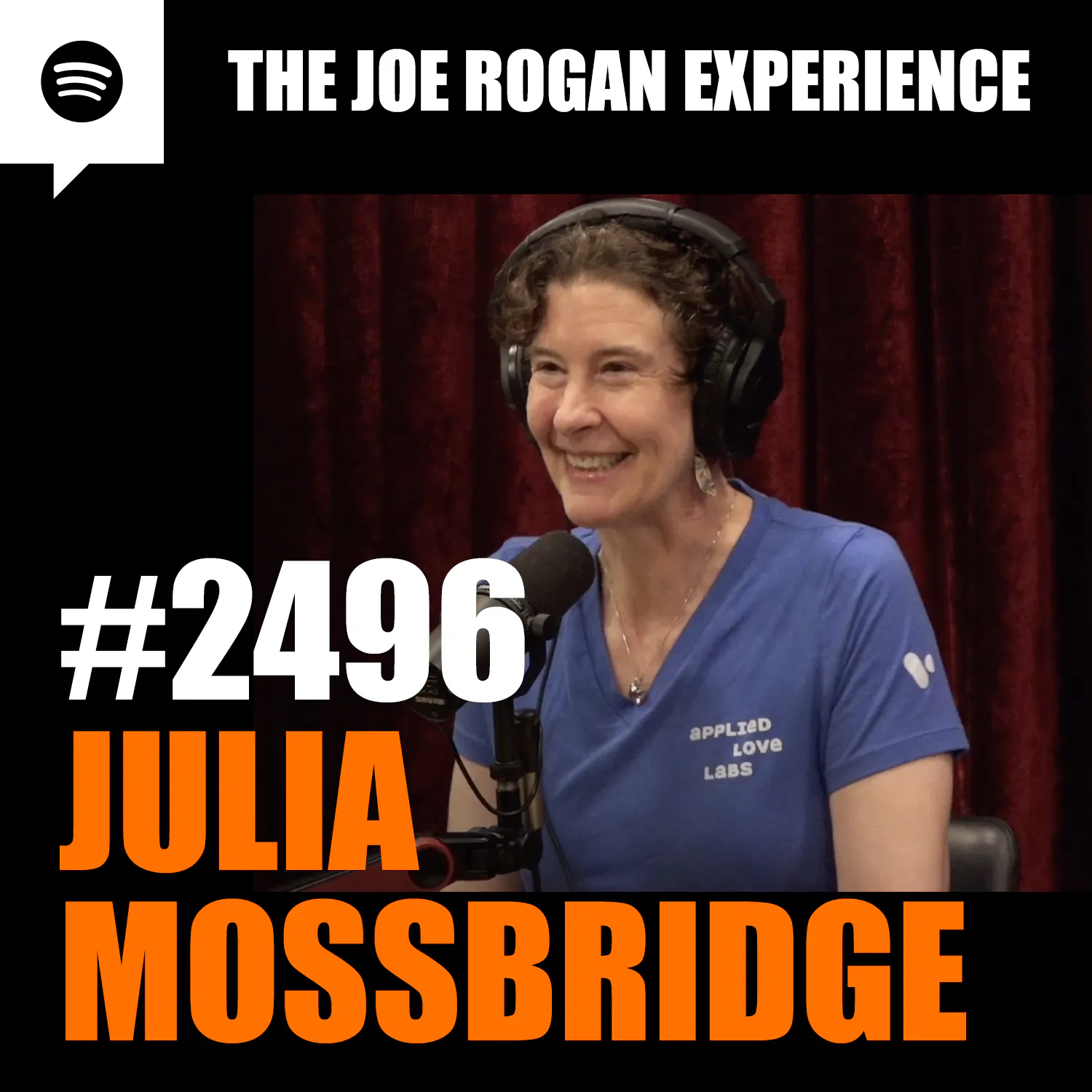
Overview of #2496 - Julia Mossbridge
Joe Rogan talks with neuroscientist and author Julia Mossbridge about precognition, telepathy, consciousness, time, and the culture around science and skepticism. Mossbridge explains how her background in cognitive neuroscience and computer science led her to study “exceptional human performance,” especially experiences like precognitive dreams, remote viewing, and possible telepathic communication. The conversation moves between her research, her personal experiences, her thoughts on academia and ego, and broader speculation about quantum physics, UFO disclosure, and how love, humility, and curiosity may matter more than status or certainty.
Mossbridge’s Background and How She Got Into This Work
From neuroscience to anomalous cognition
- Mossbridge says she was trained in cognitive neuroscience and computer science, with work in AI and brain/time perception.
- She became especially interested in precognition and related phenomena after noticing repeated, documented experiences in her own life.
- She describes herself as a scientist who wants to gather data, test controls, and see what can actually be shown.
Why she left the mainstream academic lane
- She says academia is often slow, status-driven, and hostile to unconventional questions.
- She felt pressure to suppress the psychic/precognitive side of her work in order to look “serious.”
- Rather than only publish papers, she wanted to build things and explore practical uses for these abilities.
Precognition, Telepathy, and Time
Personal experiences she uses as evidence
- Mossbridge says she had her first clear precognitive dream at age seven, involving a friend losing a watch on a playground the next day.
- She also describes family experiences with ball lightning and strange orbs that her father dismissed but her mother accepted as real.
Her scientific studies
- She discusses experiments measuring:
- skin conductance
- heart rhythms
- responses that appear to shift before random future events
- She says the effect has been seen in multiple studies and appears more strongly in men in some tasks, which she thinks may be cultural rather than strictly biological.
Her theory of time
- Mossbridge leans toward a model where time is not strictly linear.
- She uses ideas like:
- retrocausality
- a figure-eight loop of time
- an informational substrate underlying reality
- She suggests that what people call intuition, telepathy, or precognition may be information leaking from the future or from a larger field of information.
Non-Speaking Autistic Kids and Telepathy Claims
Why she thinks this population is important
- Mossbridge says non-speaking autistic children can be especially interesting for studying communication beyond ordinary language.
- She worked with a research team and with people associated with The Telepathy Tapes.
Examples she shared
- A student reportedly described a target video as “a beautiful sky” without access to the prompt.
- Another student appeared to independently repeat a prior conversation about slamming a beach ball to improve telepathy trials.
- She describes a dream in which a student showed her a rotating orb-like image, then later the student supposedly described it back as a “pre-orb with four stars”.
- She also mentions a student seemingly reading her mind about 3I/ATLAS, a medication concern, and other details he could not easily have known.
Her interpretation
- Mossbridge argues that these cases suggest:
- telepathy may be real
- language may sometimes suppress nonverbal information channels
- non-speaking people may have access to an information field that neurotypical language users filter out
- She is careful to frame this as research worthy of more study, not settled fact.
Culture, Ego, and Why People Resist These Ideas
Science, politics, and performative certainty
- Rogan and Mossbridge agree that both the left and the right can become tribal, performative, and obsessed with being “right.”
- They criticize:
- academic gatekeeping
- cult-like behavior in institutions
- intellectual dominance games
- people who use expertise as status rather than as a tool for truth
Listening, humility, and emotional maturity
- Rogan argues that being a good listener is more about curiosity and security than gender.
- Mossbridge says people often fear being seen as foolish, and that fear blocks discovery.
- They both emphasize that real conversation requires humility, boundaries, and openness.
Martial arts and hard experiences
- They compare intellectual humility to what people learn in martial arts, yoga, childbirth, sports, and other difficult practices:
- you get humbled
- you stop thinking you’re special
- you learn to assess yourself honestly
- you get out of your ego and into the task
Love, Prayer, and the “Human Problem”
Mossbridge’s broader philosophy
- She repeatedly returns to the idea that the biggest human issue is that we don’t know how to be in harmony with ourselves or others.
- She says the strongest corrective force is love, especially when combined with honesty and discipline.
- She also notes that kindness can be “selfish” in a good way because it improves how you feel and behave.
Her nonprofit and the “time machine”
- Mossbridge mentions Applied Love Labs and its time machine project:
- an audio journaling app that sends messages to your future self
- used with veterans, addiction recovery, abuse survivors, jails, and some Native groups
- The point is to build self-love over time and help people communicate compassionately across their own timeline.
UFOs, Disclosure, and Quantum Speculation
Disclosure as inner awareness
- Mossbridge’s book Have a Nice Disclosure is not mainly about aliens in the usual pop-culture sense.
- She says “disclosure” should also mean:
- revealing your own strange experiences to yourself
- being honest about what you’ve suppressed
- not waiting for authorities to define reality for you
Quantum physics and mind
- She argues that current ideas about quantum computing may be too rigid and too focused on trapping particles.
- She suggests nature, especially leaves and photosynthesis, may already show more elegant forms of “quantum computation” at room temperature.
- She repeatedly returns to the idea that:
- photons may connect mind and matter
- the observer effect may reflect mind interacting with mind
- time and reality may be fundamentally informational
UFOs and the future-human idea
- Rogan brings up UFOs, greys, and future-human possibilities.
- Mossbridge says the “greys” could fit a model of beings shaped by a very different relationship to time and communication.
- She also notes that actual physical reverse engineering of anomalous materials will matter more than endless theorizing.
Childhood, Government Programs, and Ethical Concerns
Her unusual upbringing
- Mossbridge describes a highly intellectual family:
- father: physicist
- mother: therapist/learning specialist
- sister: artist
- Dreams were discussed openly in her home, which she thinks helped normalize unusual experiences.
Gifted programs and memory gaps
- She says she has suspicious memory gaps tied to gifted programs she attended as a child.
- She also recalls a pink drink and strange interviews or sessions where her memory went blank.
Her concern about possible government involvement
- Mossbridge suggests, cautiously, that some gifted-child programs may have had intelligence or defense-related interest in exceptional kids.
- She raises concerns about:
- radiation exposure
- hidden testing
- lack of parental consent
- unethical experimentation on children
- She does not present this as proven, but as a troubling pattern she believes deserves investigation.
Closing Takeaways
- Mossbridge’s core claim is that anomalous cognition is real enough to study seriously, even if mainstream science resists it.
- The conversation repeatedly circles back to a few themes:
- curiosity over certainty
- love over dominance
- humility over ego
- experience over dismissal
- Rogan ends the episode inviting her back for a future conversation focused more specifically on remote viewing.
Notable Ideas from the Conversation
- Language may suppress subtle forms of knowing.
- Time may be non-linear, or at least more complex than everyday experience suggests.
- Non-speaking autistic people may offer a unique window into consciousness and communication.
- Kindness, humility, and self-transcendence may improve both well-being and access to unusual cognitive states.
- Much of what people call “disclosure” may ultimately be personal before it is governmental.