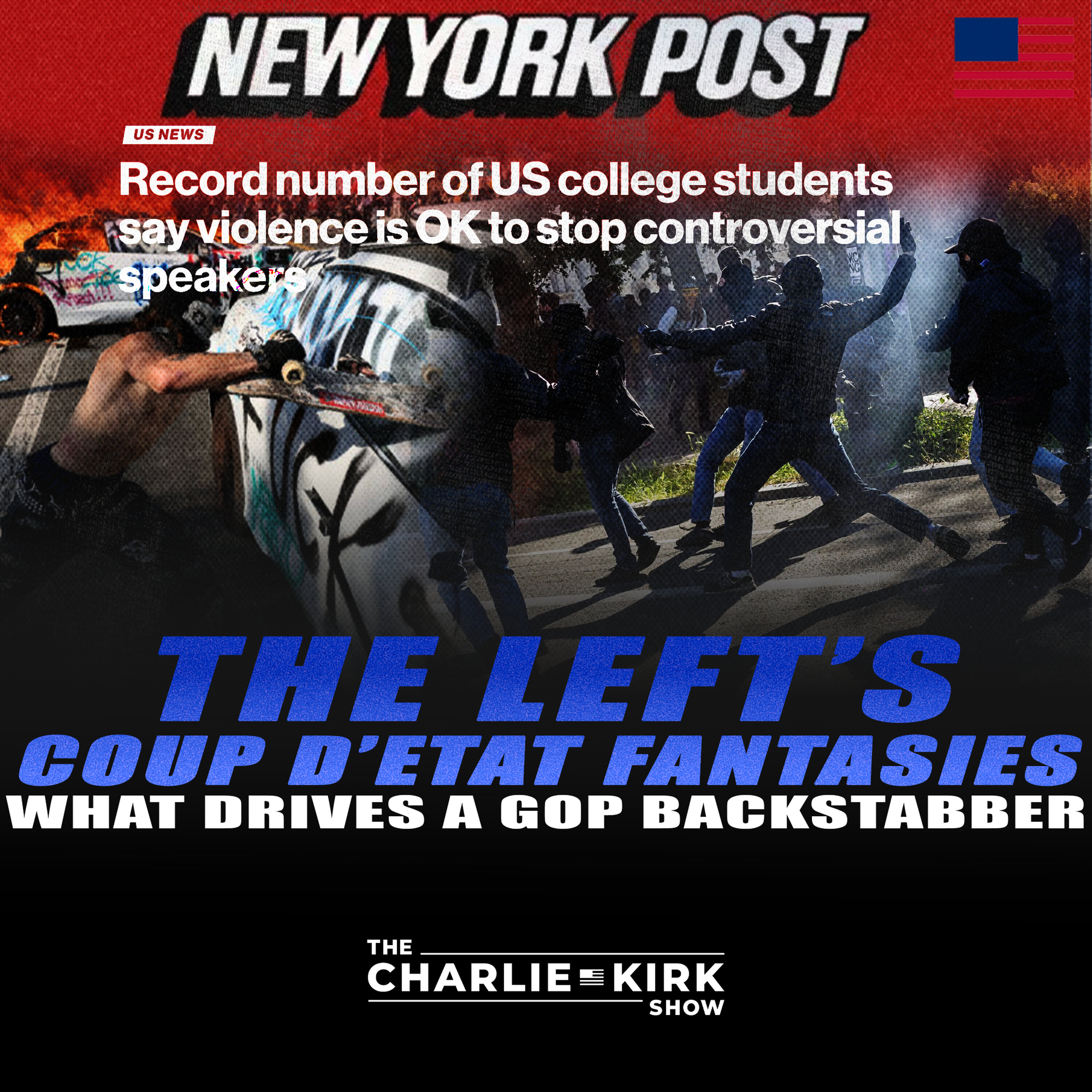
Overview of The Left's Coup d'Etat Fantasies + What Drives a GOP Backstabber?
This episode is a mix of political commentary, interviews, and culture-war analysis. Charlie Kirk argues that legacy media and institutions like ProPublica are running coordinated smear campaigns against conservatives, while some Republicans are helping amplify them. The show then pivots to a serious discussion about the rise of political violence on the left, the fallout from the Lindsay Clancy case, the normalization of anti-marriage content online, and a closing interview about how the Bible speaks to business, work, and wealth creation.
Political Smear Campaigns and GOP Infighting
Don Jr., ProPublica, and Senator Curtis
Kirk spends the opening portion attacking a ProPublica investigation into Donald Trump Jr., calling it a hit piece. The article alleged:
- a Russian oligarch helped pay for Don Jr.’s Bahamas wedding,
- and that a Pentagon loan to a company tied to his venture capital firm may have involved improper influence.
Kirk says Don Jr. denied involvement, paid back the money, and that there is no proven wrongdoing. He criticizes Sen. John Curtis of Utah for piling on and for drawing what Kirk sees as a false equivalency between Don Jr. and Hunter Biden.
Susan Collins and election timing
Kirk then argues the ProPublica piece on Sen. Susan Collins is part of the same broader operation:
- He says Collins’ office has already denied bribery claims.
- He notes that the campaign and the super PAC were separate entities.
- He emphasizes that an earlier FBI review found no wrongdoing.
His larger point: these stories are being timed ahead of the midterms to damage Republicans, and some GOP senators are helping the left by joining the attacks instead of defending their own side.
Kirk’s broader complaint
He frames this as a recurring problem inside the GOP:
- Republican senators block Trump-aligned priorities,
- fail to advance the SAVE Act and other agenda items,
- and then act as “principled” critics of Trump-world figures.
His conclusion is blunt: the party loses when Republicans prioritize looking respectable to media and establishment elites over fighting effectively.
Political Violence, Campus Radicalization, and Public Attitudes
Rich Barris on violent attitudes
Pollster Rich Barris joins to discuss alarming data on political violence. They focus on a poll showing that a significant share of Democrats find extreme methods acceptable to remove Trump from power, including:
- assassination,
- military coup,
- and other forms of extra-legal removal.
Barris says support for assassination is still disturbingly high, and warns the situation is getting worse.
Fear of reciprocal violence
A key concern Barris raises is that if conservatives believe they are being “hunted” and not protected by institutions, some on the right may eventually become more open to violent retaliation. He says the left often views violence as “self-defense” because they see politics as existential.
Campus speech and cancellation
They also discuss:
- hostility toward controversial speakers on college campuses,
- rising acceptance of shouting down or physically blocking speakers,
- and the broader collapse of shared norms around free expression.
The segment’s message is that political and cultural radicalization is no longer confined to fringe students; it has spread into the professional and credentialed classes.
Ali Beth Stuckey on the Clancy Case and Marriage Culture
Share the Arrows conference
Ali Beth Stuckey promotes her upcoming Share the Arrows conference in Dallas, aimed at Christian conservative women and focused on theology, apologetics, and encouragement.
The Lindsay Clancy case
She and Kirk discuss the murder of three children by Lindsay Clancy and the public reaction to it. Stuckey explains that she initially thought psychiatric drugs might have played a major role, but after looking into the case more deeply, she concluded:
- the evidence did not support the strongest mental-illness defense,
- Lindsay Clancy committed a grave evil,
- and attempts to shift blame onto the father, Patrick Clancy, are unjust.
They both condemn the online effort to turn the case into a political narrative rather than a tragedy requiring justice.
Jury intimidation and doxxing
They also discuss the doxxing of a juror and the danger of future jury intimidation, arguing that social media has made impartial justice harder because jurors may fear online retaliation.
Taylor Swift and marriage
The conversation turns lighter with a viral clip of Taylor Swift celebrating Travis Kelce’s touchdown and pointing to her ring. Stuckey argues the moment is good for marriage culture because it celebrates a husband’s success rather than mocking it.
Kirk then plays an old clip of himself jokingly telling Taylor Swift to “submit to your husband,” framing the moment as a humorous but real push toward pro-marriage values.
Nicholas Leone and the Business Bible
The core idea
The final interview features Nicholas Leone, founder of The Business Bible, a topical resource that organizes what Scripture says about work, wealth, stewardship, and business.
Main argument
Leone says:
- the Bible is deeply concerned with work and economics,
- God created people to work,
- and business is a legitimate way to meet human needs and create flourishing.
He argues that many Christians have a “Sunday-Monday gap” where faith is separated from work, and that the Bible offers guidance for Monday-through-Friday life just as much as for church life.
Biblical examples he highlights
Leone walks through examples like:
- Abraham, Isaac, and Jacob as business founders and stewards,
- Joseph as an economic administrator,
- and the parable of the talents as a model of productive stewardship and risk-taking.
His main takeaway: business, when done faithfully, is not just about profit — it is a vehicle for service, wealth creation, generosity, and social good.
Key Takeaways
- Kirk sees a coordinated media and institutional effort to damage conservatives ahead of the election.
- He believes Republicans hurt themselves when they help legitimize Democratic narratives.
- Barris’ polling suggests a worrying tolerance for political violence, especially on the left.
- The Clancy discussion centers on justice, online mob behavior, and the danger of narrative-driven jury intimidation.
- The Business Bible segment argues that Scripture supports work, stewardship, and wealth creation as part of a faithful life.
Notable Themes
Political
- Anti-Trump media narratives
- GOP infighting and establishment vs. MAGA tensions
- Midterm strategy and Senate gridlock
Cultural
- Political violence normalization
- Free speech on campuses
- Marriage and family as countercultural goods
Faith and Work
- Biblical stewardship
- Business as a calling
- Integrating Christian belief with professional life