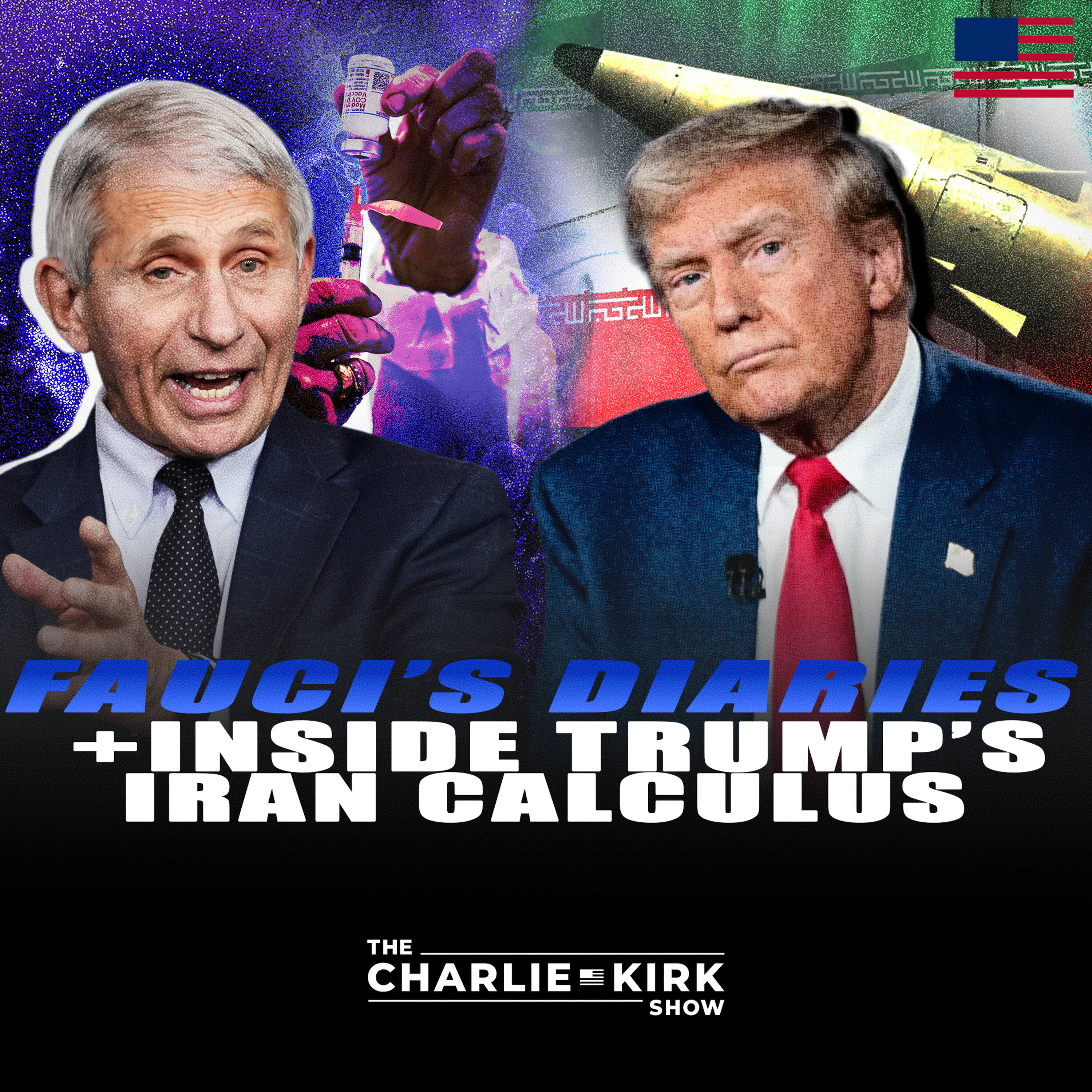
Overview of Fauci's Diaries + Inside Trump's Iran Calculus
This episode is a fast-moving mix of political commentary, media critique, and interviews with guests on three major themes: Anthony Fauci’s diary entries and what Charlie Kirk argues they reveal about COVID-era politics; the Trump administration’s internal thinking on Iran and war vs. peace; and a culture-war segment with detransitioner Chloe Cole on gender ideology aimed at children.
Fauci Diaries: Kirk’s Core Argument
Charlie Kirk opens with a long monologue focused on newly surfaced Anthony Fauci diary entries, which he says show Fauci was politically motivated during the COVID response.
Main claims Kirk makes
- Fauci’s diaries were obtained through RFK Jr. and passed to Sens. Rand Paul and Ron Johnson.
- Kirk argues the entries show Fauci and other officials:
- resisted or delayed vaccine approval,
- discussed emergency use authorization in political terms,
- and were aware that an early vaccine rollout could help Trump in the 2020 election.
- He frames this as evidence that public-health decisions were intertwined with election politics and that Fauci helped “block” an “October surprise” for Trump.
Named players in the narrative
- Deborah Birx
- Mark Meadows
- Steven Hahn
- Peter Marks
- Alex Azar
- Larry Horowitz
- Francis Collins
- Cliff Lane
Bottom line of the segment
Kirk portrays Fauci as:
- deeply narcissistic,
- politically manipulative,
- and responsible, in his view, for helping derail Trump’s reelection chances.
Interview with Jonathan Swan: Trump, Iran, and War Calculus
The episode then shifts to a substantial interview with journalist Jonathan Swan about his book Regime Change and the Trump administration’s Iran policy.
Key discussion points
- Swan describes the internal debate in the Trump White House over Iran strikes and regime change.
- He says there was skepticism in the room about whether regime-change scenarios were realistic.
- He emphasizes that:
- JD Vance was one of the most vocal skeptics,
- but Trump himself was often more hawkish on Iran than his advisers.
What Swan says about the peace push
- Swan rejects the claim that JD Vance “went rogue” on peace negotiations.
- He says Trump personally directed Vance, Steve Witkoff, and Jared Kushner to negotiate with Iran.
- According to Swan, the peace effort was not an off-script move, but part of Trump’s own strategy.
Broader strategic point
Swan argues Trump’s actions reflect a long-standing hawkish posture toward Iran, including:
- leaving the JCPOA,
- ordering the strike that killed Qasem Soleimani,
- and maintaining pressure on the regime.
Midterm and political outlook
Swan also comments on the 2026 midterm landscape:
- Republicans face headwinds because of the economy and the Iran war,
- but the Senate map may be favorable,
- and GOP financial support has improved due to shifts in Silicon Valley and crypto donors.
Sean Davis Segment: Neocon Pressure and Political Consequences
Charlie then interviews Sean Davis of The Federalist, building on the Iran discussion.
Sean Davis’s main argument
- He says the war in Iran is hurting Trump politically because of gas prices and broader economic effects.
- He argues “neocons” are pushing Trump into a policy that they know will damage his numbers, because they want Trump/MAGA weakened or removed.
Davis’s framing
- He says many of these figures opposed Trump in 2016 and still want MAGA dismantled.
- He describes their stance as principled on the surface, but politically destructive in practice.
- He argues they do not care if their policy advice hurts Trump, as long as their preferred interventionist agenda advances.
His strategic prescription
- End the war.
- Push for a peace deal.
- Reduce U.S. exposure to Middle East energy chokepoints.
- Force Europe to take more responsibility for its own security and energy needs.
Fauci Follow-Up: Accountability and Legal Exposure
Kirk then pivots back to Fauci with Sean Davis.
Davis’s view of Fauci
- He says Fauci is even more narcissistic and megalomaniacal than he expected.
- He believes the diary entries reinforce the idea that Fauci was deeply political and image-driven.
On possible consequences
- Davis says Fauci is not necessarily “off the hook” because of Biden’s pardon.
- He suggests state attorneys general could still pursue legal action if state-level crimes or conspiracies exist.
Interview with Chloe Cole: “My Gender Dolls” and Child Transition
The final major segment features Chloe Cole, a detransitioner and child-safety advocate.
Topic: “My Gender Dolls”
Cole discusses a University of Minnesota-linked project that creates dolls designed to help children explore gender identity.
Her criticism
- She says the dolls are harmful and inappropriate for young children.
- She argues the project:
- violates children’s innocence,
- normalizes confusion about sex and identity,
- and functions as grooming or ideological indoctrination.
What the project claims to be
According to the transcript, the dolls are:
- “play-based therapeutic tools”
- designed for “trans and gender diverse children”
- available to clinicians, teachers, counselors, and pediatricians.
Cole’s personal perspective
- She says the transgender medical system manipulated her family with fear-based claims, especially around suicide risk.
- She argues many parents are pressured into treatments by doctors presenting them as necessary and urgent.
- She strongly supports holding clinics and medical professionals accountable.
Chloe Cole Act and Legal Strategy
Cole also discusses proposed legislation named after her.
What the bill would do
- Ban child gender transition interventions nationwide.
- Cover:
- surgeries,
- hormone treatments,
- and puberty blockers.
- Expand legal protections for victims and extend the window to sue.
Why she says it matters
- Many young people do not realize the harm until years later.
- Statutes of limitation often expire before victims can bring claims.
- She argues lawsuits are one of the most effective ways to stop the industry.
Overall Takeaways
1. The episode is strongly anti-establishment and anti-bureaucracy
Kirk and his guests portray:
- Fauci,
- public health institutions,
- neoconservatives,
- and gender-identity activists
as powerful, agenda-driven actors operating against ordinary people and, in Kirk’s framing, against Trump.
2. Iran policy is presented as both strategic and political
The interview with Jonathan Swan and Sean Davis emphasizes:
- real internal disagreement,
- Trump’s own hawkish instincts,
- and the political costs of war.
3. Culture-war messaging remains central
The Chloe Cole segment underscores the show’s ongoing focus on:
- child protection,
- anti-trans medical activism,
- and litigation as a tool for reform.
Notable Themes
- Election-year manipulation
- State power vs. individual liberty
- Political insiders and “back channels”
- Child protection and parental rights
- America-first foreign policy
- Institutional distrust
In Short
This episode argues that:
- Fauci’s COVID decisions were politically charged,
- Trump’s Iran policy is being shaped by both strategy and political survival,
- and gender-affirming care for children is being pushed through disguised activist projects like “My Gender Dolls.”
It’s a full-spectrum conservative episode combining investigative claims, foreign-policy debate, and culture-war activism.