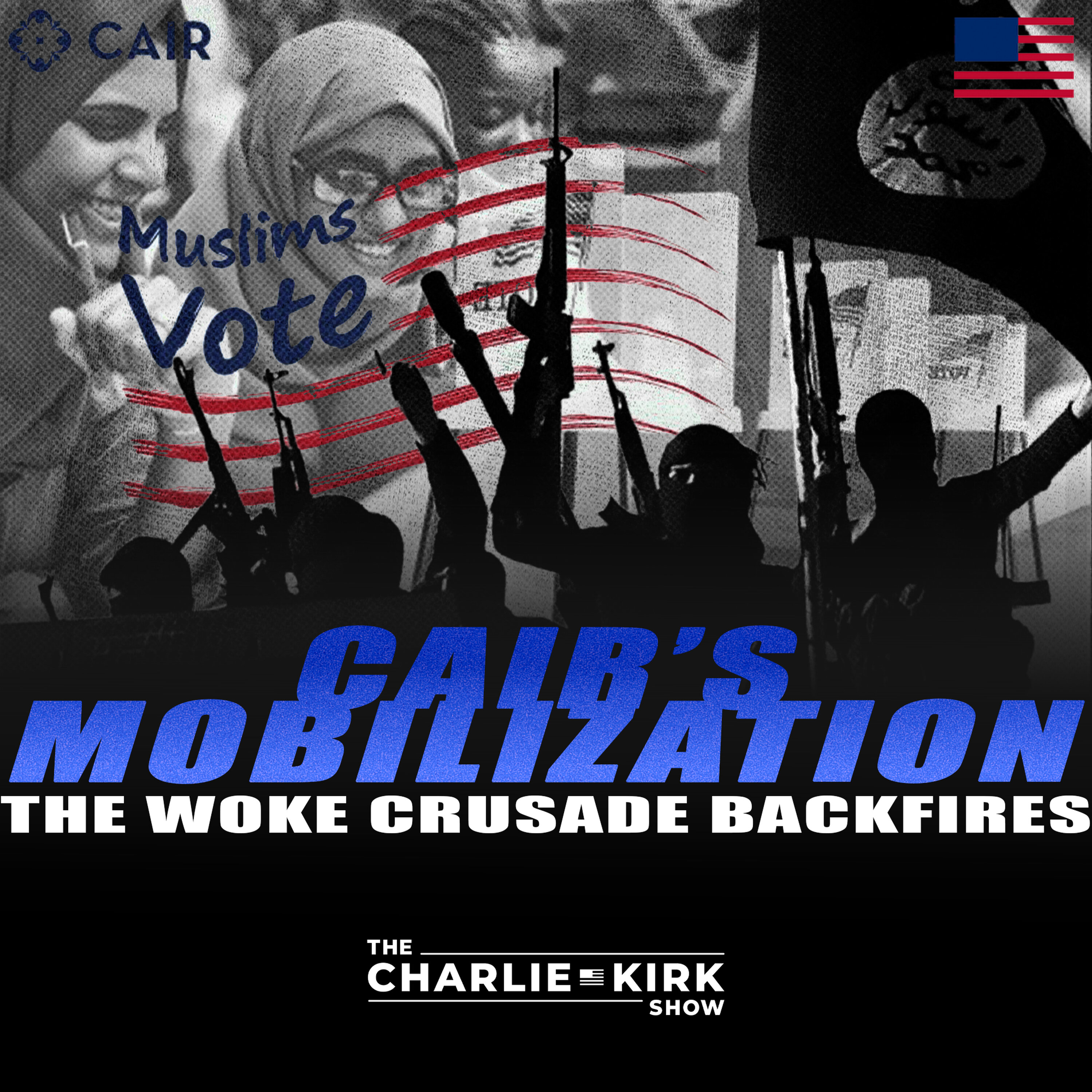
Overview of CAIR’s Mobilization + The Woke Crusade Backfires
This episode of The Charlie Kirk Show is a fast-moving mix of political interviewing, election organizing, and culture-war commentary. The first half focuses on Florida politics and Turning Point’s voter mobilization efforts, especially in key swing states. The second half turns to media accountability, Trump’s clashes with the press, and a long discussion of public education, wokeness, and racial politics through the lens of Colin Kaepernick and Nicole Hannah-Jones.
Byron Donalds on the Florida Governor’s Race
Charlie interviews Rep. Byron Donalds, who is running for governor of Florida, and frames him as one of Charlie’s final endorsed candidates.
Main themes from the conversation
- Donalds says Florida’s election is about preserving the state’s conservative, low-tax, pro-growth model.
- He argues that his opponent, David Jolly, is avoiding debates because his policy agenda is too radical to defend publicly.
- A major issue discussed is property insurance and hurricane risk in Florida.
- Donalds says Jolly’s proposal would amount to a government takeover of wind insurance that would:
- raise premiums,
- add new taxes/fees on homeownership,
- and burden residents with large assessments after storms.
- Donalds presents his own plan as a market-based fix:
- preserve tort reform,
- keep competition high,
- reform permitting and housing rules,
- speed up storm-related permitting,
- and reduce premiums through regulatory cleanup.
Broader political message
- Donalds argues Florida should not copy failed blue-state policies.
- He says Jolly is using the language of moderation while pushing left-wing ideas.
- Charlie repeatedly urges Floridians to vote for Donalds and warns against “turning back” toward big government.
Turning Point Action: Voter Mobilization and the “Freedom Ticket”
Tyler Boyer joins to give an update on Turning Point Action’s field operations.
Key updates
- The organization is hiring and training large numbers of staff and volunteers in:
- Arizona,
- Nevada,
- New Hampshire,
- and other key states.
- The goal is to maximize turnout through door-knocking, texting, voter registration, and ballot-chasing.
New tool: the Freedom Ticket
- Turning Point Action has launched tpaction.com/freedom.
- The tool helps voters plug in their address and see:
- who to vote for,
- ballot measures,
- judges,
- and local races.
- The pitch: many voters know top-of-ticket races but not local contests, so the tool fills that gap.
“Chase 100 ballots”
- Boyer also promotes tpaction.com/100, a volunteer program where supporters help chase 100 ballots.
- Volunteers can:
- go to Arizona, Nevada, or New Hampshire,
- stay in housing provided by the organization,
- and help get low-propensity conservatives to vote.
CAIR, Muslim Voter Mobilization, and Turning Point’s Warning
A major segment of the show centers on Tyler Boyer’s warning that CAIR is mobilizing Muslim voters at scale.
Main claims made in the segment
- Boyer says CAIR is connected to a large voter-turnout operation aimed at mobilizing millions of Muslims.
- The discussion frames this as a significant political force that could affect swing states.
- Charlie and Boyer argue that:
- Democrats are benefiting from this mobilization,
- and Republicans are failing to make the issue urgent enough for voters.
Related immigration and cultural arguments
- The hosts connect this issue to broader concerns about:
- illegal immigration,
- border security,
- and cultural assimilation.
- They also argue that Hispanic voters are often more persuadable on these topics because many value legal immigration, family stability, public safety, and economic opportunity.
- Turning Point says it is increasing Spanish-language outreach in Arizona to communicate on:
- immigration,
- school choice,
- taxes,
- and small-business issues.
Sean Davis on Trump Banning Major Media Outlets From White House Access
Sean Davis of The Federalist joins to discuss Trump’s decision to restrict access for CNN, Politico, and MSNBC/MSNOW.
Davis’s argument
- He says the press has a long history of hypocrisy and hostility toward conservatives.
- He argues that mainstream outlets complained loudly about being excluded, while remaining silent when the Biden administration targeted conservative media.
- According to Davis, the real issue is not the First Amendment but the media’s desire for privileged access and constant visibility.
Why the media is reacting so strongly
- The hosts note that the corporate press sees itself as a kind of moral or priestly class.
- Davis argues they are really acting like a partisan political operation.
- J.D. Vance’s defense is highlighted:
- these outlets are not being “banned,”
- they are being denied special access because they function as propaganda outlets.
Colin Kaepernick, “Woke” Politics, and Nicole Hannah-Jones
The final major conversation is with Helen Andrews, who discusses a new Nicole Hannah-Jones essay and what it says about education, ideology, and the limits of progressivism.
Colin Kaepernick segment
- The show mocks Kaepernick for still describing the NFL as exploitative or slave-like while continuing to seek a return to the league.
- The discussion frames him as:
- attention-seeking,
- politically radical,
- and no longer relevant as an athlete.
Nicole Hannah-Jones and education
Helen Andrews argues that Hannah-Jones’s latest essay reveals:
- she was wrong about what was wrong with public schools,
- but not wrong in a moral sense,
- wrong in an analytical sense.
Core point of Andrews’s analysis
- Hannah-Jones believed the main issue in failing urban schools was funding, integration, or lack of white/middle-class students.
- But her daughter’s experience showed a deeper problem:
- disorder,
- weak discipline,
- and low academic expectations.
- Andrews argues that many parents who leave public schools are making a rational decision, not an evil one.
“Talisman whiteness”
- The conversation repeatedly criticizes the idea that adding more white students will automatically fix dysfunctional schools.
- Andrews says the real remedy is not racial symbolism but:
- discipline,
- stable classroom culture,
- and clear standards.
Bottom line on the school debate
- Andrews and Charlie agree that:
- parents want safety, structure, and quality education,
- public schools often fail because they lack discipline,
- and ideological explanations often obscure practical realities.
Main Takeaways
- Florida politics: Byron Donalds is presented as the candidate who would preserve Florida’s conservative model and oppose big-government insurance schemes.
- Get-out-the-vote work matters: Turning Point Action is treating ballot chasing, voter registration, and local-race education as essential to 2026 and 2028.
- Media distrust is central: Charlie and his guests portray the corporate press as partisan and untrustworthy.
- Culture-war themes remain strong: The episode frames woke politics, racial grievance, and progressive education reform as flawed or collapsing under real-world scrutiny.
- Education is about discipline, not slogans: The discussion of Nicole Hannah-Jones concludes that classroom order and standards matter more than ideological theories about funding or integration.
Calls to Action Mentioned in the Episode
- Support Byron Donalds: ByronDonalds.com
- Join Turning Point Action voter efforts:
- tpaction.com/freedom
- tpaction.com/100
- tpaction.com/app
- Vote and encourage others to vote, especially in key states like Florida, Arizona, Nevada, and New Hampshire.