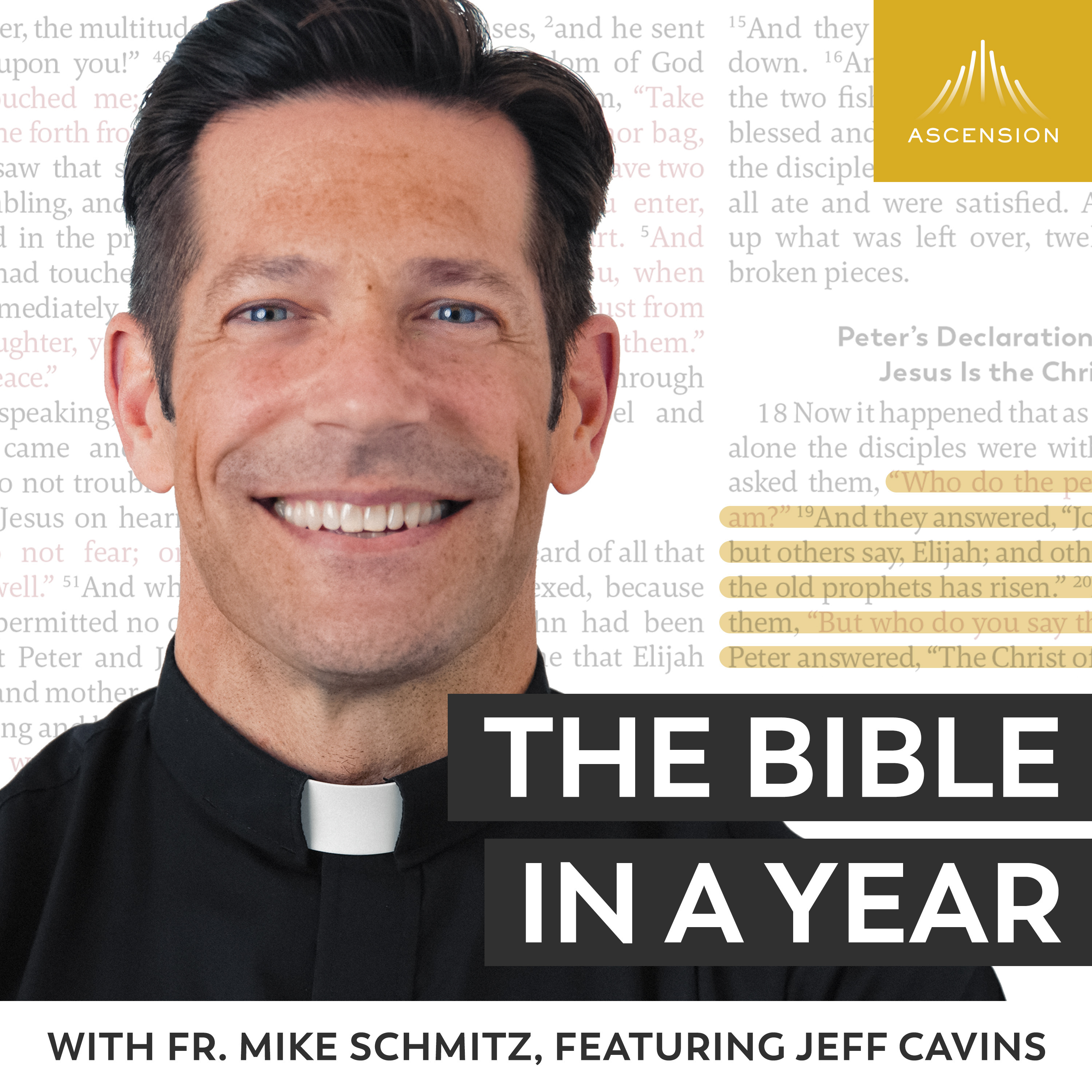
Overview of the Bible in a Year (Day 25: Job's Questioning)
Host Father Mike Schmitz (Ascension) guides Day 25 of the Bible in a Year reading plan. The episode reads and reflects on Genesis 47–48, Job 39–40, and Psalm 16 (RSV-CE, Great Adventure Bible). Father Mike situates Job’s suffering in the wider biblical story, highlights God’s response to Job, and points to the Christian understanding of redemptive suffering in light of Christ.
Readings covered
- Genesis 47–48
- Joseph brings Jacob and his family into Egypt; settles them in Goshen.
- Joseph manages famine relief; Egyptians sell land and become servants to Pharaoh except the priestly lands.
- Jacob (Israel) blesses Pharaoh, requests burial in Canaan, adopts Joseph’s sons Ephraim and Manasseh as his own, and gives Joseph a special inheritance.
- Job 39–40
- God speaks to Job from the whirlwind with a series of rhetorical questions about creation and wild animals (mountain goats, wild donkey, ox, ostrich, horse, hawk, eagle).
- God challenges Job’s ability to govern creation, then describes the “behemoth” as a demonstration of divine power.
- Job responds in humility: “Behold, I am of small account; what shall I answer you?”
- Psalm 16
- A psalm of trust: God as refuge and portion; joy and security in God’s presence; God shows the path of life.
Short chapter-by-chapter synopsis
- Genesis 47–48: Transition of Israel’s family into Egypt, Joseph’s stewardship during famine, consolidation of Pharaoh’s control over land, Jacob’s final acts—blessings, adoption of Ephraim and Manasseh, and instructions about burial.
- Job 39–40: God’s turnaround in the dialogue—He interrogates Job about the wonders of creation to show Job’s limited perspective; a poetic portrait of divine sovereignty (including behemoth).
- Psalm 16: David’s affirmation of trust and delight in the Lord; assurance of joy, security, and life in God’s presence.
Key points and takeaways
- God’s response to Job is not an immediate explanation for suffering but a reorientation: Job is shown his limited perspective amid a vast, mysterious creation.
- The divine questioning reveals that there is a larger, often hidden, story governing suffering—one only God fully knows.
- Suffering can serve multiple purposes:
- A call to repentance
- A path to greater wisdom, compassion, patience, and mercy
- Potentially redemptive—able to be offered for the good of others (Christian reading connects this to Christ’s cross)
- Job’s proper posture is humility and trust before God’s incomprehensible wisdom.
- Psalm 16 reinforces the proper trust and security we place in God amidst uncertainty.
Notable quotes and lines
- Scriptural: “Preserve me, God, for in you I take refuge.” (Psalm 16 opening)
- Job’s humble reply: “Behold, I am of small account; what shall I answer you? I lay my hand on my mouth.”
- Father Mike’s summary lines:
- “God is revealing to Job that there is a bigger story happening.”
- “Some suffering can be redemptive… offered up to God for the salvation of the world.”
- “It is easy to talk about the cross. It is not easy to carry your cross.”
Themes & theological reflections
- Sovereignty and transcendence of God: God’s interrogation emphasizes divine mastery over creation that far exceeds human understanding.
- Limits of human explanation: Friends’ theological shortcuts (suffering = punishment for sin) are inadequate in Job’s case.
- Redemptive suffering: Christianity interprets suffering not only as corrective or formative but also as capable of participating in Christ’s redeeming work.
- Compassionate community: The need for patient, wise support for those who suffer—avoid simplistic judgments or quick answers.
Practical applications / Next steps
- Read the cited passages (Genesis 47–48; Job 39–40; Psalm 16) to hear the texts in context.
- When accompanying someone who suffers:
- Avoid quick theological explanations that reduce suffering to deserved punishment.
- Offer presence, patience, prayer, and humility.
- Reflect on how personal suffering might be offered prayerfully (redemptive view) without minimizing pain.
- Use Psalm 16 as a short prayer of trust when feeling anxious or threatened.
- Follow the Bible in a Year plan (ascensionpress.com/bible-in-a-year), subscribe to the podcast, or text “CATHOLIC BIBLE” to 33777 to join the community (as promoted in the episode).
Final pastoral note (from Father Mike)
God knows the full story even when we cannot. The right response is not silence or smug certainty but humble trust, prayer, and compassionate accompaniment of one another. Father Mike closes by praying for listeners and asking for their prayers in return.