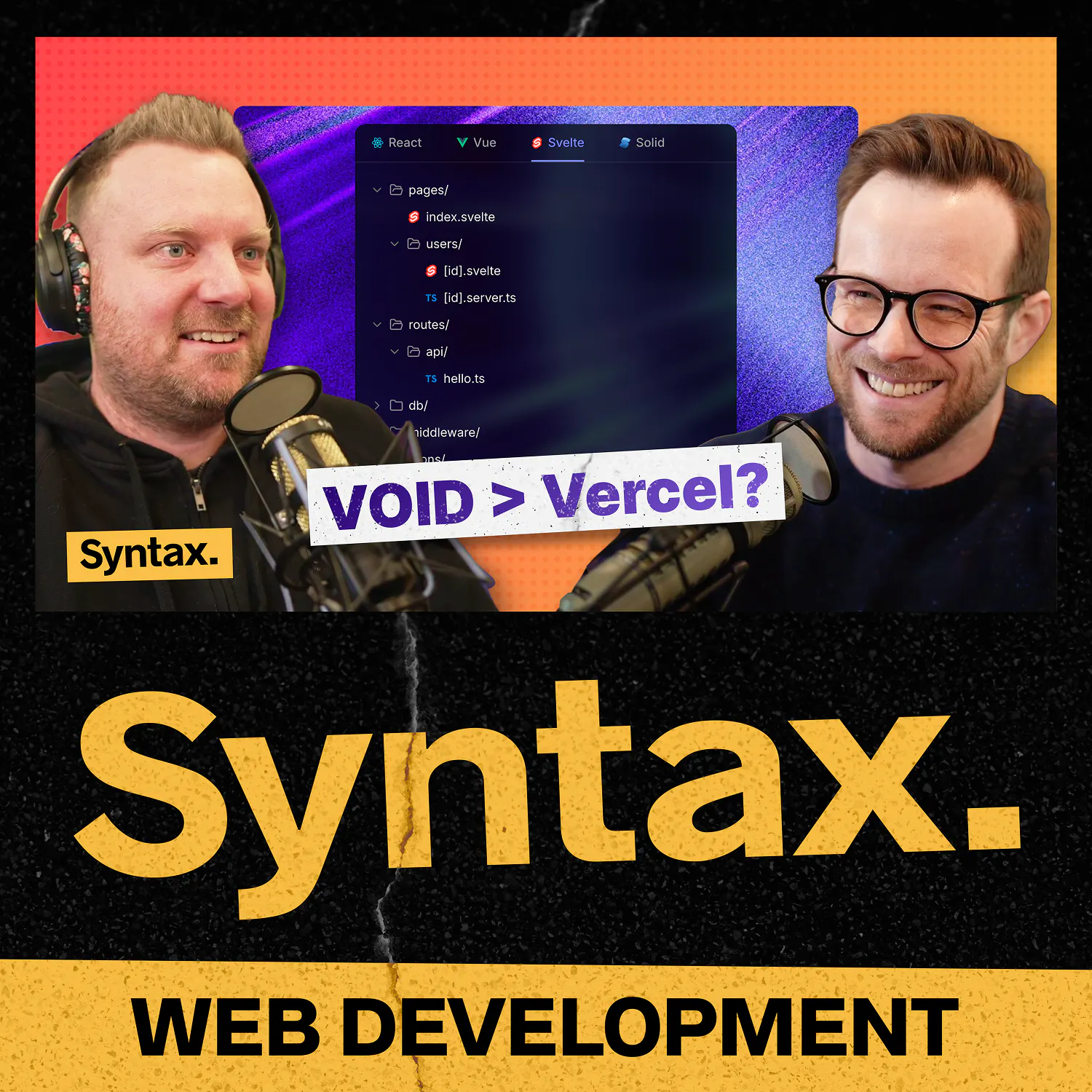
Overview of 991: Vite’s bet on Cloudflare (VOID Framework)
Hosts Wes Bos and Scott Tolinski (with CJ) discuss Void — a new full‑stack framework + deployment product from the team behind Vite (company: Void Zero). Void is delivered as a Vite plugin and a hosting/deployment platform tightly integrated with Cloudflare services. The conversation breaks down what the framework provides, how it works, where it takes inspiration (SvelteKit, Inertia, Rails/Laravel ideas), and the trade‑offs around developer experience vs vendor lock‑in.
Key topics covered
- What Void is: a Vite plugin + deployment platform with a full‑stack opinionated framework.
- How Void maps to Cloudflare services (D1, KV, Workers, Queues, Cron, AI, etc.).
- Core technical building blocks included: Drizzle (ORM), BetterAuth, D1 (SQLite), Hyperdrive (Postgres pooling), Hono runtime.
- API & DX features: typed end‑to‑end types, loaders/actions, RPC‑style calls, server/client type flow, SSR optimizations (no unnecessary network hops).
- Comparisons: Vercel vs Void/Cloudflare, SvelteKit/React/SSR patterns, Rails/Laravel analogies.
- Lock‑in concerns, local dev tooling, self‑hosting questions and pricing unknowns.
- Developer ergonomics: component vs route data fetching, migration/adapter options (Unstorage, adapter layers).
Main takeaways
- Void aims to be a batteries‑included full‑stack experience built around Cloudflare — essentially “unapologetically Cloudflare.” That integration is presented as the reason they can deliver a polished DX.
- It supports multiple view layers (React, Vue, Svelte, Solid), while unifying the backend layer and providing typed end‑to‑end data flow.
- Strong DX: typed API routes, server actions, server/client type inference, and the ability to call server functions directly during SSR (no extra network hop).
- Stack pieces are modern and popular (Drizzle ORM, BetterAuth), which lowers migration pain for parts of the stack.
- Significant trade‑off: tight Cloudflare coupling makes a smooth, feature‑rich experience possible but increases vendor lock‑in for certain services (D1, durable objects, queues, Cloudflare AI).
- Some parts are less “locked”: using Drizzle, BetterAuth or abstracted storage adapters (Unstorage) can make moving away easier.
Technical details and components
- Framework + plugin: Void exposes itself as a Vite plugin and a deploy platform. Can act as standalone full‑stack framework or be used alongside SvelteKit, Nuxt, etc. (with caveats).
- Runtime & server: built on Hono (web‑standard handlers), outputs Cloudflare Workers.
- Database/ORM:
- Drizzle ORM built in.
- D1 (SQLite) supported for Cloudflare worker environment.
- Postgres support via Hyperdrive (connection pooling/edge optimization).
- Auth: BetterAuth integrated as the default auth library.
- KV / storage: Cloudflare KV accessible; Unstorage adapters can provide an abstraction to swap backends.
- Background jobs & other infra: Queues, Cron, Cloudflare AI and Durable Objects supported — these are useful but also higher‑lock‑in.
- DX features:
- Separate .server files for loaders/actions similar to SvelteKit.
- Client fetches can be typed and, when running on server, invoke server functions directly (RPC‑like behavior).
- Supports both route‑level loaders and component‑level data fetching patterns (React server components / Svelte async patterns discussed favorably).
Pros (what’s appealing)
- Excellent developer experience — typed flows, built‑in auth, DB, KV, queues, cron, and server actions.
- Choice of UI frameworks (React/Vue/Svelte/Solid) while keeping the backend unified.
- Batteries‑included approach makes it easy to bootstrap full‑stack apps quickly (good for “vibe”/indie devs or teams wanting fast DX).
- Likely to offer a polished deploy + management UX (a Cloudflare‑native Vercel competitor).
- Many pieces use modern, portable libraries (Drizzle, BetterAuth) which can ease migrations.
Cons / concerns (what to watch)
- Intentional Cloudflare lock‑in: Void’s value proposition is coupling to Cloudflare to provide special DX — that makes migration harder for Cloudflare‑specific services (D1, durable objects, queues, some AI integrations).
- Unclear self‑hosting/BYOC story: unknown whether you can deploy Void apps to your own Cloudflare account or must use Void’s managed cloud.
- Local dev/data story: tight bindings may complicate local DB, third‑party tooling, or libraries that require native binaries (e.g., Sharp).
- Pricing uncertainty: Cloudflare may raise prices or the Void managed layer could introduce a significant premium vs using Cloudflare directly.
- Some developers (esp. those who need portability or run on other runtimes) may find the lock‑in unacceptable.
Lock‑in analysis (service by service)
- Low-ish lock‑in: Drizzle ORM, BetterAuth (library level) — these are portable; rehosting/migrate possible.
- Moderate lock‑in: KV and storage — if Void leverages Unstorage adapters, swapping backends is straightforward; otherwise migration is manageable.
- High lock‑in: D1 (Cloudflare SQLite binding), durable objects, queues, Cloudflare AI — these rely on Cloudflare worker‑specific features or proprietary services and are harder to migrate.
- Overall: Void is designed to be “unapologetically Cloudflare.” If you accept Cloudflare lock‑in in exchange for strong DX, Void is attractive. If portability is essential, proceed cautiously.
Developer experience & architecture notes
- Unifies backend API regardless of frontend framework, which reduces the need to choose a meta‑framework per UI library.
- Supports typed client access to API endpoints (autocompletion in the editor) and server‑side short‑circuiting of fetch calls during SSR.
- Favors a server‑centric model (Inertia-like) but supports both route loaders and component‑level data fetching/RPC patterns. Hosts prefer component loaders/server components for better composability.
- Uses Hono runtime (web standards), which makes request/response handling portable among web‑standard runtimes.
Use cases where Void makes sense
- New projects where speed of iteration and developer ergonomics matter more than long‑term portability.
- Small teams, startups, or indie devs who want a single integrated stack (DB, auth, queues, cron) with minimal ops friction.
- Projects targeting edge/Cloudflare benefits (low latency via edge functions, Cloudflare specific features).
- Prototyping apps or dashboards where batteries‑included hosting accelerates MVP delivery.
Questions and unknowns the hosts highlighted
- Can you self‑host Void on your own Cloudflare account (BYOC) or must you use the Void managed cloud?
- How big will the Void managed premium be vs using Cloudflare directly?
- How robust is the local/dev data story (local emulation of D1, image APIs, native bindings)?
- How complete are the features now vs in roadmap — some parts look not fully built yet.
- How well will Void integrate with non‑Cloudflare runtimes (Electron, Tauri, local apps), given Workers output vs Node runtime differences?
Recommendations / action items for listeners
- If you’re curious: try the Void plugin in a small prototype to evaluate the DX and see how it fits your workflows.
- Audit what parts of your app would rely on Cloudflare‑specific services (D1, queues, durable objects) before committing.
- If portability matters, prefer portable libraries (Drizzle, BetterAuth, Unstorage) and plan adapter layers.
- Watch Void’s documentation for BYOC/self‑host guidance and pricing details before migrating production apps.
- Provide feedback to the Void team — they appear to be listening and iterating based on community reactions.
Notable quotes / insights
- “Unapologetically Cloudflare” — Void’s approach is explicit: DX comes from tight Cloudflare integration, and they’re upfront about the trade‑off.
- Wes: “This is like a Laravel or Rails for JavaScript” — partially true: Void bundles many infrastructure pieces and opinions but isn’t as prescriptive as a full Rails ORM+convention stack.
- The hosts repeatedly praise component‑level data fetching (React server components / async Svelte) — they prefer it over strictly route‑level loaders.
Final summary
Void represents a strong DX play: an opinionated, Vite‑native framework + deploy platform that leverages Cloudflare’s edge services to offer a fast, integrated full‑stack experience. It lowers friction for building full‑stack apps (typed APIs, built‑in auth, DB, queues, cron) but does so by embracing Cloudflare‑specific bindings. If you value developer experience and are comfortable with Cloudflare dependency, Void could be compelling. If portability, BYOC, or long‑term vendor independence is critical, evaluate migration paths first (use portable libraries/adapters) and wait for more clarity around self‑hosting and pricing.