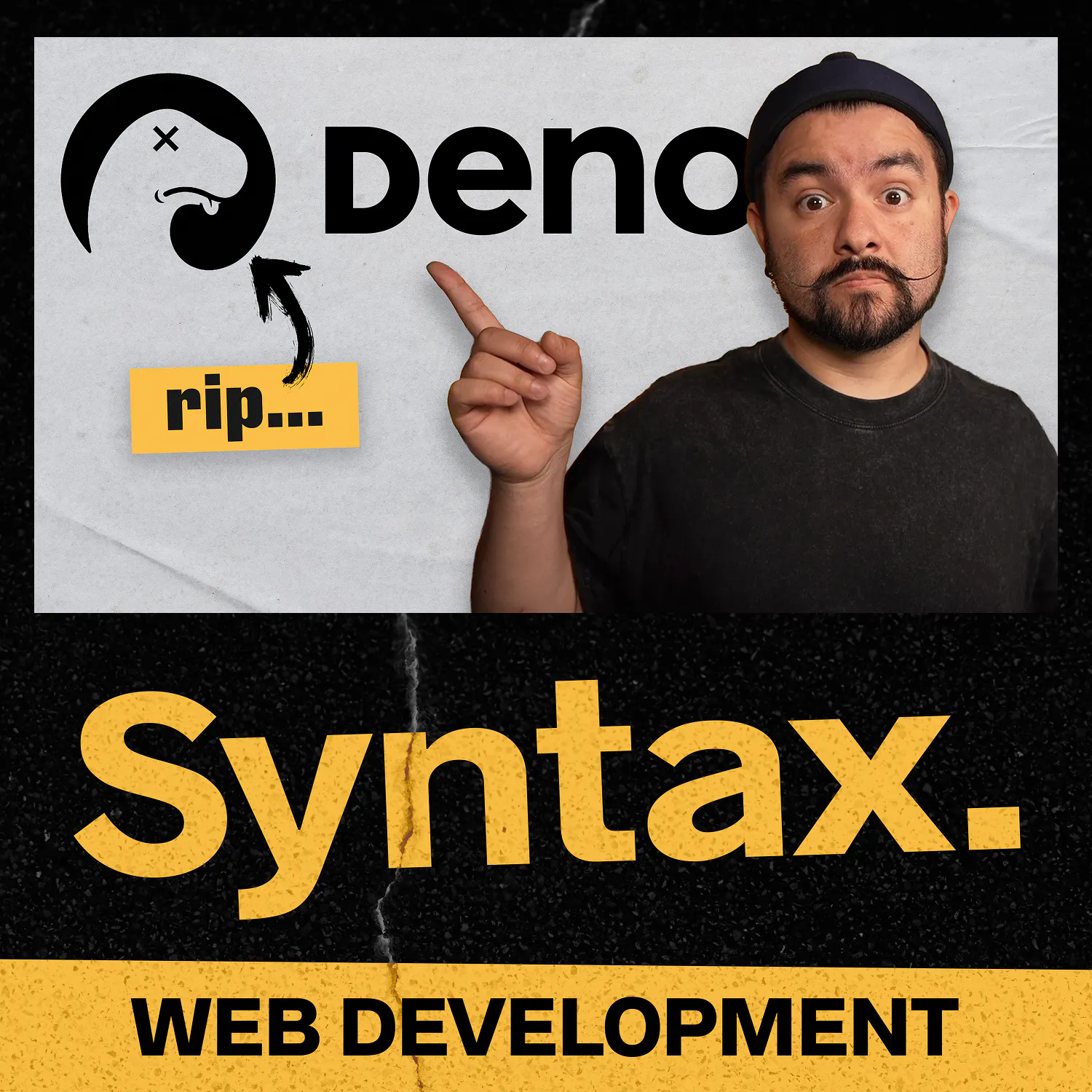
Overview of 1048: Deno Is Dead
This Syntax Live episode was packed with rapid-fire coverage of major JavaScript/runtime news, a wave of new AI model releases, and a surprisingly viral hardware hacking project involving cheap Android photo frames. The big headline was that Deno has been acquired by Cloudflare and will be sunsetted as a runtime over the next year, with Ryan Dahl shifting focus to WorkerD and Cell D. The hosts also dug into OpenCode 2.0, several new “decision” and frontier models, TanStack Start 1.0, file-search tooling drama, and a few other notable developer experiments.
Biggest News: Deno Is Ending, Cloudflare Is the New Home
What happened
- On October 9, it was announced that Deno is joining Cloudflare.
- The Deno runtime will receive monthly bug/security updates for one year, then development will end.
- Deno Deploy will continue for six months before shutting down.
- JSR will continue operating, with infrastructure moving to Cloudflare.
- Rusty V8 support will continue as well.
Why it matters
- Ryan Dahl is moving fully into WorkerD / Cell D work at Cloudflare.
- The hosts framed this as bittersweet:
- They were sad to see Deno fade out after years of effort.
- But they also see Cloudflare as the best place for this runtime philosophy to evolve.
- Their consensus: Deno won’t disappear overnight, and open source/community stewardship could keep parts of it alive.
Takeaway
- If you rely on Deno in production, plan a migration path.
- The likely destination for many teams is Cloudflare Workers / WorkerD / Cell D.
AI Model Roundup: New Releases, Mixed Impressions
Gemini 4 Argon
- Google’s new frontier model was released during the show, and all three hosts had early access.
- Their verdict was underwhelming compared to the hype:
- Good at some tasks.
- Often edited unrelated files.
- Felt like it needed more babysitting than models like Claude Opus or Astra/Fable.
- Wes and Scott both said it felt more like a “good but not special” model.
Muse Wonder, Haiku 5.5, and Embedding Gemma 2
- Muse Wonder was mentioned as Meta’s new model; the hosts didn’t feel strongly compelled to adopt it.
- Haiku 5.5 now supports different thinking levels.
- Embedding Gemma 2 is a new embedding model from Google that supports text, images, and audio for semantic search / RAG use cases.
Subquadratic Snap vs. Jev
- The hosts highlighted Subquadratic Snap as a serious Jev competitor:
- Supports images and text.
- Very large context window.
- Very low latency and low cost.
- Their impression: Jev created the market, but competitors are already catching up fast.
Main AI takeaway
- The model landscape is moving extremely quickly.
- The hosts repeatedly emphasized that price, speed, and reliability are becoming just as important as raw benchmark performance.
OpenCode 2.0 and the Rise of Durable Agent Workflows
What’s new in OpenCode 2.0
- Major architecture overhaul.
- Now runs as a single background process shared across web, desktop, and CLI.
- Adds:
- An updated effect-based client
- Background tasks
- Better plugin support
- Hot reloading for plugins
Why the hosts liked it
- They were especially excited about:
- Being able to keep chatting while subagents are still running.
- Shared state across interfaces.
- Durable backends for agent workflows.
Bigger theme
- This episode strongly reinforced the idea that agent systems are moving toward durable, persistent infrastructure, often backed by:
- Cloudflare Durable Objects
- Worker-style runtimes
- Long-lived session/process models
Related project: Talaris
- A personal AI agent built in a user’s own Cloudflare account.
- Includes chat, memory, tasks, notes, and reminders.
- Uses Durable Objects + SQLite and can run on the free tier.
Wes’s Viral Photo Frame Hack
What he built
- Wes showed off his project hacking cheap Android photo frames into useful wall displays.
- These devices:
- Cost around $50
- Run old Android versions
- Often just need a few tweaks to become powerful little screens
What the community did
- The project went viral over the weekend.
- Thousands of people bought the same frame.
- Developers contributed fixes for different hardware variants.
- Wes described it as a kind of agent-driven open source swarm, where people used their own agents to reverse engineer and improve support.
What people are doing with them
- Digital calendars
- Smart home dashboards
- Photo displays
- Air quality monitors
- Printer-like output screens
- Even custom widget dashboards controlled by agents
Security note
- Wes still keeps the device on a guest network.
- He’d prefer a full wipe and a lower-level Linux install, but for now it’s a hacked Android-based screen.
TanStack Start 1.0 Is Stable
What changed
- TanStack Start 1.0 is officially stable.
- It’s a full-stack framework for React and Solid.
- Known for:
- Type safety across the stack
- Streaming and SSR
- Better control over client vs. server rendering
- Easier responsive, dashboard-style UX
Host take
- Wes is a big fan and uses it by default in many projects.
- Scott prefers Svelte/SvelteKit but respects the direction.
- They also noted TanStack’s careful architectural decisions, especially around:
- Not blindly adopting React Server Components
- Supporting client-only builds cleanly
File Search Drama: FFF vs. F Search
The players
- FFF: a very fast file search SDK used in tools like OpenCode.
- F Search: a new CLI/file-search tool claiming major speed improvements.
- A third-party fork brought F Search into TinyCast, skipping Spotlight indexing.
The drama
- The FFF author was very active on Twitter and criticized F Search.
- The F Search author replied explaining the design tradeoffs.
- Replies were hidden, which only made the argument more entertaining.
Why the hosts cared
- macOS Finder search and Spotlight are notoriously bad and slow.
- Fast local search is a real productivity boost.
- They liked the idea of replacing Spotlight indexing entirely for some workflows.
AirDrop, OmDrop Owl, and Apple Ecosystem Frustrations
What was discussed
- A reverse-engineered AirDrop replacement called OmDrop Owl was highlighted.
- The hosts missed:
- AirDrop
- Shared clipboard
- Continuity-style workflow between Mac and iPhone
Why it matters
- They both want cross-device handoff and clipboard sharing to “just work” across platforms.
- They also noted how much Apple ecosystem convenience still keeps them locked in.
Notable Side Projects and Tools
Light Bulb Computer
- A concept device: a ceiling-mounted light bulb with a projector inside.
- Intended to project interfaces onto walls, counters, and nearby surfaces.
- The hosts liked the idea but noted current projector limitations.
AnyPS5 / PS2 Web Recomp / PSP Web Recomp
- Projects that recompile console game binaries for Linux, Windows, or even the web.
- Not emulation in the traditional sense.
- The hosts found this wild and slightly surreal.
Bootstrap 6 Alpha
- Bootstrap 6 is now in alpha.
- The big joke: “real buttons are back.”
- The hosts were amused but skeptical about how much relevance Bootstrap has in a Tailwind/AI-generated UI world.
Key Takeaways
- Deno’s runtime era is ending, but its ideas are continuing inside Cloudflare’s stack.
- Agent workflows are becoming durable, multi-surface, and stateful.
- The AI model race is no longer just about “best model” — it’s about cost, latency, context length, and practical workflow fit.
- Cheap hardware can become surprisingly useful when paired with open source tooling and agents.
- A lot of “old” developer pain points — file search, sync, dashboard displays, AirDrop-like sharing — are being revisited with new tools and better infra.
Action Items / Things to Watch
- If you use Deno, start planning for a migration.
- Check out OpenCode 2.0 if you want a durable agent workflow.
- Watch for more progress in:
- Cloudflare WorkerD / Cell D
- Durable Objects-based apps
- Decision models like Snap
- Local semantic search and better file indexing tools
- If you want a fun hardware project, the cheap Android photo frame hack is clearly the episode’s most viral DIY idea.