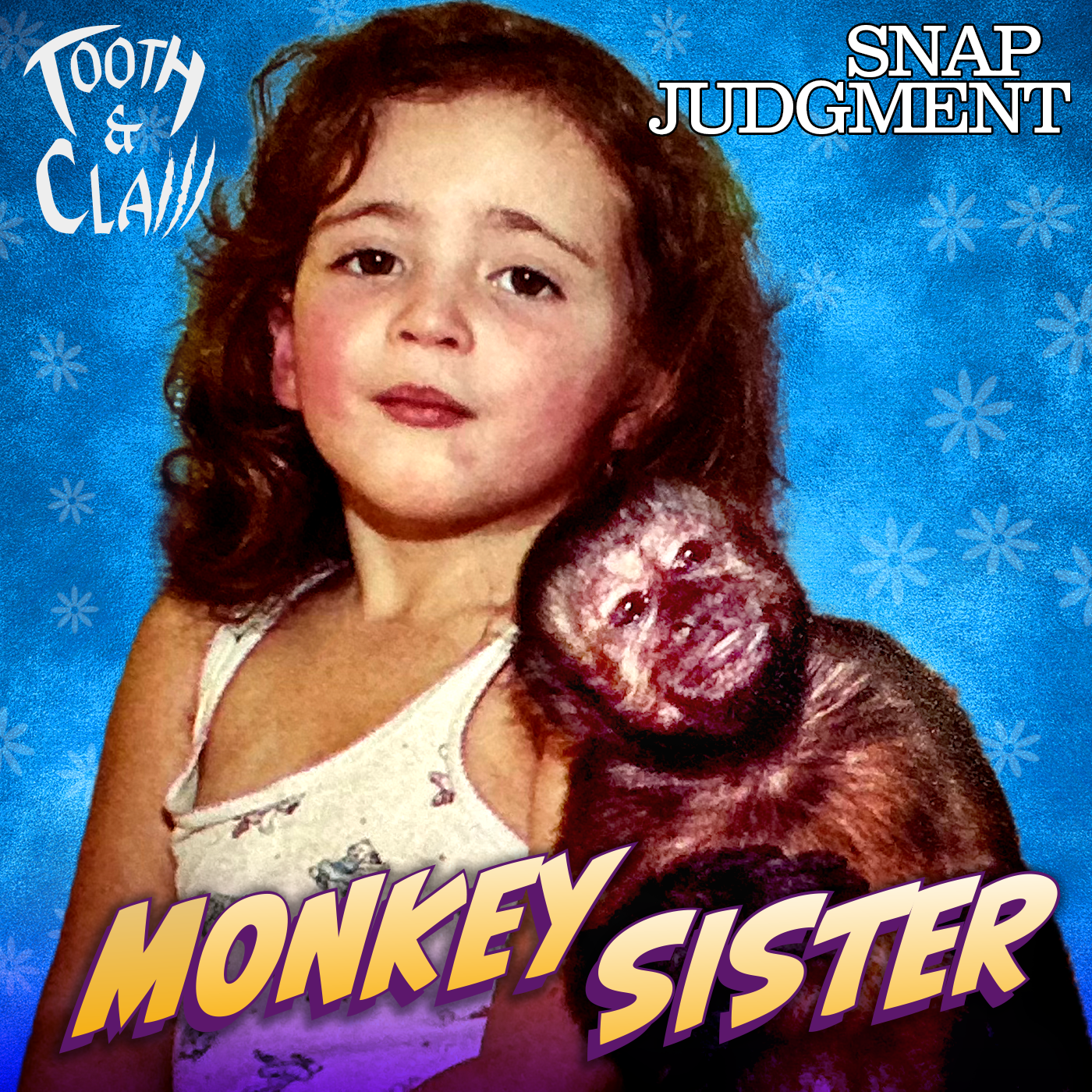
Overview of Monkey Sister — Tooth & Claw
This Snap Judgment episode (Tooth & Claw series) tells two true, vividly told stories about deep, strange human–animal relationships. The main piece, “Monkey Sister,” follows Hannah Freeman growing up with Amelia, a capuchin monkey who functioned as a family member — then a rival. The second story profiles jockey/trainer Tim Snyder and Lisa’s Booby Trap, a racehorse Snyder believes carried the spirit and traits of his late wife. Both pieces explore interspecies bonds, hierarchy, grief, and how animals shape human lives.
Episode structure & participants
- Host/curator: Snap Judgment (presented by PRX).
- Main story: Hannah Freeman (daughter who grew up with Amelia the capuchin).
- Secondary story: Tim Snyder (horse trainer/jockey) about Lisa’s Booby Trap.
- Production notes: Score by Renzo Gorio; producers/editors credited in episode. Hannah’s memoir Everything Sucks and Tim’s book The Ghost Horse referenced.
Main story — “Monkey Sister” (Hannah & Amelia)
Origin
- Amelia, a malnourished, coin- and cigarette-obsessed capuchin found on a merchant ship from Egypt, was rescued by Hannah’s mother (a zoologist/vet tech) from a lab program and taken home.
- Amelia had been declawed/teeth-removed by prior owners and was too damaged for sanctuary placement. She bonded closely with the family and even funded the house down payment via work in entertainment (movie/TV appearances).
Childhood
- Amelia was treated and perceived as a sibling rather than a pet: shared meals, toys, grooming, and public celebrity status (appeared on TV and in a movie).
- As a child, Hannah loved and enjoyed Amelia; the monkey was an asset socially (novelty, attention) and emotionally (playmate).
Adolescence — conflict and hierarchy
- As Hannah hit puberty, Amelia’s behavior shifted: stealing food/lipstick, teasing, ambushing (hiding behind doors/toilet), aggressive teasing and biting, and deliberate antagonism toward Hannah.
- The episode explains primate social behavior: capuchins operate by dominance hierarchies. Amelia saw teenage Hannah taking her place in the female hierarchy and began testing/subverting her.
- Family dynamics complicated intervention: parents encouraged Hannah to assert herself; Hannah struggled to stand up to a clever, physically daring monkey. The situation produced mixed emotions: resentment, embarrassment, and bafflement.
Climax — the mosquito-net/candle incident
- Hannah planned a romantic, private moment with her boyfriend in a candlelit bedroom blocked from Amelia by a locked door and netting. Amelia broke in, got tangled in the mosquito netting, which caught fire from the candles, creating chaos.
- The monkey escaped, defecated on the bed (a triumphant, humiliating act for Hannah), and left the family stunned. The incident crystallized Hannah’s desire to leave the house and not be defined by “the monkey girl.”
Aftermath & death
- Hannah moved away (to LA), distanced herself, and eventually Amelia aged and grew frail. The family anticipated her death; Amelia died in bed in her owner’s arms.
- The family gave Amelia a ceremonial, human-style send-off: open-casket funeral with props, portrait, and community attendance — a dignified, theatrical farewell.
- Posthumous twist: while swiping on a dating app, Hannah super-swiped a man pictured with a capuchin; he is now her husband. She sees this as Amelia’s final, mischievous blessing.
Secondary story — Tim Snyder & Lisa’s Booby Trap (the horse)
- Snyder, raised in racetrack life, lost his wife Lisa to cancer; she had said she’d “come back as a horse.”
- He later bought an overlooked, handicapped mare with one eye and foot issues, named Lisa’s Booby Trap. Through corrective care and training, the mare became an unexpectedly dominant racehorse (notable Saratoga wins, local awards).
- Snyder believes the horse mirrored his late wife’s spirit, responsiveness, and resilience. He refused multimillion-dollar offers to sell her, retired her at her peak, cared for her daily, and later bred her. He interprets their connection as near-reincarnation and emotional continuity.
Themes & takeaways
- Interspecies relationships can be deeply familial and emotionally complex; animals may fill roles beyond “pet” (sibling, partner, surrogate).
- Animal social behavior (primates’ dominance hierarchies; horses’ sensitivity to humans) can create real interpersonal conflicts when animals live as part of human family systems.
- Ethical and practical complications of keeping wild animals as pets: rescue and rehabilitation can bond animals to humans in ways that make sanctuary or reintegration difficult.
- Grief and closure around animal death can mirror human mourning rituals; communities may ritualize animal loss in human terms.
- Animals can continue to influence human lives after death — sometimes in ways people interpret as fate or meaningful coincidence.
Notable quotes / memorable lines
- “My monkey sister was real.” — Hannah, underscoring how family identity can include nonhuman members.
- “She had the last laugh… I bought the house and I got you your husband.” — Hannah, wry reflection about Amelia’s ongoing influence.
- “She is going to be back. I’m coming back as a horse.” — Lisa (as recalled by Snyder), framing the horse story’s emotional premise.
Ethical considerations & practical recommendations (implicit)
- Capuchin monkeys are intelligent and socially complex; keeping them as household pets can create welfare and safety issues and complicated social dynamics. Sanctuary placement is generally preferred but not always possible after human imprinting.
- If working with or rescuing wild/entertainment animals, consider long-term care responsibilities and the animal’s social needs before domestic integration.
Where to learn more / credits
- Hannah Freeman’s memoir: Everything Sucks (linkable via snapjudgment.org).
- Tim Snyder’s story: The Ghost Horse (available via episode webpage).
- Production: original score and sound design by Renzo Gorio; produced and edited by Snap Judgment staff (credits read in the episode).
This episode blends humor, discomfort, and tenderness to show how animals can be woven into family life — sometimes lovingly, sometimes antagonistically — and how those bonds reverberate across a lifetime.