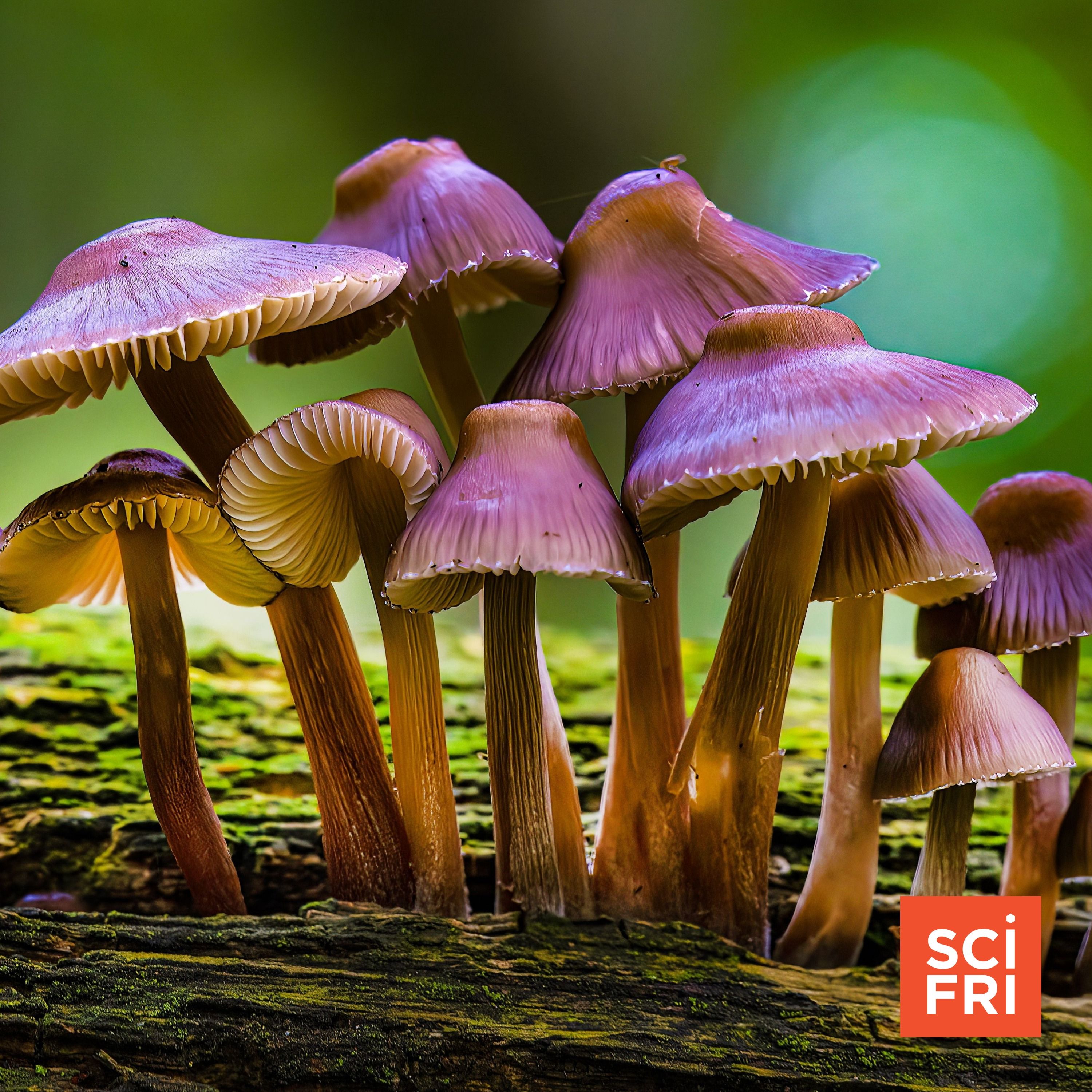
Overview of Why it's so hard to tell the age of a fungus
This Science Friday segment explores why fungi are so difficult to age, even when they form massive underground networks that may have been growing for thousands of years. Host Flora Lichtman speaks with Dr. Christine Alaclet, a researcher at Lund University, about the challenges of defining a “single” fungal organism, estimating fungal age, and why understanding fungal life histories matters for ecology, conservation, and agriculture.
Main Ideas
Fungi are hard to age because they don’t grow like animals or trees
- There is no universal “tree ring” equivalent for fungi.
- Fungal bodies can:
- grow,
- break down,
- recycle their own material,
- and regenerate in ways that make size a poor proxy for age.
- Since fungi include millions of species, any aging method would likely need to be species-specific.
Scientists use indirect clues to estimate fungal age
- One method tracks how a fungal disease spreads between trees over time.
- Another uses fairy rings, where growth patterns visible above ground can be measured over years.
- Old satellite images have also been used to estimate how long some fungal rings have been present.
- These methods can suggest growth rate, but they do not reliably reveal the true age of an organism.
The famous Oregon fungus may be thousands of years old
- The segment references a fungus in Oregon covering about 965 hectares.
- Based on observed spread rates, it has been estimated to be as old as 8,650 years.
- Researchers think similarly ancient fungi may exist elsewhere, but many have simply not been studied closely.
Christine Alaclet’s Research
Using microfluidic chips to study fungal behavior
- Alaclet’s team uses tiny chip-based systems with channels carved into silicon.
- These chips act like miniature mazes where fungal mycelium can grow under controlled conditions.
- Researchers can then introduce stimuli and observe how fungi respond over time.
Different species “recycle” themselves differently
- Some fungi leave behind a lot of empty mycelium after withdrawing contents from their hyphae.
- Others break down the mycelium more completely and reuse the material to grow new structures.
- This shows that fungi that may look similar in nature can have very different internal life strategies.
Why fungal age matters
It affects conservation and biology
- Scientists still do not know:
- when fungi reach maturity,
- when they begin reproducing,
- or whether reproduction changes across a fungus’s lifespan.
- These gaps matter for protecting rare or endangered fungi.
- Age and life cycle knowledge could help determine how to conserve fungal species and manage fungal cultures in labs or industry.
It raises deeper philosophical questions
- The conversation touches on what counts as:
- an individual organism,
- age,
- and even behavior in fungi.
- Alaclet is interested not just in fungal biology, but in understanding what it is like to be a fungus and how fungi interact with their environments.
Key Takeaways
- Fungal age is extremely hard to determine because fungi can continually rebuild and recycle themselves.
- Existing methods mostly estimate spread, not true age.
- Some fungi may be far older than we realize, including enormous underground networks.
- New lab technologies are helping scientists study fungal growth, behavior, and self-renewal in more detail.
- Understanding fungal life histories is important for ecology, conservation, agriculture, and basic biology.
Notable Insight
- “What is it like to be a fungus?”
The interview frames fungal research as both a scientific and philosophical challenge: to understand not just how fungi grow, but how they live, persist, and adapt over time.