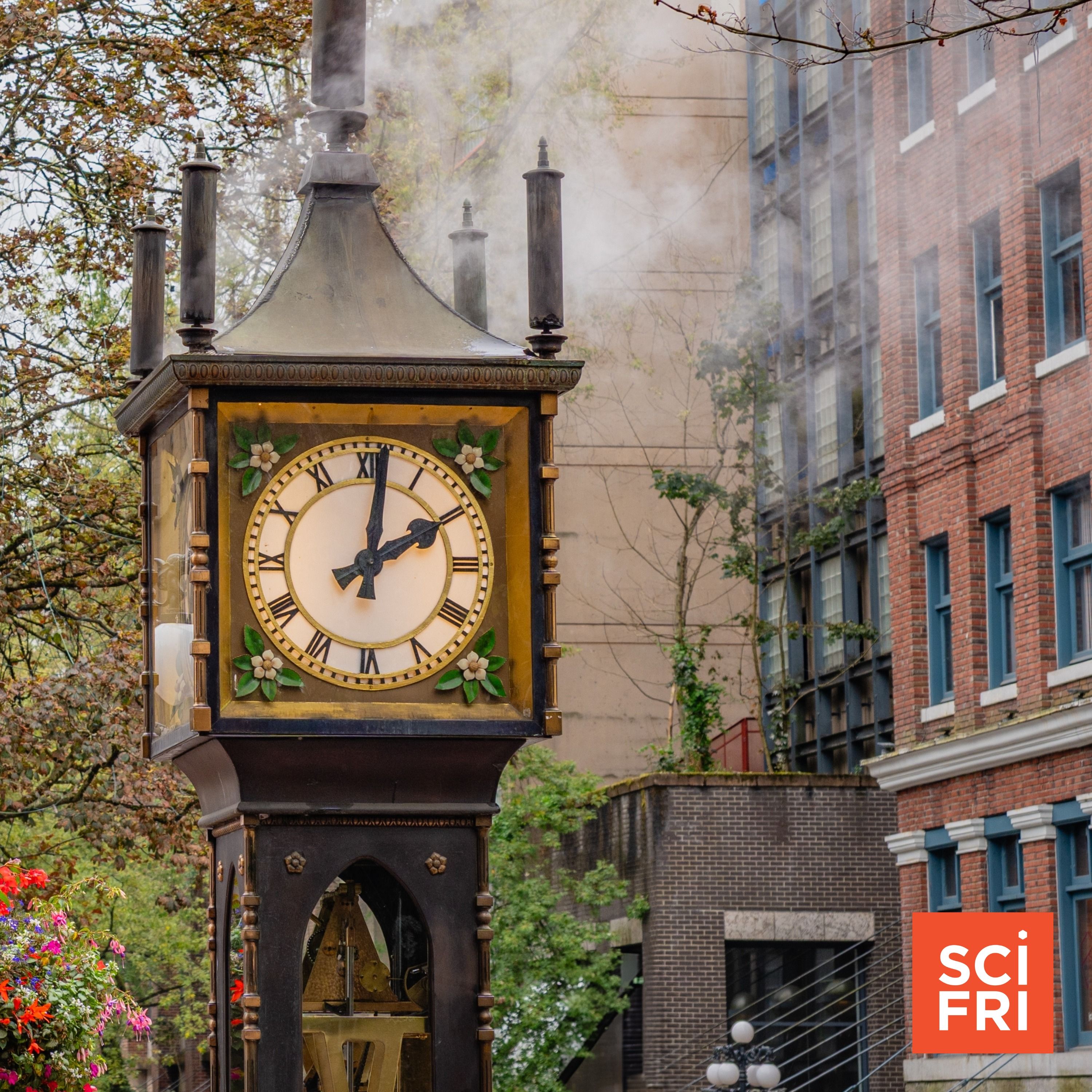
Overview of Why are we changing the way we keep time?
This Science Friday episode explains why global timekeepers decided to end the leap second, a long-standing correction used to keep atomic time aligned with Earth’s slightly irregular rotation. The discussion explores how modern timekeeping works, why leap seconds caused problems for computers and critical infrastructure, and why some scientists were hesitant to disconnect civil time from the motion of the Earth.
What the episode is about
- The world has historically kept time by syncing clocks to Earth’s rotation.
- Because Earth’s spin varies, scientists occasionally added a leap second to keep Coordinated Universal Time (UTC) aligned with astronomical time.
- A global committee recently voted to eliminate leap seconds, meaning civil time will gradually drift away from Earth’s rotation.
- The episode features:
- Emma Gomez of Scientific American
- Dr. Judah Levine of the University of Colorado Boulder and JILA
How time is measured today
Atomic clocks and UTC
- More than 90 labs worldwide maintain highly precise atomic clocks.
- Those labs send data to the BIPM (International Bureau of Weights and Measures) in France.
- The BIPM combines the data into the official record of UTC.
- The fundamental reference comes from cesium atoms, which oscillate at a fixed frequency:
- 9,192,631,770 oscillations per second
Why leap seconds existed
- Earth’s rotation is not perfectly stable; it can speed up or slow down.
- When UTC drifted too far from Earth’s rotation, a leap second was added to bring them back into alignment.
- This kept clocks closer to the Sun/Earth-based sense of time people historically used.
Why leap seconds were removed
They were hard for machines to handle
- Leap seconds create a discontinuity in time.
- Computers and networks rely on smooth, predictable timestamps.
- A sudden extra second can cause:
- software bugs
- message-timing errors
- outages in systems like DNS, cloud services, social platforms, and telecom infrastructure
They were unpredictable
- Unlike leap days, leap seconds could not be scheduled far in advance.
- That made them difficult to program into systems permanently.
- Timekeepers and engineers had to manage them manually.
Concern about a negative leap second
- Earth began spinning faster around 2016–2017, raising the possibility of a negative leap second for the first time.
- That possibility helped push the debate toward ending leap seconds altogether.
Why some experts objected
The historical link to astronomy
- Time has long been tied to the sky, the Sun, and the stars.
- Many cultural and religious traditions connect timekeeping to astronomical motion.
- Some scientists and institutions worried that fully separating civil time from Earth’s rotation would sever an important historical link.
Applications that depend on Earth time
- Certain systems still care about UT1, the measure based on Earth’s actual orientation relative to the stars.
- Those users wanted to preserve some connection between civil time and astronomical time.
What happens now
- Civil time will stay based on atomic clocks and UTC without leap seconds.
- Over time, it will drift farther from Earth’s rotation.
- The drift is slow:
- roughly a minute per century
- In the distant future, the mismatch could become large enough to matter more, but that is expected to be far off.
Key takeaways
- Leap seconds are ending because they were disruptive and difficult for modern technology.
- Atomic clocks are now the backbone of global timekeeping.
- The decision prioritizes stability and predictability for computers, communications, and navigation.
- Time will gradually become less tied to the Earth’s rotation and more purely a standardized human system.
- Experts emphasize this is a long-term change, not an immediate crisis.
Notable insight
“Time is something of a democratic process.”
Emma Gomez describes how timekeeping is built from a global network of labs rather than a single authority, highlighting how standardized time is one of the invisible systems holding modern life together.