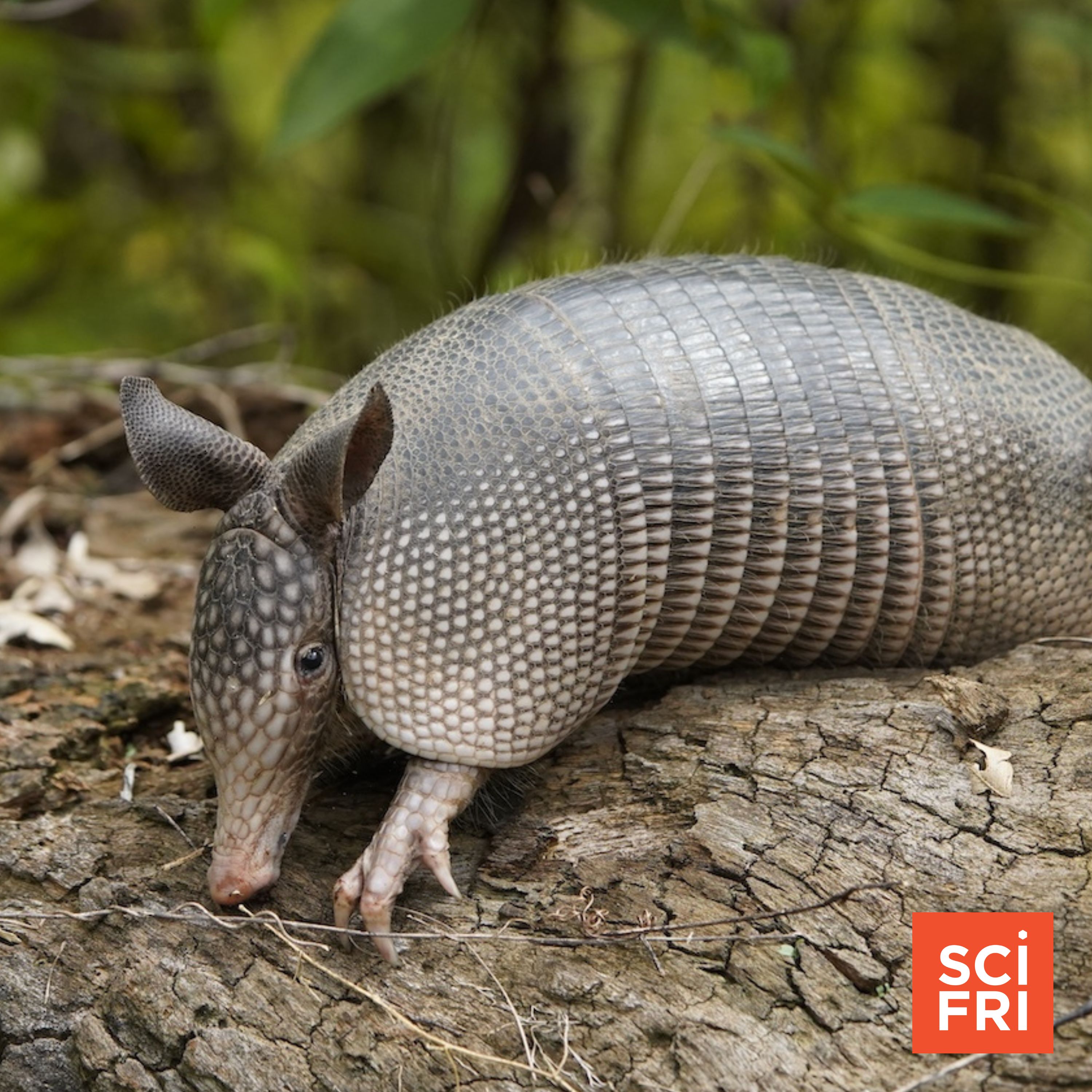
Overview of Why are armadillos moving up north?
This Science Friday segment explores why nine-banded armadillos are rapidly expanding their range into places like Kentucky, Indiana, Illinois, and beyond, and what their spread says about changing ecosystems. Reporter Giselle Roden explains that armadillos are acting as a signal species—an animal whose movement reflects environmental change, especially warming temperatures. The episode also digs into the armadillo’s unusual biology with mammalian evolutionary biologist Anderson Feijó, highlighting the species’ armor, surprising diet, defense behaviors, and reproductive quirks.
Why armadillos are moving north
- Armadillos are spreading north on their own; they were not introduced by people.
- In Kentucky, the first known sightings were in 1986 in LaRue County.
- Since then, they’ve expanded into 63 of Kentucky’s 120 counties.
- The main driver appears to be warmer temperatures and milder winters.
- Kentucky’s average temperatures have risen by nearly 3 degrees since around 1970.
- As climates shift, armadillos are moving into areas that are now more suitable for them.
Signal species: what armadillos can tell us
- A signal species is an organism that reflects changes in an ecosystem.
- Armadillos can indicate:
- Rising temperatures
- Shifting habitats
- Changing vegetation and land use
- Their spread is a sign that the environment is changing, not simply that the animals are “invading” for no reason.
What makes armadillos biologically unusual
Family and range
- There are 25 species of armadillos overall.
- The familiar North American species is the nine-banded armadillo (Dasypus novemcinctus).
- Armadillos are native to South and Central America, with some species adapted to many habitats:
- Amazon rainforest
- Dry forests
- Wetlands
- Mountain regions
Diet: from insect-heavy to more flexible
- In their native range, armadillos rely more heavily on insects.
- In North America, they appear to have developed a broader diet, becoming more omnivorous.
- This dietary flexibility likely helped them survive colder, more temperate environments and keep expanding northward.
Armor and defenses
- Their most famous feature is the carapace—the armored shell.
- Feijó noted that the armor is impressive, but not always as predator-proof as people assume.
- A domestic dog was once observed breaking an armadillo’s carapace.
- Other defenses include:
- A loud scream in some species, used to startle predators
- Jumping suddenly, sometimes as high as five feet, to evade threats
Reproduction: identical quadruplets
- Nine-banded armadillos are famous for giving birth to four genetically identical young.
- Some species in the group can have even more—up to 12 identical offspring.
- Scientists still don’t fully understand why this evolved, but armadillos are useful for studying reproduction and twinning.
Ecological and human impacts
- Armadillos’ sudden jumps can contribute to roadkill, especially when they leap in the wrong direction as cars approach.
- They can carry leprosy, so people should not handle wild armadillos, especially injured ones.
- The episode treats armadillo spread as a reminder that climate change is reshaping where animals can live.
Memorable takeaway
- Feijó’s favorite species is the three-banded armadillo, the only one that can roll into a ball.
- He described finally seeing one in the wild after a long search as a deeply exciting, almost childlike moment—showing how even common animals can be extraordinary to researchers.
Key takeaways
- Armadillos are moving north largely because of warming climates and changing habitats.
- Their spread functions as a biological indicator of environmental change.
- Their success comes from a mix of diet flexibility, strong digging limbs, armor, and defensive behaviors.
- Despite their strange reputation, armadillos are a serious subject for studying range shifts, adaptation, and climate impacts on wildlife.