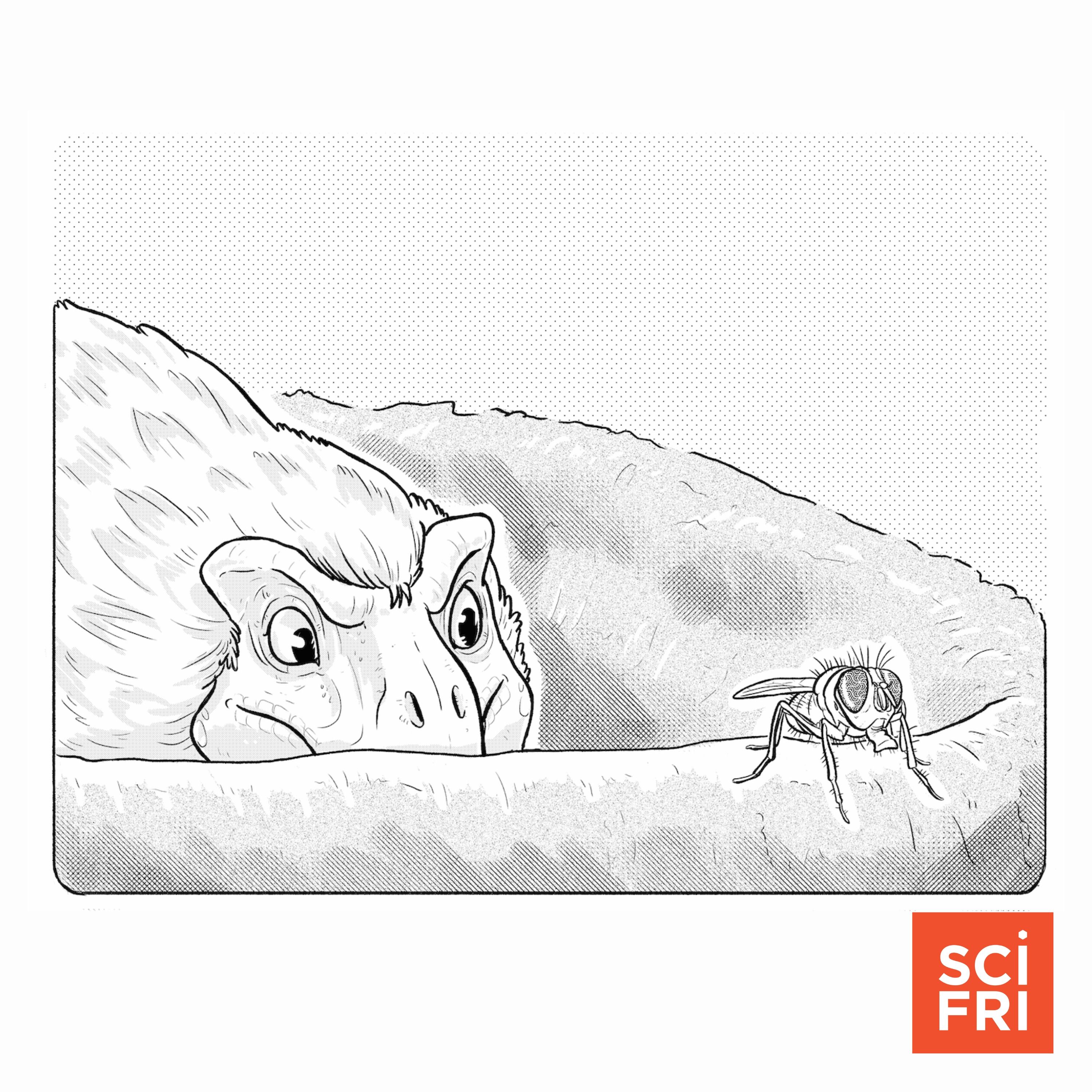
Overview of What was life like for Tyrannosaurus rex?
Science Friday explores what T. rex may have really been like beyond the Hollywood version: how it sounded, looked, grew up, interacted with others, and shaped its ecosystem. Guest Riley Black, author of Tyrant, Lizard, Queen, explains how paleontologists use fossils, modern animal analogs, and ecology to reconstruct the life of the “tyrant lizard queen” with surprising nuance—and why the best way to think about T. rex may be through empathy rather than fear.
Key Takeaways
-
T. rex probably didn’t roar exactly like in the movies.
- Scientists don’t know for sure, but Riley Black suggests it may have made deep, bass-heavy bellows or roars, more like crocodilians than a Jurassic Park-style cinematic roar.
-
Its popularity comes from both science and spectacle.
- T. rex became a sensation early in the 20th century as one of the largest carnivorous dinosaurs known.
- A famous fossil skeleton at the American Museum of Natural History helped cement its status as a prehistoric icon.
-
T. rex likely looked different from the classic scaly monster image.
- Evidence suggests it may have had some feathers or fuzzy covering, especially when young.
- It likely had lips covering its teeth, broad skull ornaments, and a very muscular, bulky body.
-
Baby T. rex was vulnerable, not fearsome.
- Young dinosaurs faced extremely high mortality—possibly up to 90% in the first year.
- Hatchlings were probably gangly, big-eyed, and relatively cute, with different skull shape and teeth than adults.
- Juveniles may have hunted smaller prey like insects before developing into the huge bone-crushing adult form.
-
T. rex was not necessarily a pack hunter, but it wasn’t truly “solitary” either.
- Adults may have spent much of their time alone, but they still interacted with one another.
- Bite marks on snouts show evidence of conflict between T. rex individuals.
- Like modern animals, they likely courted, mated, and sometimes fought over territory or resources.
-
Paleontology combines hard evidence with educated inference.
- Fossils provide direct clues, such as bite marks, injuries, and tooth wear.
- Scientists also rely on comparative anatomy and behavior in living animals like birds, crocodiles, and alligators to make informed hypotheses.
-
T. rex played an important ecological role beyond being a top predator.
- It acted like a “garbage disposal” for carcasses, helping recycle nutrients through the ecosystem.
- Its presence likely influenced plant and animal behavior, including where herbivores moved and fed.
- In this sense, T. rex shaped its environment as much as it was shaped by it.
-
A new body temperature study suggests T. rex was active and adaptable.
- UCLA research estimated a T. rex body temperature around 97°F, close to humans.
- This implies it may have had a broad habitat range and high activity level, supporting the idea that it could thrive across much of western North America.
Notable Ideas and Insights
T. rex as a living part of an ecosystem
Riley Black emphasizes that T. rex did not dominate a vacuum. Its survival depended on plants, microbes, herbivores, and the broader food web. The dinosaur’s fearsome reputation can obscure how interconnected it was with everything around it.
Empathy over sensationalism
One of the episode’s strongest messages is that dinosaurs should be understood as real animals, not just monsters. Black hopes people will think about what T. rex shared with modern creatures—and with us—such as sensing the world, feeling temperature, and responding to their surroundings.
Main Topics Covered
- Whether T. rex could roar
- Why T. rex became such a cultural icon
- Feathering, lips, and body shape
- Baby and teenage T. rex development
- Social behavior and interaction
- Fossil evidence vs. modern analog animals
- T. rex’s role in its ecosystem
- Body temperature and geographic range
- A more human, empathetic way to think about dinosaurs
Recommended Follow-Up
- Read Riley Black’s book Tyrant, Lizard, Queen for a deeper, imaginative look at T. rex life.
- Revisit dinosaur depictions in media with a more critical eye—many classic portrayals are more dramatic than scientifically accurate.
- Think of T. rex not just as a predator, but as a complex animal embedded in a whole ecosystem.