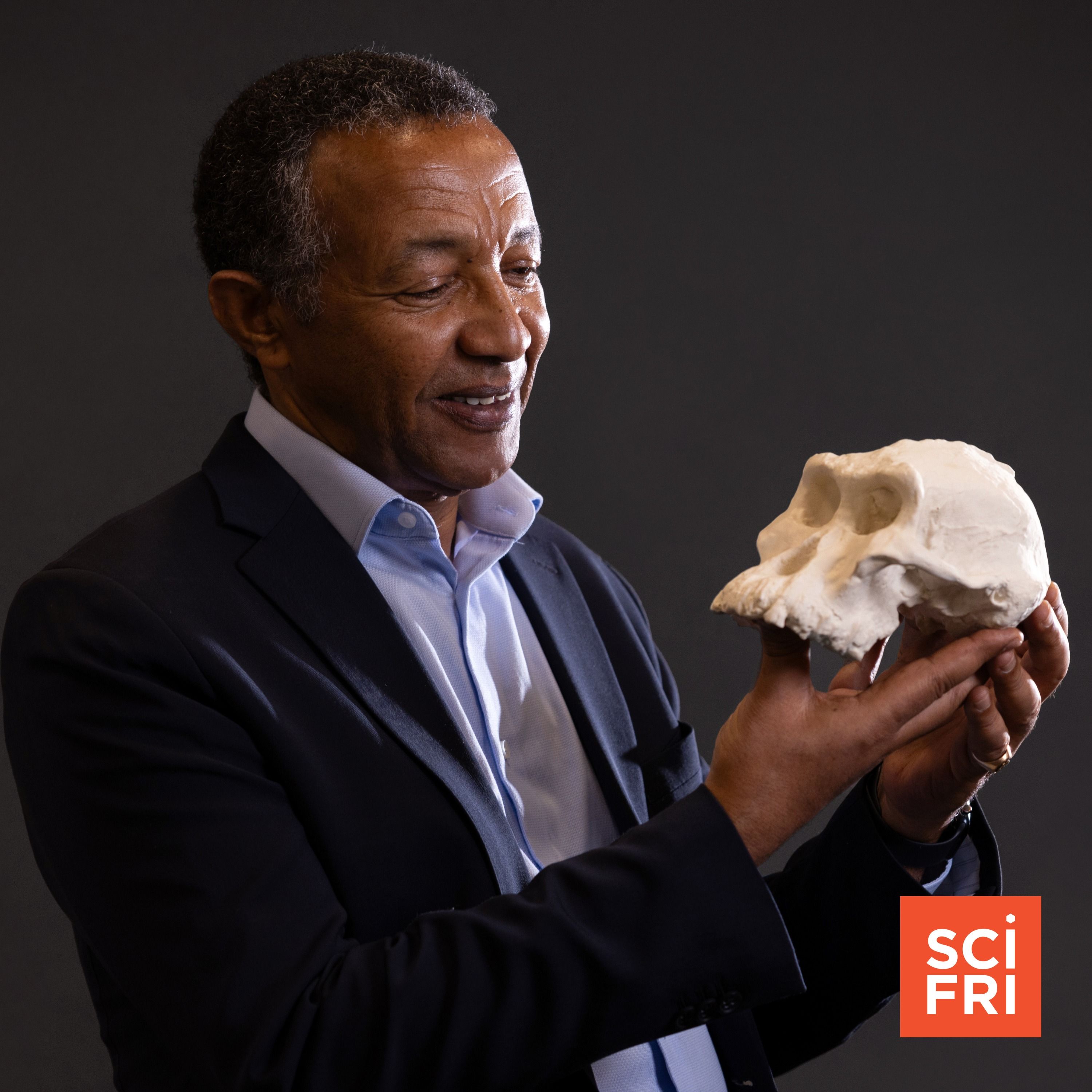
Overview of Telling the tale of human origins, one fossil tooth at a time
This Science Friday interview with paleoanthropologist Dr. Johannes Haile-Selassie explores how scientists piece together the story of human origins from fragmentary fossils—especially teeth and bones found in Ethiopia’s East African Rift. Haile-Selassie discusses his own path into paleoanthropology, what fieldwork is actually like, why certain places become fossil hotspots, and how genetics is reshaping what we know about early humans, “ghost” ancestors, and the broader human family tree.
Key Themes and Takeaways
How human origins research works
- Paleoanthropology is often less about dramatic digging and more about careful survey work: walking terrain, scanning the ground, spotting tiny fossil fragments, and cataloging what’s found.
- Teeth are especially important because they preserve well and are among the most common fossils in the record.
- Successful fossil hunting requires:
- trained visual attention,
- experience identifying bone fragments,
- and a fair amount of luck and timing.
Why Ethiopia is so important
- Much of the earliest human evolutionary history took place in Africa, especially in the East African Rift System.
- The rift exposes ancient sediment layers through tectonic activity and erosion, making buried fossils accessible.
- Because primates are tropical animals, the earliest hominins are more likely to be found in warm regions than in colder northern areas.
Haile-Selassie’s scientific path
- He began with a history degree at Addis Ababa University and discovered archaeology through a course on “early man.”
- Working for Ethiopia’s Ministry of Culture and out in the field gradually drew him into fossil hunting.
- He became known for major discoveries, including:
- Ardipithecus kadabba,
- Ardipithecus ramidus,
- Australopithecus garhi,
- fossils of Australopithecus afarensis,
- and later Homo erectus specimens.
The field is changing
- Haile-Selassie says paleoanthropology was historically competitive and secretive, with researchers often withholding data.
- He argues that the field is now moving toward greater collaboration, data sharing, and transparency, partly because funding agencies increasingly require it.
- He sees this as essential for scientific progress and public relevance.
Decolonizing paleoanthropology
- He acknowledges the colonial legacy of outside researchers “parachuting in” to Africa, collecting fossils, and publishing without sufficient local engagement.
- A major priority now is:
- involving local communities,
- collaborating with local institutions,
- and helping build training programs in-country.
- He points to ASU’s partnership with Samara University in Ethiopia and plans for a new paleoanthropology master’s program.
Genetics is transforming the field
- New genetic tools are changing the way scientists understand human evolution.
- Haile-Selassie highlights:
- possible “ghost” ancestors not yet identified in the fossil record,
- and the way genetics is linking fossils previously hard to classify, such as some remains associated with Denisovans.
- He also notes growing interest in ancient proteins, which may extend the reach of evolutionary analysis deeper into time.
Notable Insights
“Missing link” is outdated
- Haile-Selassie says the old idea of a single “missing link” is misleading.
- Human evolution is not a chain with one absent piece, but a branching tree with many lineages still not fully recovered.
The past matters for the future
- He argues human origins research is not just about where we came from, but where we’re going.
- Studying ancient environments can help us understand:
- how early humans adapted to climate change,
- why some hominin species went extinct,
- and what that may suggest about Homo sapiens today.
His research goals have evolved over time
- First dream: find the earliest human ancestor — achieved with Ardipithecus kadabba.
- Second dream: establish his own research site — achieved at Woranso-Mille.
- Third dream: understand the transition between Australopithecus anamensis and Australopithecus afarensis — supported by major finds.
- Current dream: find an even earlier Homo fossil in sediments around 2.8–2.9 million years old.
Why This Research Matters
- It helps answer one of science’s biggest questions: What does it mean to be human?
- It connects fossils, genetics, climate history, and evolution into a broader story about survival, adaptation, and extinction.
- Haile-Selassie emphasizes that understanding the past is not just academic—it may help us think more clearly about our future as a species.
Closing Note
The interview ends on a forward-looking note: science is no longer just about finding isolated fossils, but about building a more complete, collaborative, and globally inclusive story of human origins. Haile-Selassie’s work shows how even a single tooth can help reshape our understanding of who we are.