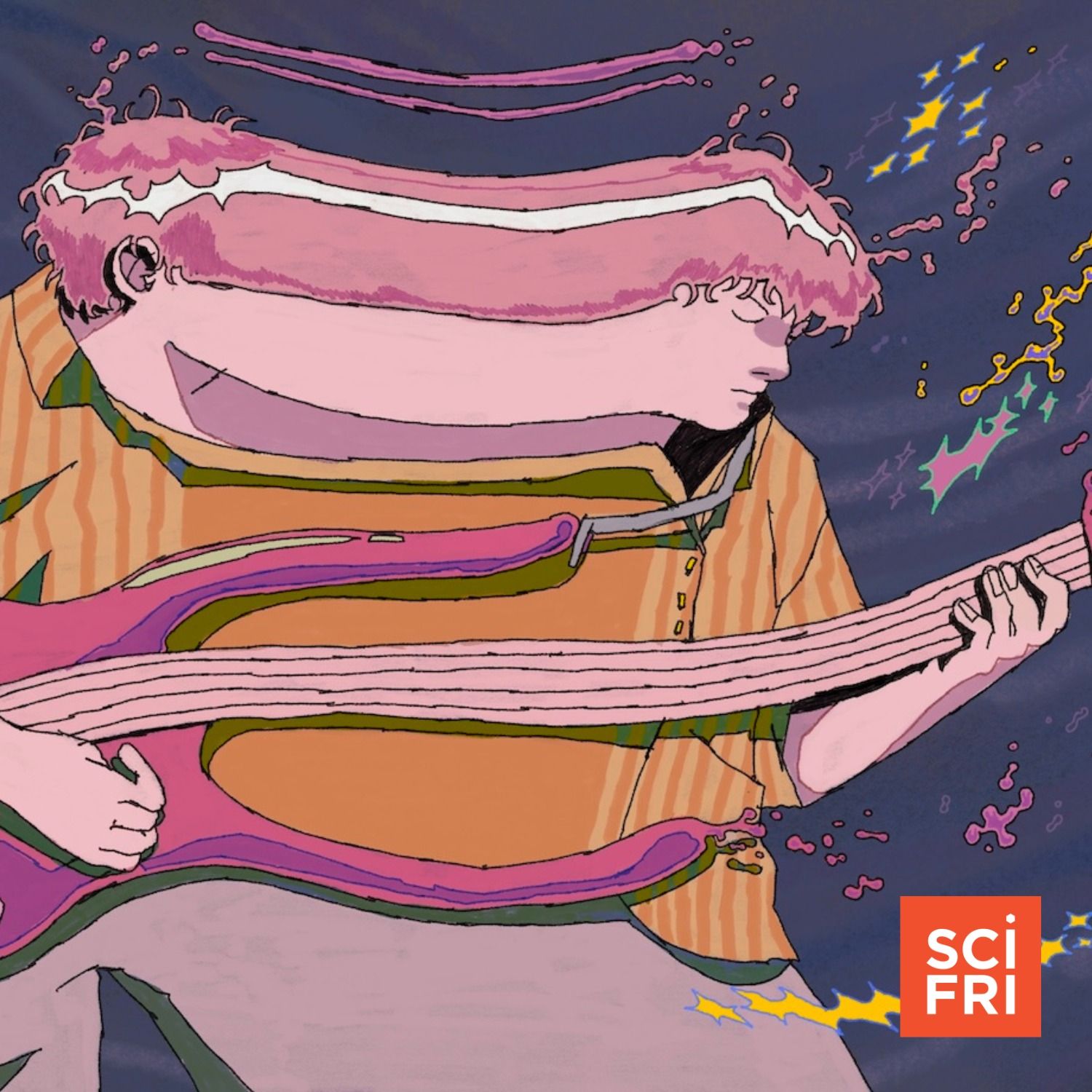
Overview of Why The Bassist From Phish Is Funding Research Into ‘Flow State’
This Science Friday episode (WNYC Studios) explores why Phish bassist Mike Gordon is funding scientific research into flow — the “in the zone” state musicians, athletes, surgeons and others describe. Mike talks with neuroscientist Dr. Greg Appelbaum (UC San Diego) about how the band recognizes “hooking up” during improvisation, how researchers define and detect flow with brain and physiological measures, and a device project (Zenbox) that aims to use biofeedback to cue or prolong flow.
Key takeaways
- Mike Gordon describes flow in Phish as “hooking up”: a shared, hard-to-put-into-words transcendence during improvisation that changes how the music behaves.
- Researchers are trying to operationalize flow by combining behavioral markers with brain and physiological measures to find reproducible biosignatures.
- Early findings in Mike’s recordings show strong alpha waves (~10 Hz) and patterns consistent with hypofrontality (reduced frontal/executive activity) during flow.
- Flow signatures appear to share commonalities across domains (music, sports, even surgery): reduced executive/frontal activity, heightened sensory processing, and autonomic/respiratory changes.
- A practical goal is to translate measured signals into biofeedback (lights, sound effects, musical pedals) that help induce or extend flow — Mike’s Zenbox concept.
How the research works (methodology)
- Defining flow behaviorally first: the team triangulates flow moments using three sources
- Audience judgments,
- Real-time self-report from the performer (a pedal Mike can press),
- Expert annotation from Mike’s longtime producer/sound engineer (Jared Slomoff) who identifies standout moments.
- Once a behavioral “flow” window is defined, researchers analyze concurrent EEG and physiological signals (heart rate, respiration).
- Technical challenges include signal-to-noise in mobile/active performance (movement and muscle artifact) and variability across contexts (sitting vs. standing vs. moving).
- Measured markers so far: increased alpha-band activity, changes consistent with hypofrontality, and autonomic shifts (e.g., deeper respiration).
Examples & descriptions of flow (from the episode)
- Mike uses the Bathtub Gin jam as an exemplar: the band migrates chords, changes textures and effects, and collectively focuses on getting into a dreamlike space rather than “playing notes to show off.”
- Subjective features Mike mentions: loss or distortion of sense of time, vivid dream-like imagery while playing, extreme absorption and reduced self-consciousness.
- Flow is described as deeply personal and varied — different people signal flow in different ways (tears, forgetting to swallow, etc.).
Zenbox and potential applications
- Zenbox: Mike’s envisioned device that uses biofeedback to help musicians (and others) enter or prolong flow. Ideas include:
- Translating brain signals (e.g., alpha increases) into sound effects, lighting cues, or pedal effects.
- Making flow-related cues “autopilot” so the environment responds to the performer’s state.
- Broader applications suggested: performance enhancement for musicians and athletes, surgical team optimization, and possibly consumer biofeedback tools for creativity or focused work.
Limitations & open questions
- Reliability: Can flow be detected consistently across people, contexts, and movement-heavy performances?
- Individual variability: Flow experiences and biosignatures vary by person; mapping generalizable biomarkers remains challenging.
- Signal quality: Movement and muscle artifacts complicate EEG and physiological measurement during live performance.
- Translation: Even with measurable markers, determining effective, non-disruptive interventions to induce/extend flow is an open problem.
Notable quotes and soundbites
- Mike Gordon: “We were really hooking up” — the band’s phrase for flow.
- Mike Gordon: “When the muse plays the music rather than the musician” — his ultimate goal for the device/approach.
- Greg Appelbaum on flow physiology: “What we think is happening during flow is a reduction in the frontal cortex … and more activity in the sensory systems.”
- Producer role: Jared Slomoff serves as the team’s “secret weapon” for identifying musical moments of articulation that correlate with flow.
Who’s who (guests & roles)
- Mike Gordon — bassist for Phish; project instigator and subject/partner in the research; founder of the Zenbox concept.
- Dr. Greg Appelbaum — professor of psychiatry and behavioral sciences, UC San Diego; leads the neuroscience/measurement side.
- Jared Slomoff — Mike’s longtime producer and sound engineer; annotates musical moments that represent flow.
- Host: Flora Lichtman (Science Friday).
Practical tips for listeners
- Musicians: cultivate listening to bandmates, train improvisation, and focus less on self-performance and more on communication to increase chances of “hooking up.”
- Anyone seeking flow: practice activities that reduce overthinking (training, repetition, focused attention) and experiment with biofeedback or breathwork to notice physiological patterns that accompany flow.
- Keep in mind: self-reports and environmental cues (audience energy, lighting, effects) all play into whether a group reaches flow — it’s both personal and social.
Produced by Science Friday; the episode balances musician-first descriptions of flow with a scientist’s perspective on measurable brain and bodily signals, and it surfaces a concrete translational project (Zenbox) aiming to make flow more accessible.