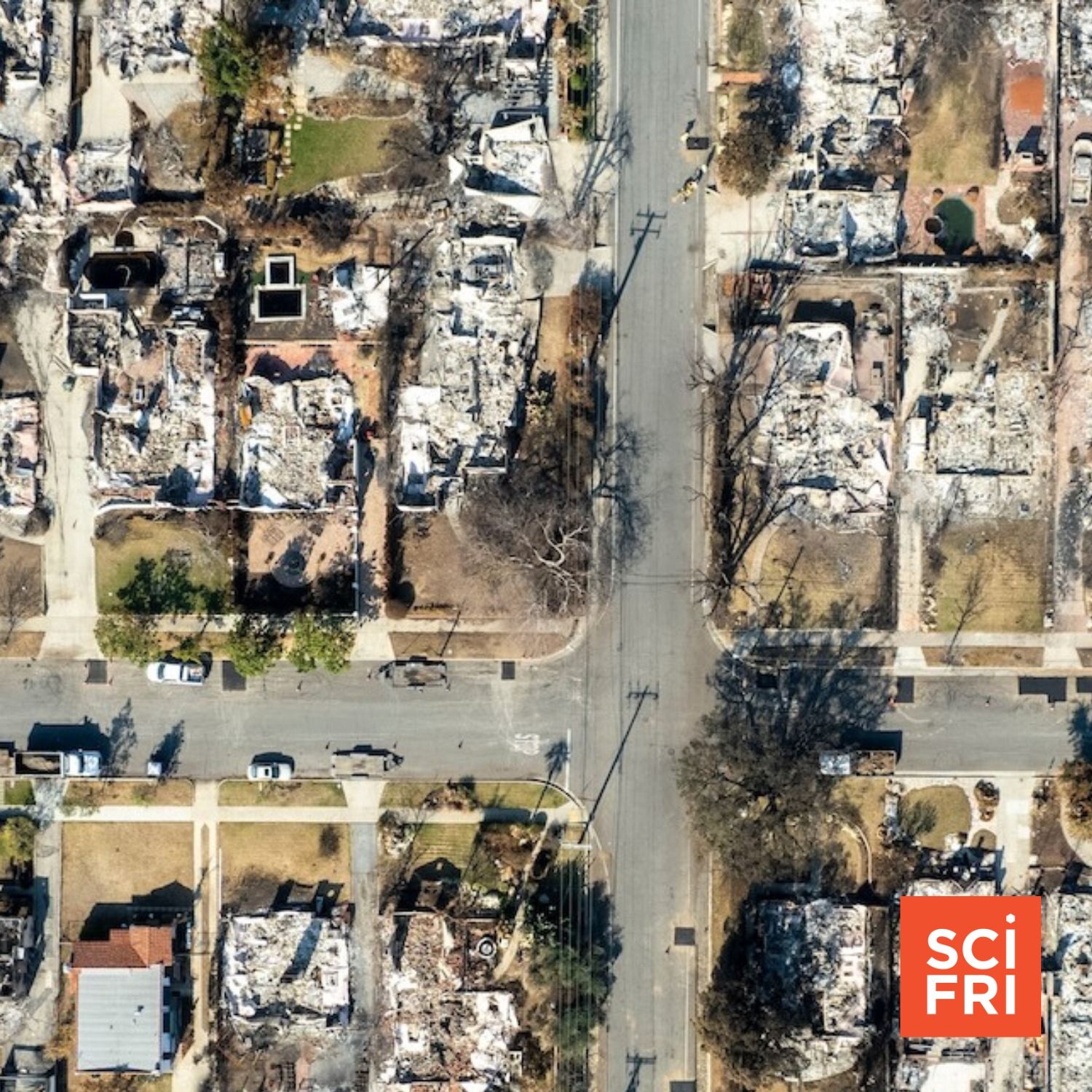
Overview of Tracking The Toxic Fallout Of The LA Fires
This Science Friday episode (host Flora Lichtman) investigates the chemical aftermath of the large urban fires in and around Los Angeles (e.g., Altadena) a year earlier. Guests Dr. Francois Tissot (Caltech, geochemist) and Dr. Yifeng Zhu (UCLA, air quality & health) describe what researchers found in air and homes, how contamination behaves indoors, what is known and unknown about health impacts, and practical remediation guidance — plus the policy and funding gaps that complicate recovery.
Who spoke and why it matters
- Dr. Francois Tissot, Caltech — geochemist who pivoted from cosmochemistry to study post-fire contaminants after his neighborhood was heavily damaged.
- Dr. Yifeng Zhu, UCLA — atmospheric health researcher who led phased indoor/outdoor air sampling around the fires.
- Relevance: Urban megafires burn not only vegetation but homes and infrastructure, releasing heavy metals and industrial/household chemicals that are different from typical wildfires and pose new exposure risks.
Key findings
- Contaminants detected: elevated lead and arsenic in homes; asbestos; volatile organic compounds (VOCs) such as benzene and other combustion-related organics; chemicals from batteries, solar panels, insulation, cleaning products, and treated wood.
- Indoor concentrations can be higher than outdoors after fires, especially in unoccupied, sealed homes. Soaked soft goods (rugs, couches, clothing, stuffed toys, pillows) absorb smoke contaminants during fires and later off-gas them into indoor air.
- Many homes showed lead and arsenic above EPA recommended safety limits. Sources included lead paint/lead pipes (older homes) and arsenical termite treatments used historically in lumber.
- For heavily contaminated homes, current remediation practice by experts may recommend demolition or stripping to studs rather than relying on surface cleaning — because we don’t yet know if cleaning can effectively remove deep, widespread contamination.
- Acute health effects were already documented: increases in ER visits and abnormal blood tests during active fire periods. Long-term health impacts remain largely unknown.
Methods & research approach
- Phased sampling: air samples collected during active fire, mid-containment, and post-fire periods; measurements made both indoors and outdoors.
- Parallel experiments: off-gassing studies from smoke-soaked soft goods to quantify ongoing indoor source strength.
- Geochemical concentration analyses to quantify heavy metal contamination (lead, arsenic, etc.).
Health impacts — what we know and don’t
- Known: short-term increases in respiratory and other emergency visits during fires; biological markers in ER patients indicated acute exposures.
- Unknown: long-term health outcomes from chronic low-to-moderate post-fire household exposures; dose-response relationships for many post-urban-fire contaminant mixtures are not well characterized.
- Vulnerable populations (children, older adults, people with preexisting conditions) are of particular concern, but specific long-term risks are not yet defined.
Remediation guidance and homeowner actions
Practical, evidence-based measures (with caveats that research is ongoing):
- Ventilate indoor spaces when outdoor air is safe.
- Use HEPA air cleaners and filtration; choose units with activated carbon/charcoal filters to reduce VOCs.
- Clean or service HVAC systems and replace filters.
- Remove smoke-impacted soft goods (rugs, upholstered furniture, bedding, stuffed toys) that can continue off-gassing; these items can be persistent indoor sources.
- For moderate contamination: wet wiping and HEPA vacuuming are standard cleaning approaches.
- For heavy contamination: remediation professionals currently often recommend demolition or stripping to studs; scientific certainty about less invasive cleaning methods is lacking.
- Document contamination and communications, and insist on accredited lab testing when needed — but be prepared for insurer resistance.
Policy, funding, and institutional gaps
- Many homeowner insurance guidelines for post-fire cleanup are based on wildfires (fuel/vegetation fires) and do not account for combustion of built environment materials that release metals and industrial chemicals.
- Insurers may refuse to pay for testing or remediation if their guidebooks don’t recognize urban-fire contaminants.
- Federal rapid-response funding and targeted research mechanisms have lagged; Caltech provided internal emergency support to start research immediately — an example of what rapid federal action should look like.
- The National Academies and researchers point to the need for systematic study of urban-interface fires (WUI) and their distinct contaminant profiles.
Notable quotes and soundbites
- “There is almost no literature on this kind of urban mega fires.” — Dr. Francois Tissot
- “Some houses have been contaminated to such an extent that we do not know if the cleaning techniques that we have are appropriate or efficient at all.” — Dr. Francois Tissot
- “One in three houses in the U.S. is in an environment called the WUI (wildland–urban interface).” — Dr. Francois Tissot (context on future risk)
Actionable checklist for homeowners after urban fire exposure
- If you suspect contamination: get professional, accredited testing (document and insist — but expect insurance obstacles).
- Until testing is complete: ventilate when safe, run HEPA + activated carbon air cleaners, and avoid reoccupying sealed homes with smoke-soaked materials.
- Remove and safely dispose of heavily smoke-impacted soft goods.
- Clean using wet-wiping and HEPA vacuuming for lower-level contamination; consult licensed remediation professionals for more serious contamination.
- Keep detailed records for insurance and public health inquiries; seek local public health guidance.
- Advocate for local/state support and for rapid federal funding for post-fire environmental health studies.
Takeaways and next steps
- Urban megafires create a different and under-studied contamination profile compared with wildfires; heavy metals (lead, arsenic), asbestos, VOCs, and other industrial/household chemicals can persist in homes and off-gas from materials long after flames are out.
- Researchers urgently need rapid funding, systematic studies, and standardized guidance for testing and remediation so communities and insurers have clear, science-based paths to recovery.
- In the meantime, homeowners should prioritize ventilation, filtration, removal of smoke-soaked soft goods, accredited testing, and working with public health and certified remediation experts when possible.