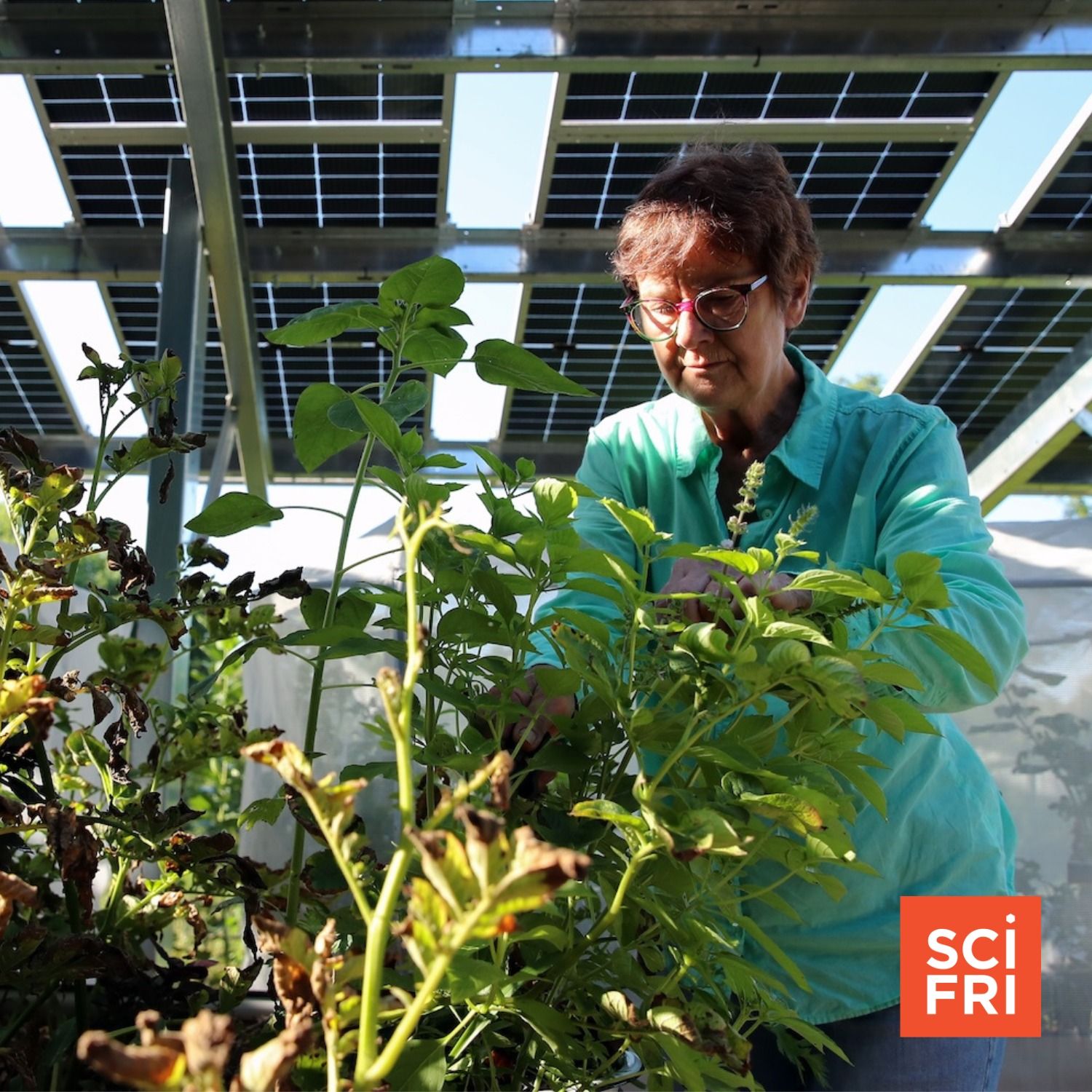
Overview of The Growing Experiment Of Putting Solar Panels On Farmland
This Science Friday episode (hosted by Ira Flatow) examines agrivoltaics — the practice of combining photovoltaic solar panels with agricultural production — through reporting from KBIA producer Jana Rose Schleiss and research from Dr. Madhu Khanna (University of Illinois). The segment covers how farmers are experimenting with panels (especially on small farms), which crops and livestock are already working under arrays, economic trade-offs, community responses, and what research and design changes would be needed to scale agrivoltaics to commodity-row crops.
Main takeaways
- Definition: Agrivoltaics = agriculture + photovoltaics; simultaneous production of crops (or grazing) and solar energy on the same land.
- Early results are promising for specialty crops and livestock: panel shade can reduce evaporation, cool panels (improving efficiency), and lessen heat stress on plants — beneficial in hot/arid climates.
- Sheep grazing is the most established agrivoltaic use because sheep fit the typical solar layout and graze grass without damaging infrastructure.
- Scaling agrivoltaics to commodity crops (corn, soy, wheat) faces big technical and economic hurdles: panels must be taller, rows farther apart, and foundations/cabling more robust — all substantially raising costs and lowering panel density.
- Community opposition to converting cropland to solar is growing (aesthetic, identity, and economic concerns); some counties have bans or restrictions.
- Current and projected land footprint for utility-scale solar remains small nationally (today ≪1% of cropland; projections through 2050 still under ~2%), but local impacts can be significant in some counties.
- Potential solutions include co-development / farmer ownership models, benefit-sharing with local communities, optimized panel/field design, and new equipment (small tractors, robots) to operate in tighter spaces.
Notable quotes and framing
- Farmer description: agrivoltaics is “sort of like farming the sun.”
- Benefit framing: farmers can get “two harvests” — produce plus energy/rental income.
- Research caution: “We are still at really the early stages of investigating the performance of this technology.”
Topics discussed (by segment)
- Farmer experiences and motivations
- Example: Linda Hetzel (Kearney, MO) growing herbs under a ground-mounted solar array; shade helps reduce heat stress on crops and on the farmer.
- Incentives: access to land management opportunities, rental income from leases, on-site energy for farm operations.
- Livestock integration
- Sheep: widely used and compatible.
- Cattle: technically possible but costly and uncertain (need taller structures, more grazing area; unknown animal-infrastructure interactions).
- Climate and crop-specific outcomes
- Arid/semi-arid zones (Arizona, Colorado): panels reduce evaporation and irrigation needs; can improve produce quality.
- Rain-fed zones (Illinois): different trade-offs; shade can reduce yields for sun-loving commodity crops.
- Technical and economic barriers for commodity row crops
- Required panel height increases (to 6–12 ft) and spacing increases (from ~18 ft to ~40 ft) raise construction costs and reduce energy yield per land area.
- Panel design (fixed vs. tracking), material translucency, and array layout strongly affect crop outcomes.
- Social/political dynamics
- Local opposition often driven by place/identity and concern about losing agricultural land and related businesses.
- Solar developers face delays, cancellations, and higher costs where restrictions exist.
Challenges & trade-offs
- Construction costs: taller racks, deeper foundations, buried cabling, and stronger supports increase capital costs exponentially.
- Energy vs. food yield: wider spacing lowers panel density and energy output; shade can lower yields for sun-loving crops.
- Equipment compatibility: conventional large farm machinery needs wider row spacing; adapting machinery is costly or requires smaller robotic systems.
- Local equity: perceived mismatch between where benefits accrue (often urban electricity consumers) and where land-use costs are borne (rural/agricultural communities).
Research and design priorities (recommended)
- Field trials optimizing: panel height, row spacing, tilt/fixed vs. tracking systems, and semi-translucent materials matched to specific crops and climates.
- Crop-panel pairings: identify which commodity and specialty crops tolerate/benefit from partial shade under different climate scenarios.
- Livestock studies: animal behavior, welfare, and infrastructure interactions (especially for cattle/dairy).
- Equipment and automation: develop smaller machinery and robotic solutions able to farm under tighter arrays.
- Economic and social studies: co-ownership models, lease structures, revenue-sharing, and local benefit mechanisms to reduce community opposition.
- Climate resilience assessment: evaluate agrivoltaics under future extreme-heat and variable-precipitation scenarios.
Actionable recommendations (for stakeholders)
- For farmers: consider pilot projects (small arrays, on-farm ownership, or sheep grazing) and evaluate leases vs. partnerships; track irrigation and yield changes.
- For developers: engage communities early, explore co-development/farmer-ownership models, and provide transparent benefit-sharing plans.
- For policymakers/planners: support field research, incentivize co-benefit models, and craft zoning/land-use policies that account for local economic impacts.
- For researchers/funders: prioritize interdisciplinary trials that combine agronomy, engineering, animal science, economics, and social science.
Who contributed / examples to follow up on
- Reporter: Jana Rose Schleiss, KBIA (podcast series: The Next Harvest).
- Researcher: Dr. Madhu Khanna, Professor of Environmental Economics, University of Illinois, Director, Institute for Sustainability, Energy and Environment.
- Farmer example: Linda Hetzel (Kearney, Missouri) — herbs and produce grown under ground-mounted panels.
- Notable established practice: sheep grazing under solar arrays.
Bottom line
Agrivoltaics shows real promise for specialty crops and grazing (notably sheep) and could improve resilience in hot, water-limited regions. But meaningful scaling to large-scale commodity agriculture requires design innovation, new equipment, altered economics, stronger local partnerships, and more research to resolve trade-offs between energy production, crop yields, costs, and community impacts.