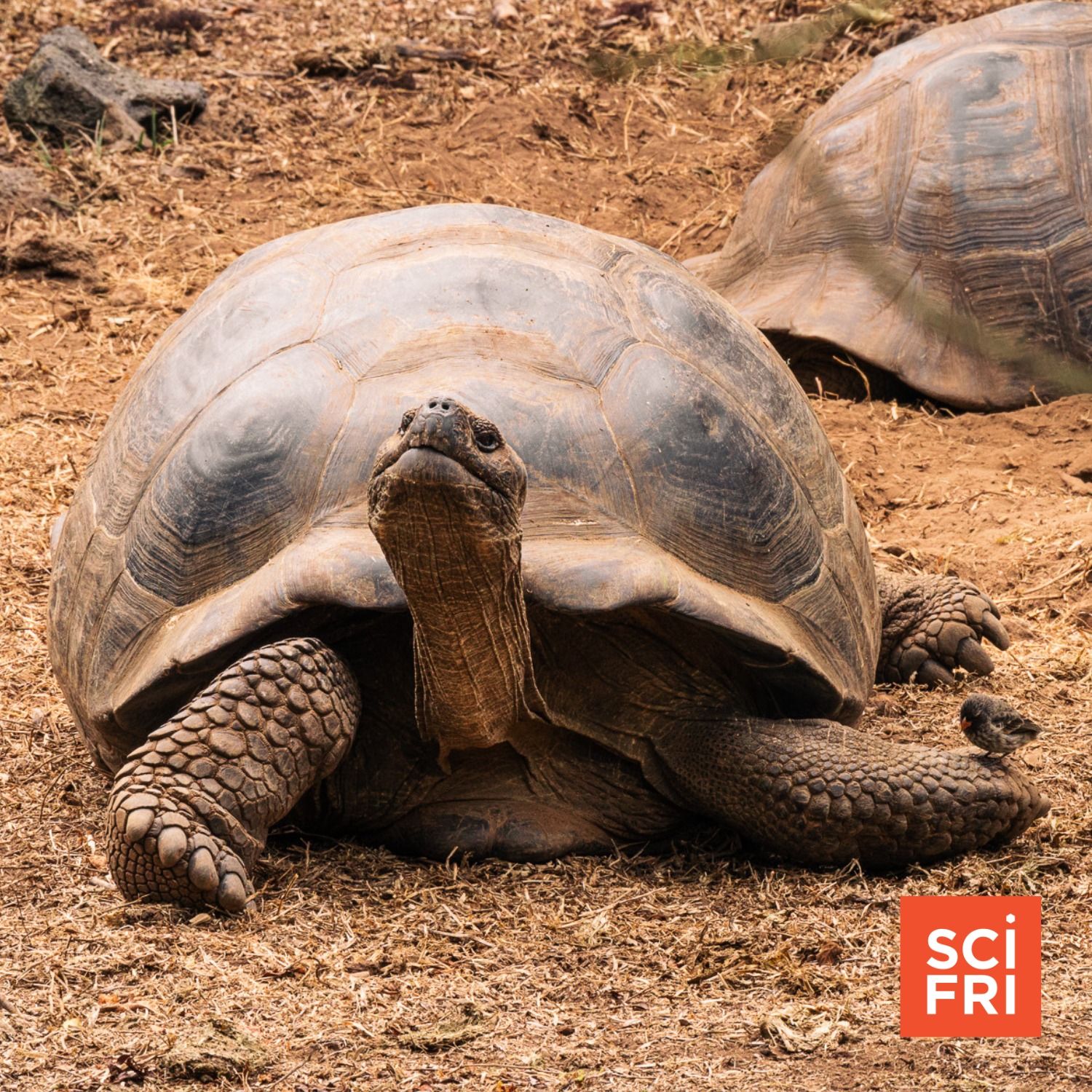
Overview of Slow Breaking News: A Giant Tortoise Revival
This Science Friday segment (WNYC Studios) — hosted by Flora Lichtman with Charles Berquist as Sci-Fi’s turtle and tortoise correspondent — highlights three slow-moving, conservation-focused stories: the reintroduction of a Galápagos tortoise subspecies to Floriana Island, the start of sea turtle nesting season in Florida, and fossil evidence interpreted as an ancient sea turtle “stampede.” The piece blends conservation science, genetics, community restoration, and natural-history sleuthing.
Key takeaways
-
Floriana tortoise revival:
- Conservationists released 158 juvenile Galápagos tortoises (8–13 years old, ~18" long, 30–50 lb) onto Floriana Island after a sustained restoration effort.
- Those juveniles descend from a captive breeding program started from ~20 individuals whose genetics matched Floriana subfossil DNA recovered from island caves.
- Tortoises won’t reach sexual maturity until roughly age 25; further releases and continued restoration are planned.
- The reintroduction was paired with invasive-species removal and 15+ years of community-led island restoration; local ceremonies involved emotional community participation (kids naming tortoises).
- Released tortoises are being tracked with transmitters for monitoring.
-
Sea turtle nesting season:
- Leatherback nests have been reported on Delray Beach, Florida — an early sign of the season.
- In Florida, nesting typically runs March–October; nests take about two months to hatch.
- Public guidance: don’t disturb nests or nesting turtles, and reduce beachfront light pollution (artificial light disrupts nesting behavior and hatchling orientation).
-
Fossil sea-turtle “stampede”:
- Researchers (paper in Cretaceous Research) analyzed crescent-shaped flipper marks on limestone near Ancona, Italy, found in 2019.
- The slab preserves hundreds of flipper traces and ripple marks plus fossil plankton; interpretation: an ~80-million-year-old event where sea turtles scuttled across soft substrate (possibly fleeing an earthquake), then were rapidly buried and preserved.
Topics discussed
- Difference between turtles and tortoises: tortoises are land-dwelling turtles (all tortoises are turtles, but not all turtles are tortoises).
- Genetic detective work: matching modern individuals to subfossil DNA from caves to reconstruct an extinct-on-island lineage.
- Captive breeding and genetic management to retain as much of the original Floriana genotype as possible.
- Island restoration as a “closed system” where ecosystem recovery can be tracked and amplified.
- Practical conservation actions the public can take during sea turtle nesting season (avoid disturbance, limit lights).
Notable quotes and moments
- “They wasted no time… Every green leaf along their way, they’re eating it and they went in every particular direction and started exploring.” — Penny Becker, describing the released tortoises’ immediate behavior.
- Community reaction: the release ceremony was emotional — “there was not a dry eye” — and children helped name the tortoises.
- The fossil discovery evokes vivid imagery: hundreds of preserved flipper marks frozen by an ancient sediment event.
Action items / recommendations
- If you live near or visit turtle-nesting beaches:
- Be aware of nesting signs (weird shapes on sand may be nests).
- Give turtles and nests space; do not disturb or attempt to move them.
- Turn off or shield beachfront lights during nesting season to prevent disorientation of nesting females and hatchlings.
- Support or follow island-restoration and tortoise conservation organizations (e.g., Island Conservation) to track progress and volunteer/donate if inclined.
Why this matters
- The Floriana tortoise story is a rare, positive conservation outcome: genetic sleuthing, captive breeding, invasive-species control, and local community engagement combined to restore a locally extinct megafaunal species to its native island.
- Sea turtle nesting reminders and fossil evidence both connect present-day conservation to deep-time natural history, highlighting how ecosystems change, recover, and leave records we can study and act upon.