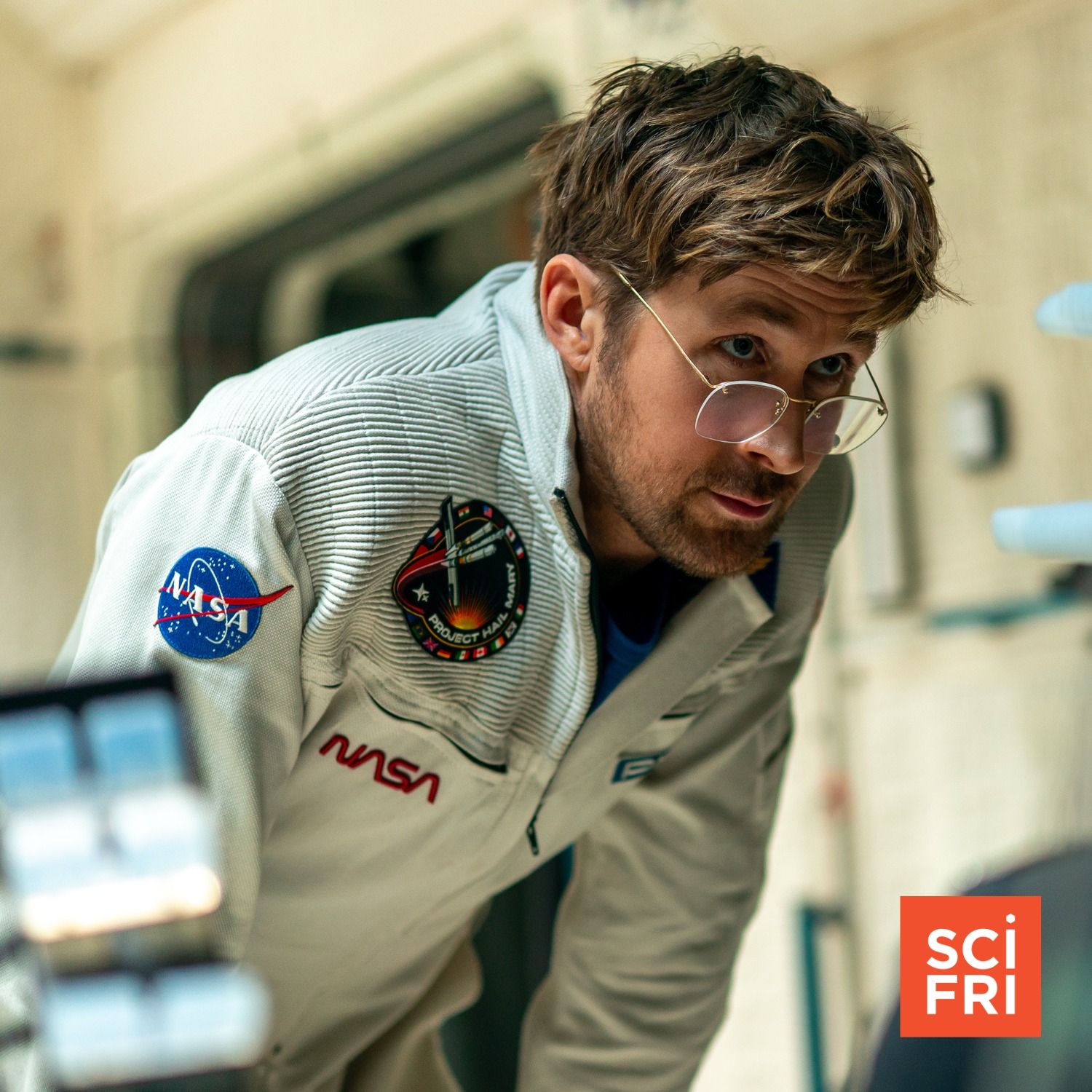
Overview of Science Friday — ‘Project Hail Mary’ brings a new kind of alien to the big screen
This episode of Science Friday (WNYC Studios) discusses the big‑budget film adaptation of Andy Weir’s novel Project Hail Mary. Host Flora Lichtman interviews Andy Weir (author, producer) and Mike Wong (astrobiologist/planetary scientist) about the movie, the science behind it, alien design, and how the book translated to film — including what was kept, what was omitted, and why.
Guests
- Andy Weir — author of Project Hail Mary and The Martian; producer on the film.
- Mike Wong — astrobiologist and planetary scientist (Carnegie Institution for Science).
What the story/movie is about
- Premise: A microbial alien species (astrophage) is dimming the Sun and threatening Earth with global freeze. Failed molecular biologist–turned–middle school teacher Ryland (Rylan in transcript) Grace is sent to space to solve the crisis.
- Major emotional core: an unexpected friendship between Grace and an alien called Rocky (an Iridian), who is non‑humanoid, has no face, and communicates via sounds and body language.
- Tone: science-driven hard sci‑fi with humor and heart; focuses on problem‑solving, cross‑species friendship, and ethical stakes.
Key creative choices & behind‑the‑scenes
- Andy Weir served as a producer and was heavily involved during shooting; he praises the adaptation and had limited small regrets about omitted book scenes.
- Ryan Gosling contributed substantial ad‑lib lines (example cited: joking about casting Meryl Streep to voice Rocky), and the filmmakers incorporated some of these improvisations.
- Rocky’s screen realization relied on sophisticated puppetry, voice work, and body language to build audience empathy for a non‑facial, non‑humanoid creature.
Science & plausibility — main ideas discussed
Astrophage (the sun‑dwelling microbe)
- Origin: Weir conceived astrophage while reverse‑engineering a story from a science premise — he wanted a biologically plausible mass‑conversion energy source that could enable space travel.
- Concept: Single‑celled organisms that live on the star’s surface, absorb stellar energy, and convert it into mass for spore dispersal — effectively “living” on the sun rather than eating it.
- Narrative role: Astrophage functions as an invasive, ecological threat rather than a predatory monster, and acts as an allegory for slow‑moving planetary threats (e.g., climate change).
Rocky and Iridian biology
- Designed to be truly alien: pentaradial symmetry (fivefold), thorax with five legs, three‑fingered hands, internal respiration, and air bladders that produce multi‑chord sounds (analogy to whale song).
- Incompatibility with human physiology and atmosphere was intentional — emphasizing path‑dependent evolution and the likelihood that alien life would be biologically incompatible with humans.
- Sound and gesture were essential to convey emotion and intelligence for a faceless, rock‑like alien.
Non‑water and exotic life
- Ryland Grace’s background (advocating non‑water‑based life) reflects a real astrobiological position: scientists consider that life elsewhere might not follow Earth’s water/carbon/ribosome template. Mike Wong relates personally to that outsider perspective.
Differences between book and film
- Most of the book’s core science, plot beats, and the Ryland–Rocky relationship were retained; some minor book scenes and deeper scientific digressions were omitted for pacing.
- Mike Wong noted a significant omission in the film: a fuller treatment of relativity (how Iridians perceive light, time dilation implications) that featured more prominently in the book. Weir and the filmmakers chose to streamline such content to preserve momentum and accessibility.
- Weir admits some details were abbreviated but is generally pleased with the adaptation.
Themes and takeaways
- Speculative science can drive plot: Weir often starts with a nerdy scientific idea and builds story mechanics around it.
- Alien life need not be humanoid nor malicious to be existentially threatening.
- Empathy across radically different lifeforms is possible to portray if filmmakers use consistent internal logic (biology, body language, sound).
- Astrobiology and the idea of “life in space” are mainstream scientific pursuits, and the story highlights how novel concepts (non‑water life) can inspire future scientists.
Notable quotes / lines from the episode
- Weir on his writing approach: “I almost always start with, like, I want this science thing. How do I make the science thing happen in a story?”
- Mike Wong on astrobiology’s legitimacy: “When we discovered that our planet was an inhabited world… we discovered life in space.”
- On Rocky’s casting/voice: Ryan Gosling ad‑libbed lines (e.g., “Meryl Streep, man, she could play anything”) — and the team actually asked Meryl Streep to record a line for the film.
Recommended next steps (for interested listeners)
- Read Andy Weir’s Project Hail Mary (if you haven’t) for fuller scientific detail, including relativity elements and deeper character context.
- Watch the film to see Rocky’s visual and puppetry realization and Gosling’s performance.
- For scientists/aspirants: explore astrobiology literature on non‑water‑based life and speculative evolution to see how fiction and science intersect.
- If you want to respond to the show: Science Friday invites listener feedback (phone number given in episode).
Final notes
- Overall reaction from guests: Both praised the adaptation — Andy is humbled and mostly satisfied; Mike enjoyed both the book and the film and appreciated the faithful portrayal of genuinely alien morphology and the scientific thinking underpinning the story.