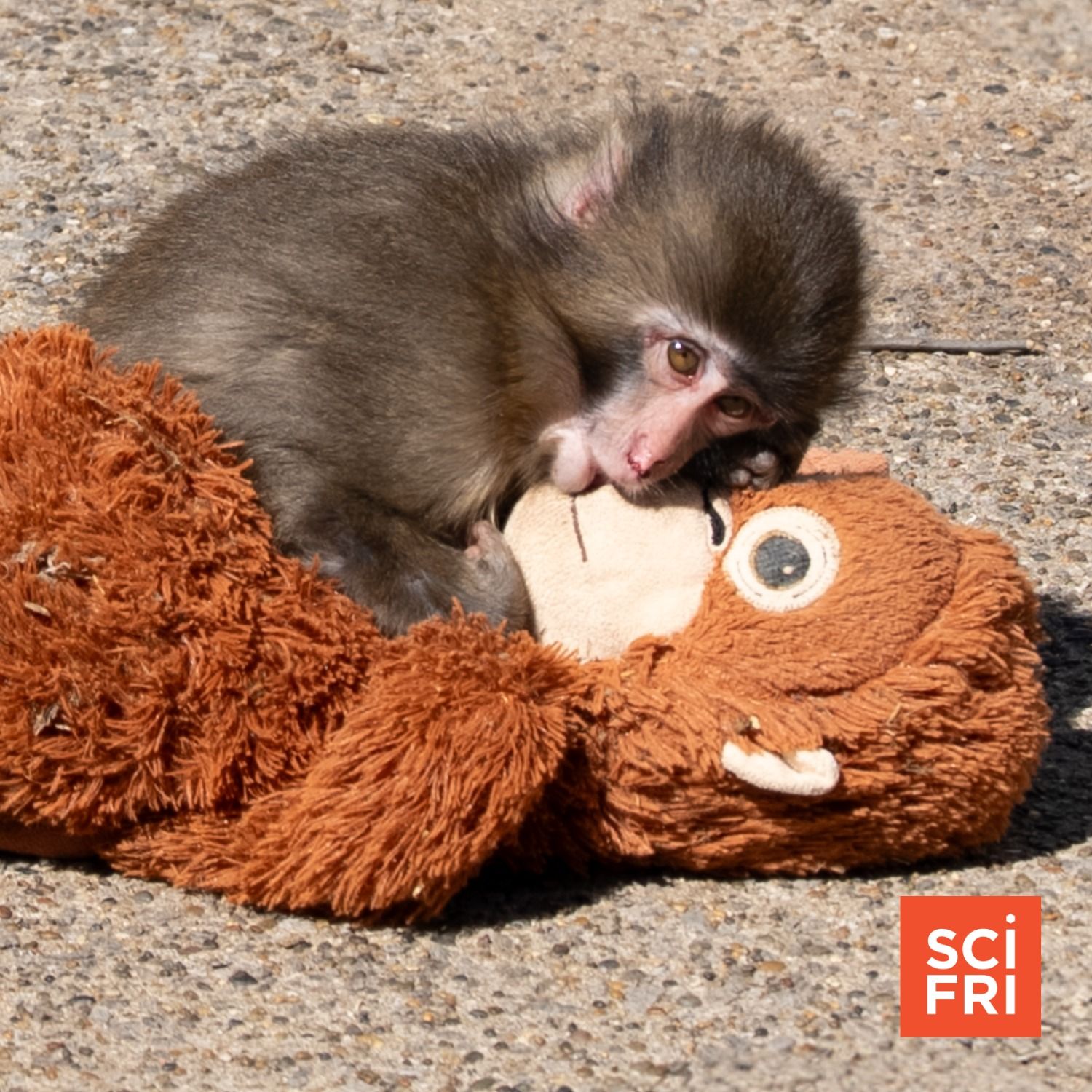
Overview of Is Punch the monkey really just like us?
This Science Friday segment (host Flora Lichtman) features primatologist Dr. Christine Webb (NYU, author of The Arrogant Ape) discussing why the viral story of Punch, a mother‑rejected baby macaque in a Japanese zoo who bonded with a stuffed toy, resonates so strongly with people. The conversation covers anthropomorphism, human exceptionalism, how scientific methods can bias comparisons between humans and other primates, and why acknowledging continuity between species can improve both public understanding and scientific practice.
Key takeaways
- Punch’s popularity reflects a deep public tendency to identify with primates because they are our closest living relatives, share similar body plans, and display complex social behavior.
- Anthropomorphism — projecting human traits onto animals — is traditionally discouraged in science, but for primates it can be a reasonable starting point because continuity of emotions and cognition across related species is plausible.
- The historical idea of human exceptionalism (from Aristotle through Western thought) shapes scientific assumptions that humans are fundamentally separate or superior to other animals.
- Comparative cognition studies are often biased by human‑centric methods (e.g., puzzle boxes, touchscreens) and by testing animals in deprived or unnatural captive settings, which can lead to underestimating nonhuman capacities.
- Scientists should acknowledge their own cultural and methodological biases; being transparent about these can produce better, more accurate science.
- It’s possible — and reasonable — to accept some human uniqueness while rejecting the idea that it makes humans morally or epistemically superior to other species.
Topics discussed
- The viral Punch the macaque story and public reaction
- Anthropomorphism vs. reasonable inference of shared capacities
- Franz de Waal’s argument for continuity in emotions and cognition
- The history and influence of human exceptionalism on science
- Methodological problems in comparative cognition research
- The possibility of animal interior worlds different from ours
- The importance of humility and explicit acknowledgement of bias in science
Notable quotes
- On anthropomorphism: “The A word. It’s seen as a cardinal scientific sin.”
- On parsimonious explanation: “You could argue that the most parsimonious straightforward explanation is to assume continuity among species … in emotions and relationships and cognitive faculties.”
- On science and bias: “If we were just more open and honest about the fact that science is not value‑free … then I think we would actually do better science.”
Scientific and public implications
- For researchers: design experiments that respect species‑specific ecologies and sensory modalities; avoid tasks that unfairly favor human abilities; be explicit about assumptions and limitations.
- For journalists and the public: recognize the value of relating to animals (it can promote empathy and conservation) while avoiding unfounded projections that misrepresent animal welfare or behavior.
- For educators: use viral animal stories as teachable moments to discuss comparative cognition, ethics, and how cultural narratives shape scientific interpretation.
Practical recommendations (what listeners can do)
- When following viral animal stories, look for reporting that cites experts and mentions welfare/context (captivity, rearing history).
- Support science communication that explains both similarities and differences between humans and other animals.
- Encourage research funding and methodologies that test animals in naturalistic settings and with species‑appropriate tasks.
- Treat descriptive empathy (feeling for animals) as a gateway to learning more about animal lives, not as definitive evidence of human‑level experiences.
Produced by Science Friday — concise context for understanding why a viral macaque can tell us a lot about how we think about minds, animals, and science.