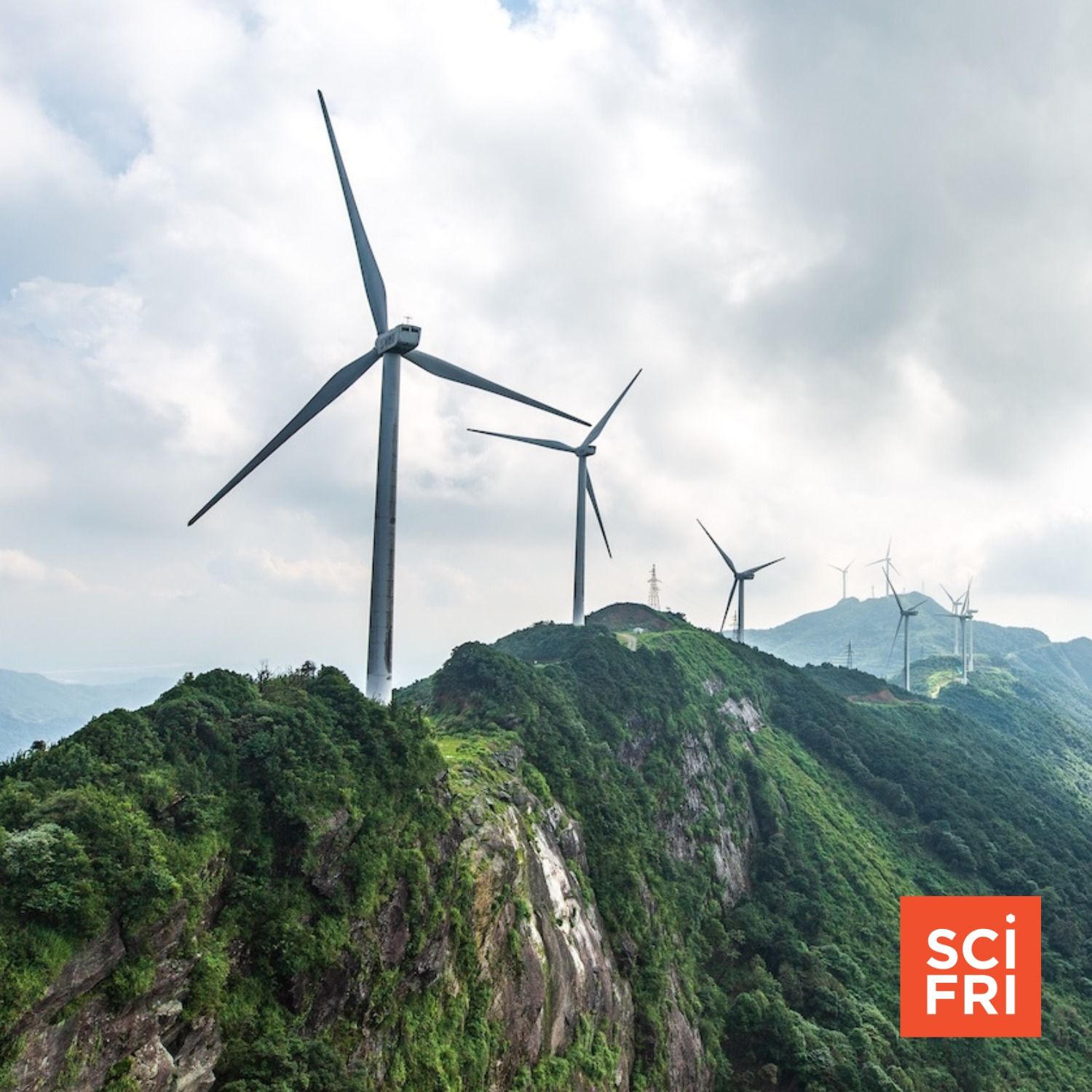
Overview of Science Friday — How China Is Driving Down Electricity Costs With Renewables
This episode features Jeremy Wallace (Johns Hopkins SAIS), discussing China’s massive build-out of wind and solar, how that build-out is reshaping global electricity costs and markets, and why claims that China only manufactures renewables but doesn’t use them are incorrect. Wallace explains the scale of China’s deployments and exports, the technical issues (like curtailment), recent policy-driven installation spikes, and what to watch for in 2026.
Key takeaways
- China is the world leader in both production and deployment of wind and solar — it installs roughly as much new solar and wind each year as the rest of the world combined.
- Claims that China makes turbines and panels only to export them (and not use them domestically) are false: Chinese wind farms and solar arrays do produce electricity, although curtailment occurs sometimes.
- Solar is now the cheapest source of electricity in history, driving rapid global adoption and making solar exports transformative for many countries (notably in Africa, India, and Pakistan).
- China manufactured about 600 GW of solar panels last year and installed ~350 GW domestically; total installed electricity capacity in China is roughly 3,700 GW versus ~1,300 GW in the U.S.
- Electricity’s share of final energy use is larger in China (~30%) than in the U.S. (~20%), but China’s electricity mix still relies heavily on coal (about half of its electricity), and it remains the world’s largest coal consumer and emitter — though coal use fell in the most recent year amid heavy renewables deployment.
- Rapid deployment led to grid and pricing stresses; a major installation spike (about 90 GW in a month, roughly 3 GW/day) occurred when developers rushed to lock in older, more generous pricing before rules changed. That makes 2026 a key year to watch for whether growth slows or continues under new pricing.
Topics discussed
- Reality vs. rhetoric: Trump’s claim about Chinese wind farms contrasted with actual deployment and generation.
- Curtailment: What it is, why it occurs, and why it isn’t a fatal problem (can be mitigated by storage, market design).
- Scale and manufacturing: China’s dominance in polysilicon solar panel production and global exports; the U.S. has some domestic manufacturing (e.g., First Solar thin-film) but much of the world’s panels are made in China or by factories supplied from China.
- Global impacts: Who’s buying Chinese panels (Africa’s spike in imports, India’s strategy of importing cells/components to build its own capacity, Pakistan’s system-wide transformation).
- Economics: Solar’s record-low costs and even anecdotal examples (panels cheaper than fencing materials).
- Electrification and emissions: China electrifying more of its energy system, but coal remains a large share; recent data show coal use decreased as renewables scaled up.
- Policy and markets: How pricing rules and incentives influence deployment timing and volumes.
Notable quotes & insights
- “They do spin and make electricity.” — Jeremy Wallace, rebuttal to claims China only manufactures renewables for export.
- “Solar is now the cheapest source of electricity in the history of the world.” — Wallace on why uptake is exploding.
- “China’s renewable energy revolution is a huge mess that might save the world.” — Title of Wallace’s Wired piece summarized in the interview.
- Example of scale: “90 gigawatts… three gigawatts every day. That’s three nuclear power plants every day of solar panels going in.” — describing the May deployment spike.
Data & figures cited (rounded)
- China total installed generation capacity: ~3,700 GW
- U.S. total installed generation capacity: ~1,300 GW
- China solar installed last year: ~350 GW
- China solar panels manufactured last year: ~600 GW
- Recent deployment spike: ~90 GW in a month (~3 GW/day)
- Electricity share of final energy: U.S. ~20%, China ~30%
- Share of China’s electricity from coal: ~50%
Implications & what to watch
- Grid integration: Continued build-out requires storage, better pricing mechanisms, and grid upgrades to handle intermittency and large volumes of distributed generation.
- Global price pressure: China’s manufacturing and exports will keep downward pressure on solar costs, accelerating global adoption and energy transitions in lower-income countries.
- Policy sensitivity: Generous pricing and subsidy changes can produce rapid phases of build-out followed by potential slowdowns — 2026 will reveal whether China’s deployment pace sustains under new pricing rules.
- Emissions trajectory: Even with rapid renewables growth, China remains a major coal consumer; sustained declines in CO2 depend on continuing rapid electrification plus replacement of coal generation with low-carbon sources.
Recommended next steps / resources
- Read Jeremy Wallace’s Wired piece: “China’s Renewable Energy Revolution is a Huge Mess That Might Save the World” for a deeper dive.
- Track monthly export and deployment data (think tank Ember and other energy data resources) to monitor where Chinese panels are going and how global flows change.
- For policymakers and planners: prioritize storage, flexible grid operations, and pricing reforms to absorb rapid renewables growth.
Produced by Science Friday; guest: Jeremy Wallace, Johns Hopkins SAIS.