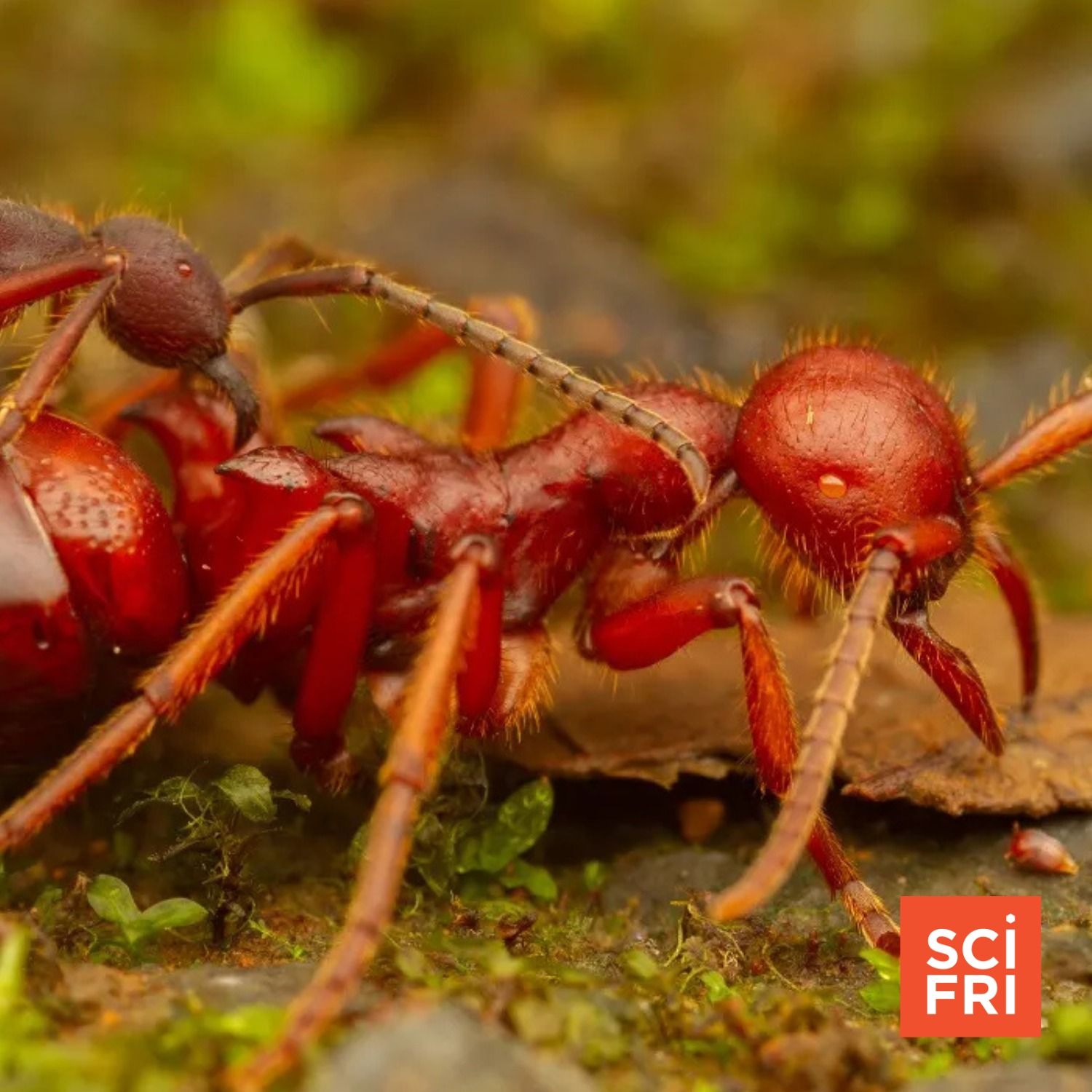
Overview of How A Woodpecker Pecks Wood, And How Ants Crown A Queen
This Science Friday episode (host Flora Lichtman) covers two short science stories: a biomechanical study that reveals how woodpeckers generate powerful, repeated pecks without injury; and new research into how ant larvae become queens versus workers, highlighting genetic and developmental controls of caste. Guests are Dr. Nick Antonsen (postdoc, Brown University) on woodpeckers and Dr. Daniel Kronauer (evolutionary biologist, Rockefeller University) on ants.
How a woodpecker pecks wood
Why study woodpeckers
- Woodpeckers perform extreme, high‑impact pecking (drilling into wood) that exceeds typical bird pecking performance.
- Studying such extreme behaviors reveals limits and specializations of muscle, respiratory, and skeletal systems.
Methods
- Researchers instrumented eight downy woodpeckers with tiny muscle monitors (EMG/pressure sensors) and filmed them with high‑speed video in a lab chamber.
- Birds wore custom backpacks to carry sensors and were given a variety of woods to peck.
Key findings
- Force concentration: woodpeckers deliver pecking forces of about 20–30 times their body weight, focused to a very small contact area.
- Whole‑body choreography: pecking engages muscles across the whole body, not just the head/neck. Sequence includes:
- Neck muscles initiating the forward motion
- Hip flexors pulling the body forward
- Tail bracing against the tree
- Posterior head/neck muscles stiffening the head
- Abdominal muscles exhaling during the strike to stabilize the core
- Respiratory timing (the “grunt”): woodpeckers exhale through each strike — up to ~13 exhalations/strikes per second — and inhale very quickly (~40 ms) between strikes. Exhaling stabilizes the core and adds power, analogous to athletes vocalizing during a strike.
- Precision: muscle activation timing is highly repeatable and precisely ordered during repetitive strikes.
- Injury avoidance myth busted: the idea that a woodpecker’s tongue wraps around the brain to cushion it is incorrect. The tongue wraps around the outside of the skull as a storage/launch mechanism for feeding (it has a barbed tip to spear insects). Woodpeckers avoid concussions largely because their brains are very small — low mass produces lower absolute G‑forces on the brain.
Implications / takeaways
- Pecking is an integrated whole‑body behavior combining biomechanics and respiratory control.
- Respiratory exhalation during impact is an underappreciated mechanism for adding strike power and stability.
- The tongue-as-shock-absorber story is a myth; the tongue is principally a long, projectile feeding tool.
How ant queens are crowned
Background
- Ant colonies produce different castes (queens vs. workers) from genetically identical eggs — a classic example of phenotypic plasticity.
- Diet/feeding during larval development is a major environmental factor (e.g., more food often leads to queen development). Workers typically control larval feeding.
New study findings (Daniel Kronauer)
- There are two genetic components influencing queen development:
- Genes that affect body size (and thus the likelihood of becoming a queen because size is a key cue).
- Genes that alter the relationship between body size and caste outcome — i.e., genotypes that trigger queen development at smaller sizes.
- In other words: some genotypes produce queens by making individuals larger; other genotypes lower the size threshold required to trigger queen development — two different routes to becoming a queen.
- Timing of caste determination varies across ant species: in some species it’s set very early (egg stage), in others relatively late (larval/pupal transition).
- Ant colonies often produce many potential queens (hundreds to thousands) during reproductive episodes; only some go on to found new colonies after mating flights.
Why it's a hot topic
- It addresses fundamental questions of nature vs. nurture, developmental plasticity, and how a single genome can yield strikingly different adult forms (the “superorganism” and stem‑cell analogies).
- Understanding molecular/developmental mechanisms is an active area for future research.
Implications / takeaways
- Caste fate is controlled by an interaction of genes and environment (especially nutrition and worker provisioning).
- There isn’t a single mechanism; evolution has produced multiple genetic/developmental ways to produce queens.
- The queen’s role is primarily reproductive (long‑lived egg layer), not social ruler, complicating anthropomorphic ideas of “royalty.”
Notable quotes & soundbites
- “A woodpecker can peck at about 20 to 30 times their body weight.”
- “The grunt is actually making them stronger” — exhalation during each strike stabilizes and adds power.
- “There are two different ways to be a queen… one is to be larger and one is to have a genotype where queen development sets on at smaller body sizes.”
References / credits
- Woodpecker study: Dr. Nick Antonsen — NSF postdoctoral research fellow, Brown University; paper published in Journal of Experimental Biology.
- Ant caste research: Dr. Daniel Kronauer — Rockefeller University; work on clonal raider ants and developmental/genetic control of caste.
- Episode host: Flora Lichtman; Science Friday / WNYC Studios.
If you want the original papers or specific citations mentioned in the show, look up the Journal of Experimental Biology paper by Nick Antonsen et al. (woodpecker EMG/high‑speed study) and recent caste‑determination work from Daniel Kronauer’s lab on clonal raider ants.