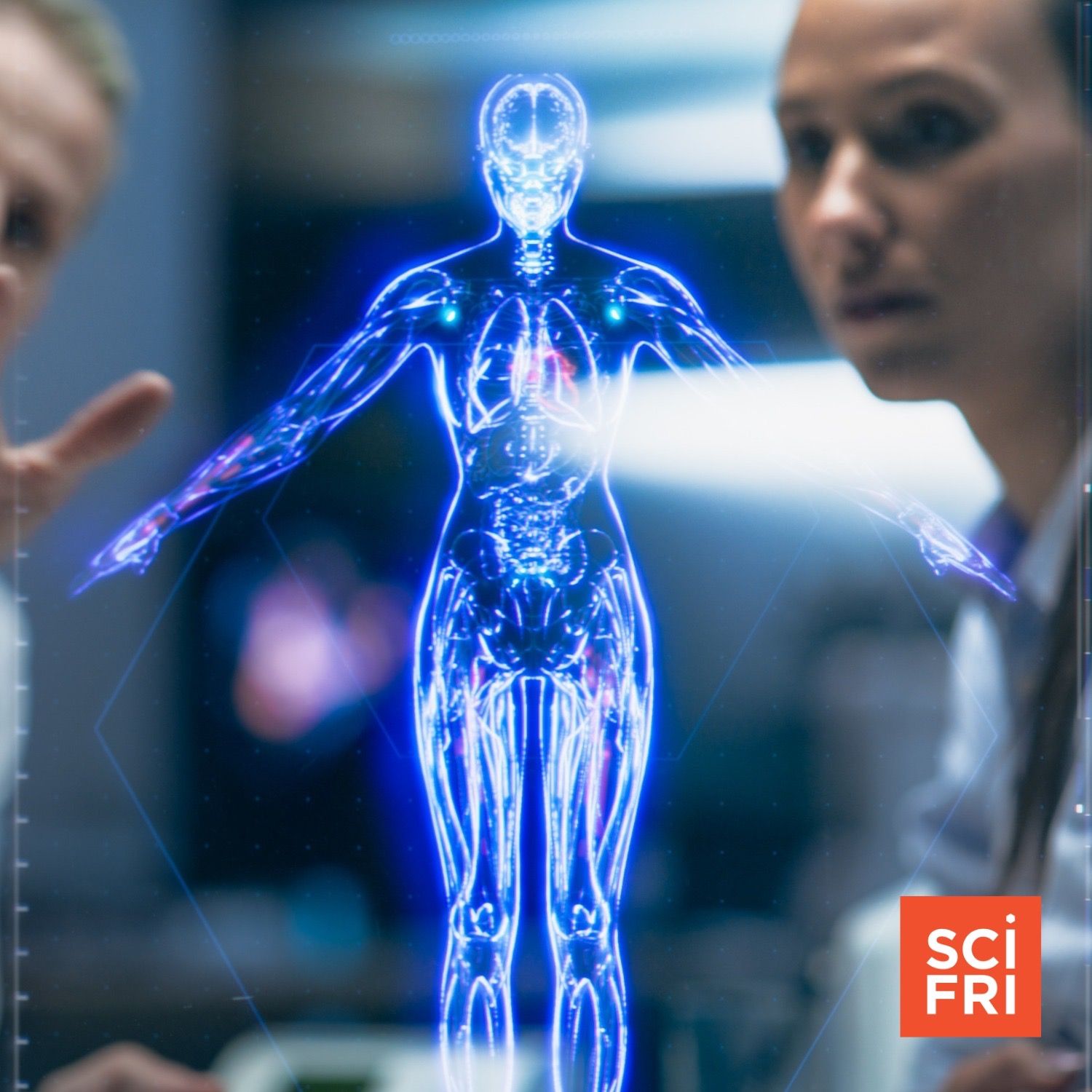
Overview of Science Friday — Could a ‘digital twin’ help you get better health care?
This episode explores the emerging concept of “digital twins” in medicine: dynamic digital models built from a person’s health data (genetics, labs, imaging, history) that simulate how that individual might respond to treatments. Radiation oncologist Dr. Caroline Chung (MD Anderson) explains what digital twins are, where the idea came from (aerospace), how they’re being developed (mechanistic, AI, and hybrid models), clinical use cases, data and technical limits, and the ethical, legal and practical challenges to making them part of routine care.
Key points and takeaways
- Definition: A medical digital twin is more than a static avatar or aggregate record — it’s a predictive, continuously updated simulation that interacts with new data and guides decisions over time.
- Origin: Concept comes from aerospace engineering, where digital replicas are used to test and predict failures before building expensive physical prototypes.
- Model types: Physics-informed/mechanistic models, AI-only models, and hybrid models (combining both). Mechanistic models help constrain predictions and avoid implausible outputs.
- Fit-for-purpose approach: Full “virtual human” twins are an aspiration, but most practical applications will be targeted twins built to answer specific clinical questions.
- Data readiness: Some systems (e.g., cardiovascular flow mechanics) are well-suited to modeling; many areas of biology remain incomplete, requiring more research and data.
- Clinical promise: Personalized radiation dosing, cardiology flow simulations (predictive catheterization), personalized screening schedules, and optimized chemotherapy scheduling are concrete examples with early evidence or trials.
- Risks and challenges: privacy and identifiability, ownership/access to twins, liability for incorrect predictions, clinician overreliance on algorithms (automation bias), and equity/access issues.
- Implementation needs: robust data flows, legal/regulatory frameworks, clinical trials, thoughtful user-interface design to create cognitive pause and preserve human judgment.
Examples / use cases (clinical)
Radiation oncology
- Digital twins can help identify subregions of tumors that need higher radiation doses and areas of normal tissue to spare.
- Goal: adapt radiation plans early in treatment for better tumor control and reduced toxicity.
- MD Anderson is designing clinical trials and has colleagues (e.g., Heiko Enderling) running related studies.
Cardiology
- Models of blood flow and vessel mechanics can help predict who needs catheterization or intervention before catastrophic events.
Cancer screening and chemotherapy
- Personalized screening intervals based on individualized risk rather than one-size-fits-all schedules.
- Simulation studies suggest that the same total chemotherapy dose given on different schedules can produce different outcomes—personalized timing may improve efficacy without extra drugs.
Technical approaches & data readiness
- Physics-informed / mechanistic models: use known physical laws (e.g., fluid dynamics) and are valuable where biology is well-characterized (e.g., heart flow).
- AI models: useful when patterns are learned from large datasets, but risk producing nonsensical outputs without constraints.
- Hybrid models: combine mechanistic constraints with AI flexibility — often a preferred path for safety and plausibility.
- Data gaps: biological complexity and incomplete molecular knowledge limit where full, accurate twins are possible today.
- Infrastructure: maintaining a living twin needs continuous data pipelines, software, and model support — access and portability are nontrivial.
Ethical, legal, privacy & safety concerns
- Ownership and access: who owns a digital twin? Even if patients “own” it, technical and institutional dependencies may limit practical access.
- Identifiability: aggregating many unique data elements increases the risk of re-identification.
- Liability: who is responsible if the twin’s recommendation leads to harm — model creators, clinicians, or institutions?
- Automation bias: humans tend to defer to algorithmic outputs; clinicians need tools and training to critically evaluate model suggestions.
- Equity: data collection and operational deployment must avoid widening disparities in access to these technologies.
Implementation challenges & recommended next steps
- Determine fit-for-purpose uses first (targeted twins for specific clinical questions) rather than attempting a monolithic virtual human.
- Run prospective clinical trials to validate benefits and harms (MD Anderson and others are starting this work).
- Build legal/regulatory frameworks for ownership, liability, transparency, and data governance.
- Design clinician-facing interfaces that produce a “pause” for critical thinking (reduce automation bias).
- Invest in interoperable data pipelines and affordable infrastructure so twins don’t become accessible only to well-resourced centers.
- Prioritize privacy-by-design and minimize identifiability when merging multiple data types.
Notable quotes & insights
- “A digital twin is more than just a model… it really is an ongoing interaction between what the model will predict, your actions based on what information you receive, and continued data collection to update the information and predictions.” — Dr. Caroline Chung
- “A digital twin really needs to be fit for purpose… what are we actually using it for?” — emphasizes pragmatic design and cost/benefit.
- On human-machine interaction: design and presentation matter — we need ways to prompt critical thinking rather than faster unquestioned acceptance.
Bottom line
Digital twins hold clear promise for more personalized, adaptive medical care in areas like oncology and cardiology, but major technical, clinical validation, privacy, legal, and human-factors issues remain. Short-term progress will likely come from targeted, well-validated twins answering specific clinical questions rather than an all-encompassing virtual human.