Overview of Science Friday — "CERN finds a new particle + News alerts for the cosmos"
This episode covers two short science news segments. First, Hassan Jawahari (University of Maryland, member of the LHCb collaboration) explains LHCb’s observation of a new composite particle — a “heavy proton” made of two charm quarks and one down quark. Second, Dr. Eric Bellm (Rubin Observatory alert product lead) describes the Rubin Observatory’s real‑time astronomical alert stream, its first test run (∼800,000 alerts in one night), and how researchers will filter and act on millions of nightly alerts once operations ramp up.
LHCb: a new “heavy proton” observed
- What was found
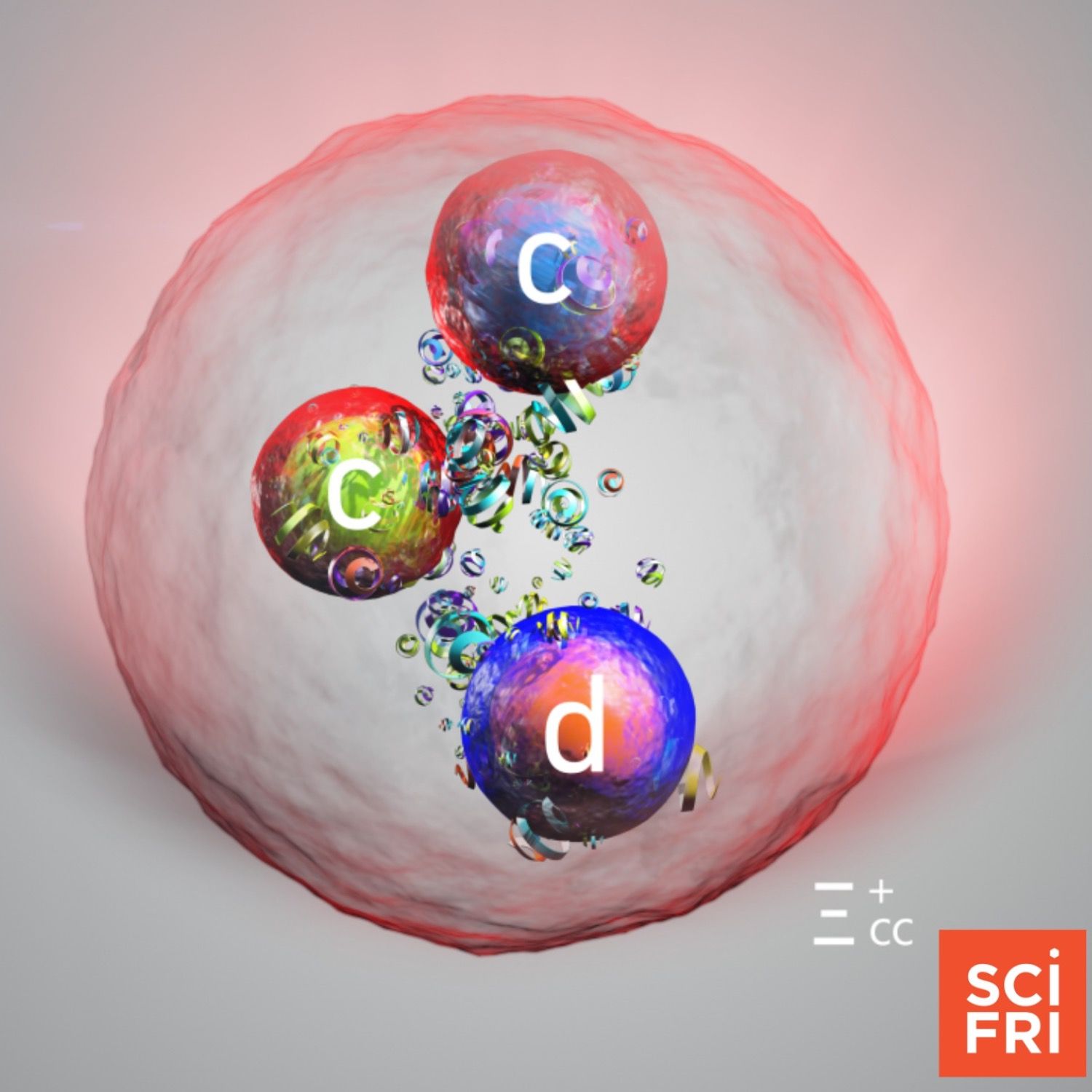
- LHCb reports the first observation of a baryon composed of two charm quarks and one down quark (cc d).
- Described as “proton-like” because, like a proton, it’s a three‑quark composite; two light up quarks of a proton are replaced by heavier charm quarks.
- Key properties
- Mass: roughly four times the proton’s mass (because charm quarks are much heavier).
- Lifetime: extremely short — less than a few trillionths of a second (so it cannot form atoms or macroscopic matter).
- Significance
- This is not a new fundamental particle; it’s a new bound state of quarks predicted by theory.
- Observation matches theoretical predictions for mass and (so far) lifetime, reinforcing confidence in our understanding of quark interactions.
- Finding required improved sensitivity from LHC upgrades and long data runs.
- What’s next
- Measure more properties of this baryon (quantum numbers, decay modes) as more data accumulate.
- Search for related states (e.g., two charm + strange quark).
- Continued LHCb work on B‑quark physics and CP violation — central to probing why the universe is matter dominated.
Rubin Observatory: astronomy alert stream and early test
- What Rubin does
- Rubin will repeatedly image the entire southern sky, taking an exposure roughly every 30 seconds.
- Images are sent from Chile to a processing center (SLAC, California) where they’re differenced against stacked reference images to detect changes.
- First test results
- On the first test night the system produced about 800,000 alerts (expected to scale to ~7 million/night at full ops).
- Early interesting finds included rapidly rotating asteroids.
- What triggers an alert
- Any moving, brightening, dimming, or changing source: asteroids, supernovae, variable stars, and rare/transient phenomena.
- Latency and follow-up
- Alerts are generated within minutes of image acquisition to enable rapid follow-up.
- Some follow-up is automated (robotic telescopes triggered by preset filters), but humans often remain in the loop—especially to trigger scarce resources like Hubble or JWST.
- Major challenges
- Filtering: extracting the small subset of scientifically interesting alerts from millions per night.
- Solution approaches: machine learning and classification algorithms, human vetting, curated summary products.
- Public and amateur involvement
- Primary audience is professional astronomers, but Rubin has education/outreach plans and will provide summary products that amateurs can use to participate.
Key takeaways
- LHCb’s new baryon (cc d) confirms theoretical expectations about heavy-quark bound states and showcases improved detection capability from collider upgrades.
- The particle’s properties (mass, short lifetime) are consistent with predictions; more data are needed to probe detailed behavior and any surprises.
- Rubin Observatory’s alert stream will produce huge volumes of change-detection alerts (millions/night); filtering and classification are the central technical and scientific challenge.
- Rapid alerts open opportunities for both automated and human-directed follow-up, enabling time-critical science (fading transients, fast rotators, etc.).
Notable quotes
- On the new particle’s lifetime: “Lives fast, dies young.” (describing how short-lived heavy-quark baryons are)
- On alert volume: Rubin’s test “went ding” about 800,000 times the first night — and will be much larger at full scale.
Action items & resources
- For readers/listeners interested in following these stories:
- Watch for the LHCb collaboration paper(s) and press releases for measured properties and decay modes as more data are analyzed.
- Rubin Observatory will publish alert access procedures, developer tools, and outreach projects — sign up for Rubin or affiliated data/education channels to receive summaries tailored for professionals or the public.
- If you’re an amateur astronomer: look out for Rubin public summaries and outreach projects that will highlight follow-up opportunities.
Producer note: This episode was produced by Charles Bergquist; hosts and guests include Flora/Laura Lichtman (hosts), Hassan Jawahari (LHCb), and Dr. Eric Bellm (Rubin Observatory).