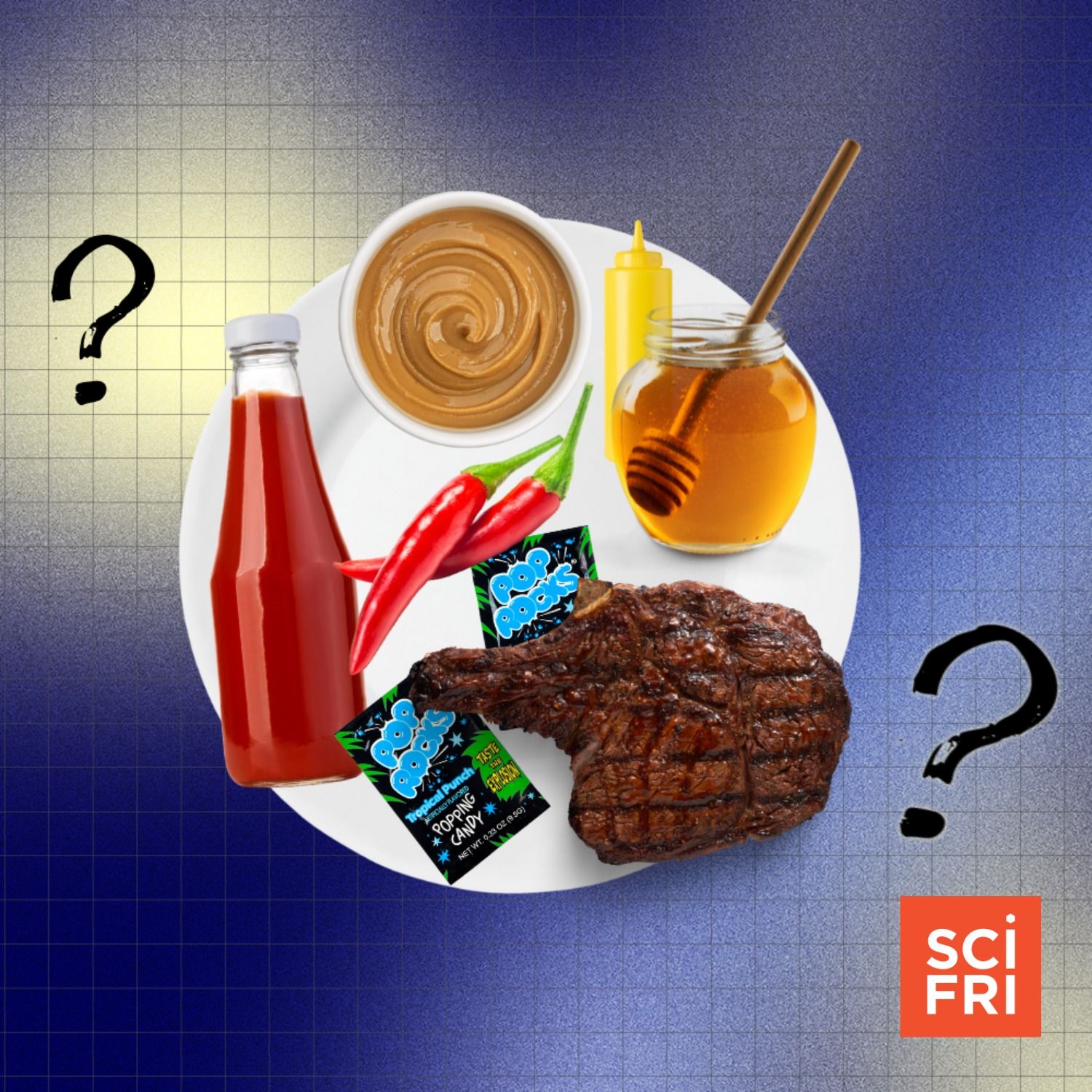
Overview of Attention, Trivia Nerds! It’s A Food Science Fact Feast (Science Friday)
A light, game-show-style episode of Science Friday (host Flora Lichtman) featuring food-science trivia. Flora and trivia co-host Mangesh Hatikudur quiz a caller, Emily (a medical student and former state trivia champ), on five food-science questions. Each question sparks short explanations and related food-science facts from experts. The segment is playful but informative — good for listeners who want quick, memorable food-science takeaways.
Key takeaways
- Pandas have lost the ability to taste umami (savory) because their ancestors were carnivores; modern pandas subsist largely on bamboo.
- The Maillard reaction causes browning and complex flavor in cooked foods (bread, meat, coffee); more browning with higher sugar/protein and under alkaline conditions.
- The Scoville scale (Wilbur Scoville) quantifies chili heat by how much dilution is required to eliminate perceived burn.
- The pungency of chili peppers comes from the placental tissue/veins (the inner walls), not the seeds.
- Under extreme pressure, carbon-rich foods (notably peanut butter in an experiment) can be transformed into microscopic diamonds.
- Honey is effectively nonperishable: low moisture, acidity, and hydrogen peroxide content prevent spoilage — archaeologists have found edible ancient honey.
Trivia Q&A (questions, answers, short explanations)
-
Q: Pandas are unable to detect which basic taste?
A: Umami (D).
Explanation: Panda ancestors were carnivores; over evolution on a bamboo diet they lost functional umami taste receptors. -
Q: What happens when a food experiences a Maillard reaction?
A: It turns brown (B).
Explanation: The Maillard reaction (named for a French chemist) creates browned color and complex flavors in baked/cooked foods. To enhance browning: add sugar or protein/amino acids, and increase alkalinity (e.g., a bit of baking soda). Acid reduces browning. -
Q: Which American pharmacist developed a scale to measure chili pungency?
A: Wilbur Scoville (A).
Explanation: The Scoville scale measures the dilution needed before the burn is no longer detected. -
Q: Which part of a chili contains most of its heat? (Related fact)
A: The veins/placental tissue (not the seeds).
Explanation: Capsaicin is concentrated in the inner ribs/veins; seeds are adjacent but not the source. -
Q: Which food is so carbon-rich it can be made into a diamond?
A: Peanut butter (B).
Explanation: In lab experiments recreating lower-mantle pressures, carbon-rich peanut butter has been converted into microscopic diamonds. -
Q: Honey is one of the few foods that can never do what?
A: Expire (A).
Explanation: Extremely low moisture, acidity, and naturally occurring hydrogen peroxide inhibit microbe growth; archaeologists have found 3,000-year-old honey still edible.
Notable quotes and expert tips
- Ariel Johnson (food scientist): “If you want more browning… add more sugar or protein/amino acids. Browning increases under alkaline conditions and decreases under acidic conditions — a little baking soda increases browning.”
- Paul Bosland (Chili Pepper Institute): The heat is in the veins/placental tissue; the seeds have little to no capsaicin.
Fun facts & vivid details
- Pandas can spend up to 12 hours a day eating 80–100 pounds of bamboo to meet calorie needs; they digest only a fraction.
- The Scoville scale is based on human sensory dilution tests (later adapted to chemical measurements).
- Lab-made microscopic diamonds have been produced from peanut butter under extreme pressure.
- Honey’s preservation properties have enabled millennia-long survival in archaeological finds.
Episode outcome & prizes
- Contestant Emily won Science Friday & Part-Time Genius merch, an atomic fireball candy, a bottle of Linneweber’s Hot Honey (winner at the Scovie Awards — local to Indiana), and the playful title/crown for the Superfood Science Excellence Trivia Blowout (SFS ETBO).
Who this is for
- Casual listeners who like quick, memorable food-science facts.
- Trivia fans wanting concise question-and-answer takeaways.
- Home cooks curious about browning (Maillard) and practical tips (use sugar/protein, tweak pH).
Produced by Science Friday; episode tone is entertaining and educational.