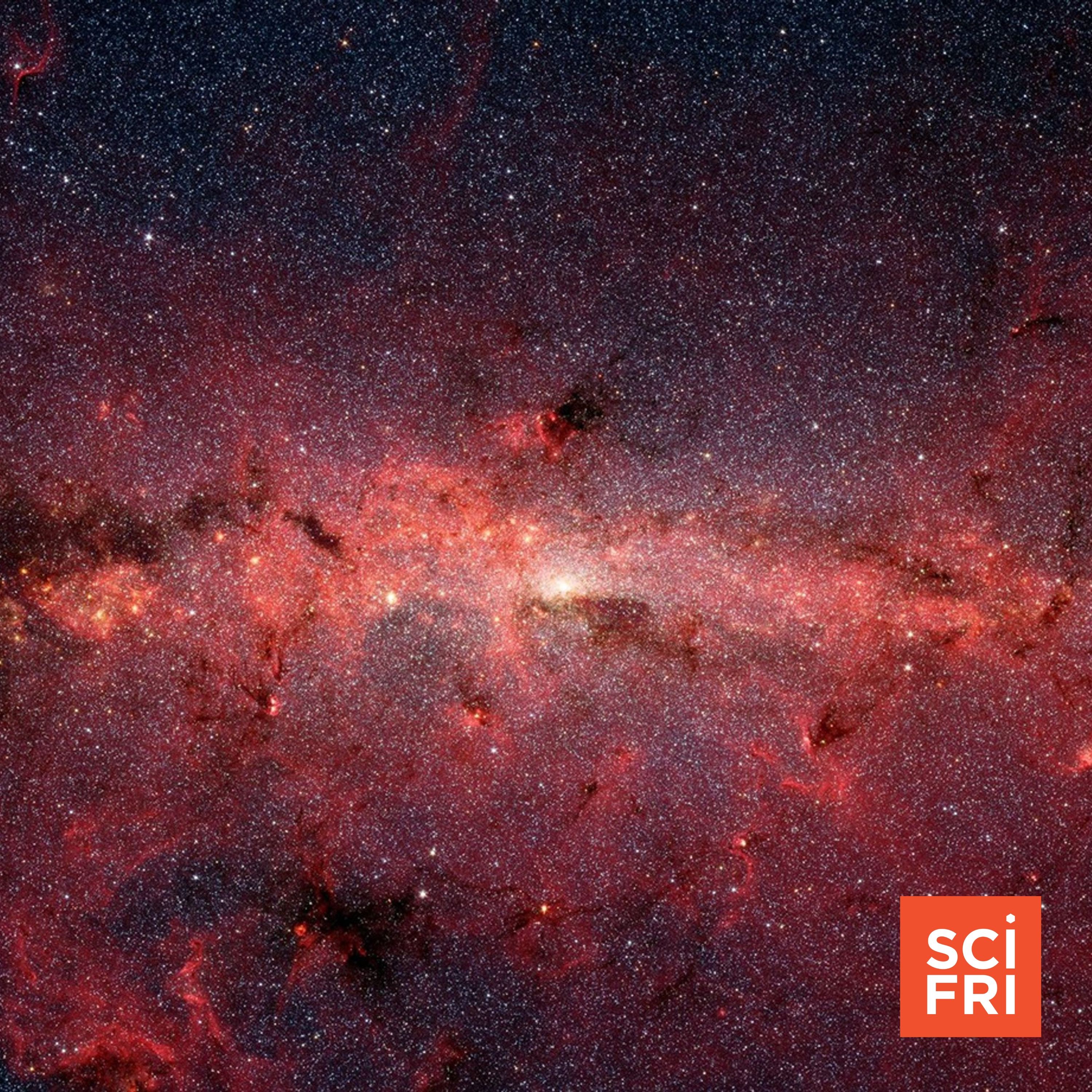
Overview of Peering through dust clouds to the center of the galaxy
This Science Friday interview with Nobel laureate Andrea Ghez explores how she and her team used high-resolution observations to peer through the dust at the center of the Milky Way and prove there is a supermassive compact object there—now understood to be the black hole Sagittarius A*. The conversation also covers how the discovery was made, what it means for our understanding of galaxies and gravity, and Ghez’s own perspective on doing science over the long term.
Main Discovery: The Milky Way’s Central Black Hole
- Ghez’s work revealed that the center of our galaxy contains about 4 million times the mass of the Sun packed into a region roughly the size of our solar system.
- That density ruled out alternative explanations and strongly supported the existence of a supermassive black hole.
- She shared the 2020 Nobel Prize in Physics with Reinhard Genzel for this discovery.
Why it mattered
- Before these observations, scientists debated whether a supermassive black hole really existed at the center of the Milky Way.
- Her measurements helped move the field from “maybe” to “almost certainly,” and eventually to “all alternatives are ruled out.”
How the Discovery Was Made
Tracking stars near the galactic center
- Ghez’s group followed the motions of individual stars close to the center of the galaxy.
- The key idea: stars orbiting near the center act as probes of the mass hidden inside their orbits.
Technology and methodology
- The work depended on the newly opened Keck Telescope, then the largest telescope in the world.
- Because Earth’s atmosphere blurs images, Ghez used techniques to correct for that distortion and sharpen the view.
- The process unfolded in stages:
- Detect the stars and measure their motion across the sky.
- Observe their motion bending into arcs, showing acceleration.
- Measure full orbital paths, which dramatically strengthened the evidence.
The scale of the challenge
- The final evidence was described as a roughly 10 million-fold improvement over earlier constraints.
- Even the initial proposal was rejected because reviewers doubted the technique and whether stellar motion could be detected at all.
What We Still Don’t Know
Black holes remain conceptually mysterious
- Ghez emphasizes that while scientists know a black hole is something with gravity so intense that not even light can escape, they still do not have a complete physics description of what a black hole is.
- Black holes sit at the intersection of:
- General relativity
- Quantum mechanics
Big open questions
- How do black holes actually form?
- Do they form before galaxies, after them, or together?
- How does gravity behave near the event horizon?
- How do black holes influence the formation and evolution of their host galaxies?
Theory, Observations, and Scientific Debate
- Ghez strongly argues that theory and observation depend on each other.
- She sees skepticism not as a setback, but as a sign that the work matters:
- Criticism forces stronger tests.
- Alternative explanations sharpen the science.
- Debate can help justify more telescope time and better measurements.
Her view of uncertainty
- Ghez says she is most engaged when she is most confused.
- She frames science as a puzzle: the best problems are the ones that are difficult but still solvable with the right tools and patience.
The Event Horizon Telescope and the “Image” of a Black Hole
- Ghez praises the Event Horizon Telescope for producing the famous black hole image.
- She notes that it is not a photograph of the black hole itself, since black holes emit no light.
- What we see is really the shadow of the black hole and light being bent by its gravity.
- She sees that project as both a scientific breakthrough and a major public-engagement success.
Ghez’s Personal Path in Science
- Ghez describes herself as an observational astrophysicist who enjoys the interplay between technology, data, and theory.
- She says growing up around both science and art shaped her thinking:
- Her father was a professor.
- Her uncle was a physicist.
- Her mother ran a contemporary art gallery.
- She draws a parallel between art and science:
- Both expand how we see the world.
- Both rely on new ways of looking.
Key Takeaways
- The Milky Way’s center contains a supermassive black hole.
- The discovery came from tracking stellar orbits over many years with advanced telescope techniques.
- The result helped settle a major astrophysical debate and opened new questions about:
- black hole formation,
- galaxy evolution,
- and the nature of gravity itself.
- Ghez’s career reflects the value of patience, persistence, and curiosity in long-term scientific work.
Notable Insight
- Ghez’s central scientific philosophy is that confusion is productive: when observations don’t fit neatly into existing models, that is often where the most important discoveries begin.