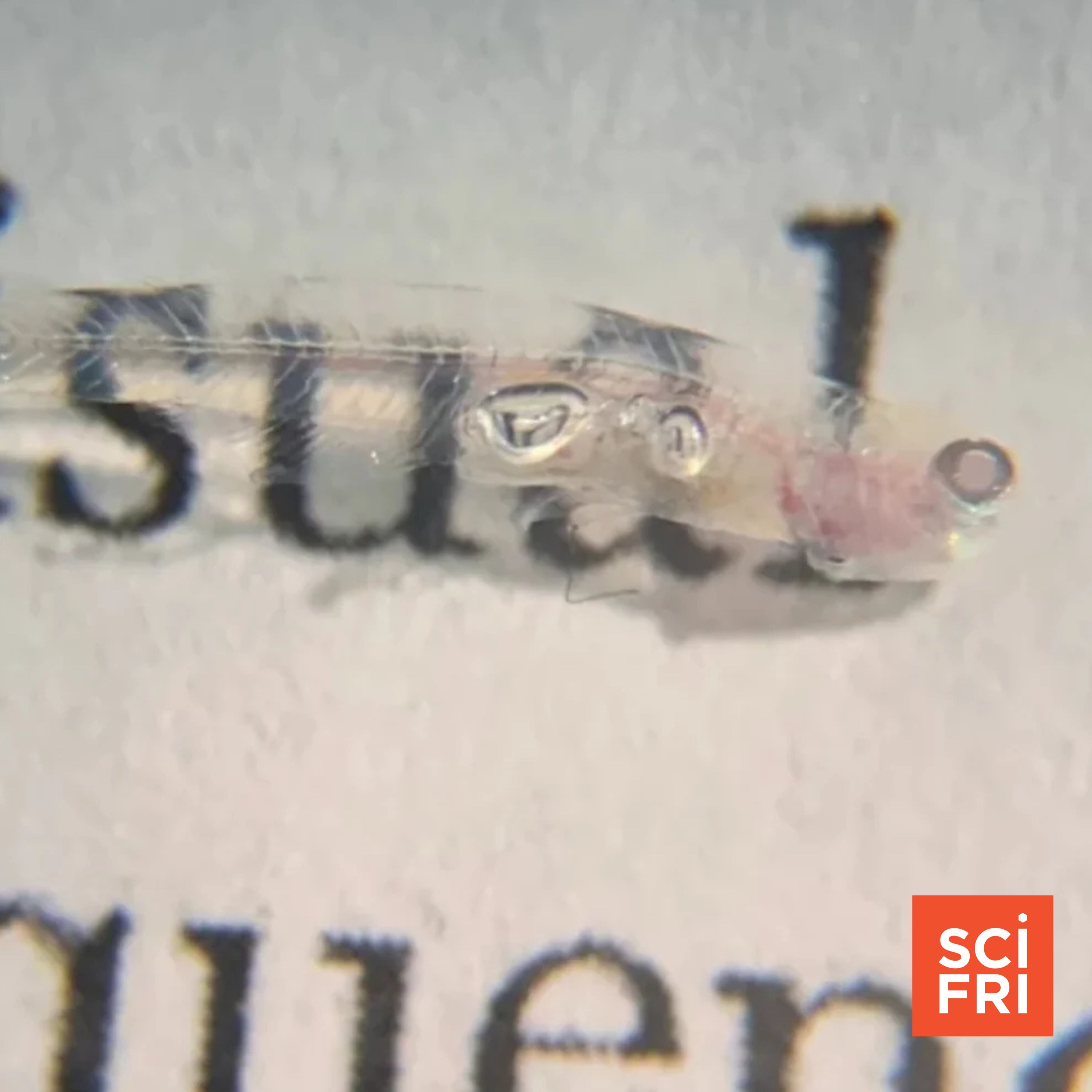
Overview of Meet the tiny, see-through fish that can regenerate its brain
This Science Friday segment spotlights a tiny transparent fish from the Danionella genus that is emerging as a powerful new model organism for studying regeneration. Because its body is see-through, scientists can watch internal organs—including the brain—during injury and repair in real time. The fish is also unusually regenerative, able to regrow parts of its body and brain, making it a promising tool for understanding how tissues rebuild themselves and what that might eventually reveal about human neurodegeneration and repair.
Why this fish is exciting
A new model organism for regeneration
- Dr. Dennis Ottobai/Attobai at MIT’s Whitehead Institute says he was searching for a species where regeneration could be observed as it happens, rather than inferred from snapshots.
- He found this fish through an old fish-keeping magazine reference and obtained starter fish from labs in Europe.
- Once in the lab, the team had to optimize water conditions, pH, and husbandry—turning the project into a mix of neuroscience and aquarium expertise.
Key traits that make it useful
- Transparent body: lets researchers see organs and brain structure directly.
- Brain regeneration: the fish can recover from brain injury.
- Miniaturized body: small enough to build a whole-body single-cell atlas.
- Vocalization: males make audible sounds, opening another avenue for behavioral and communication studies.
What researchers have learned so far
The fish is highly regenerative
- Initial experiments involved small injuries to the tail and brain.
- Results showed the fish is extremely regenerative, confirming it as a serious candidate for studying tissue repair.
A single-cell atlas of the whole animal
- Because the fish is so small, researchers mapped hundreds of thousands of cells across the body.
- The atlas shows which genes are active in each cell type and where cells are located in relation to one another.
- This gives scientists a detailed view of tissue organization and possible regeneration niches in the brain.
Big questions scientists want to answer
How does regeneration actually work?
- What molecular and cellular programs replace missing tissue?
- How do new neurons integrate into existing brain circuits?
What happens to brain activity during repair?
- Researchers want to know whether regeneration recreates developmental-like neural activity patterns.
Can the body compensate when regeneration is incomplete?
- The team is also interested in how tissues reorganize to recover function when full regeneration is not possible.
Why this matters for medicine
- The long-term hope is that understanding regeneration in fish could uncover conserved biological mechanisms relevant to humans.
- This could eventually inform treatments for neurodegenerative diseases and other conditions where specific cells are lost.
- The idea is not immediate clinical translation, but foundational biology that could one day support cell replacement or repair strategies.
Expert perspective from Alejandro Sanchez Alvarado
Why transparency matters
- He argues the fish’s biggest advantage is that its transparency makes internal biology visible in a way most vertebrate models are not.
- He compares its importance to the leap from fruit flies to transparent C. elegans in developmental biology.
Important caveat
- The fish is an adult larva in developmental terms, due to a process called progenesis.
- That means scientists must be careful when applying findings from this fish to fully developed adult brains.
The frontier: cell plasticity
- One major question in regeneration research is whether differentiated cells are truly “terminal” or more flexible than assumed.
- He suggests cells may be stably differentiated rather than permanently locked into one identity.
- This opens the possibility that existing cells might be reprogrammed to support repair instead of being replaced.
Examples from nature that inspire the field
- Salamander eye regeneration: pigmented retinal cells can dedifferentiate and become lens tissue.
- Jellyfish life-cycle reversal: some jellyfish can revert from adult form back to a polyp under stress.
- These examples reinforce the idea that dramatic cellular reprogramming is not science fiction—it already exists in nature.
Main takeaway
The episode argues that this tiny transparent fish could become a major new regeneration model because it combines visibility, miniature anatomy, and unusual repair ability. Scientists hope it will help answer foundational questions about how brains and tissues regrow, how cells change identity, and whether those insights can eventually inform human medicine.