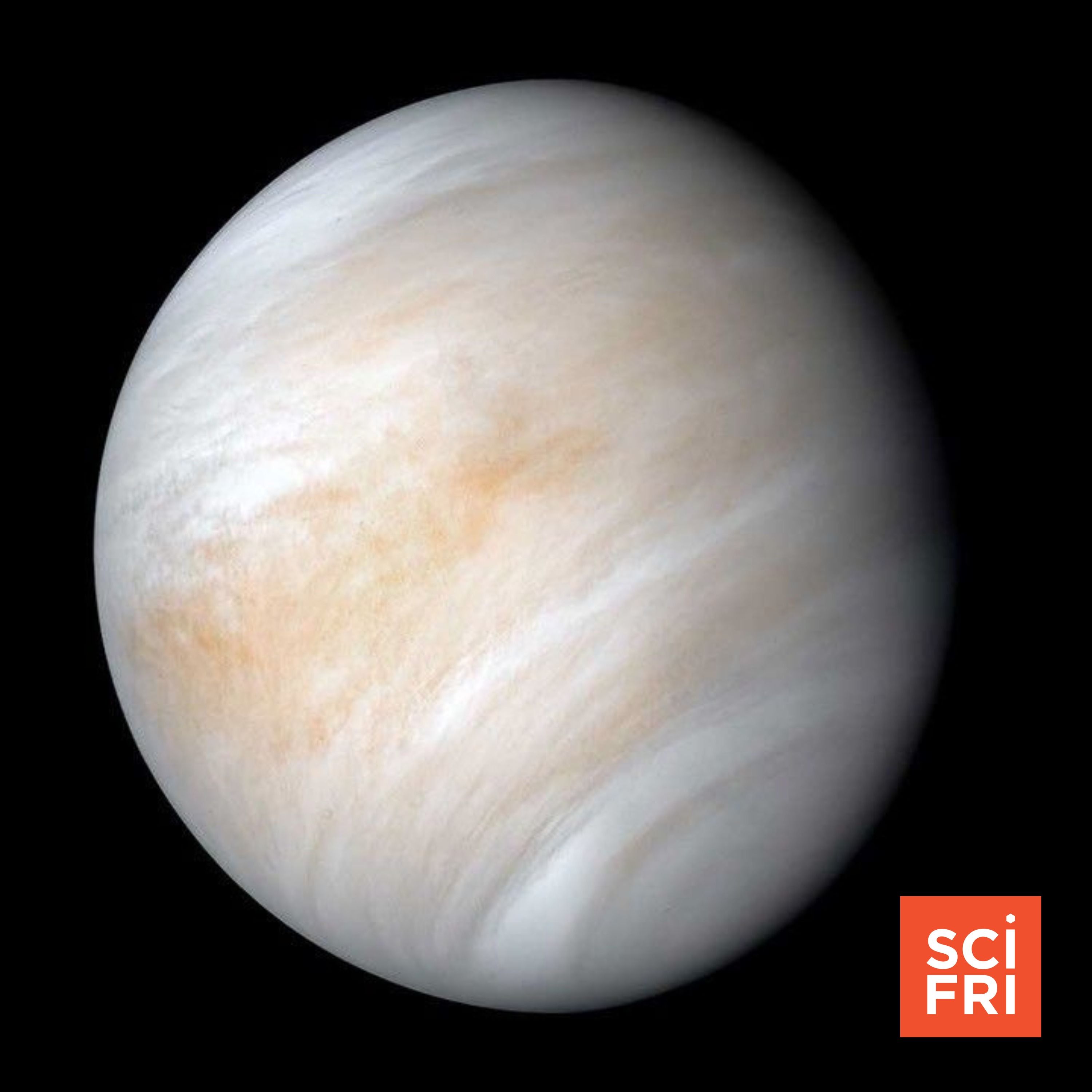
Overview of Looking for Life in the Clouds of Venus
In this Science Friday interview, astrophysicist and planetary scientist Dr. Sarah Seager explains why Venus—despite its scorching surface and acidic atmosphere—has become a serious target in the search for extraterrestrial life. Seager argues that the cloud layer of Venus may offer the right temperature, energy, and liquid environment for some form of primitive life, and she outlines her team’s plan to test that idea through a staged series of missions. The conversation also explores the scientific controversy around phosphine on Venus, the difficulty of defining biosignatures, and how Venus research could reshape the search for life on exoplanets.
Why Scientists Are Looking at Venus
Venus is hostile on the surface, but the clouds are different
- Venus’s surface is extremely hot—hot enough to melt lead.
- Its atmosphere is mostly carbon dioxide and its clouds contain sulfuric acid.
- But conditions change with altitude: higher in the atmosphere, temperatures become much more Earth-like.
- Seager’s key point: if life only needs:
- the right temperature,
- an energy source,
- and a liquid medium, then the Venus cloud layer becomes scientifically interesting.
The idea is not new
- The notion that Venus could host life in its clouds goes back to Carl Sagan, who first raised the possibility decades ago based on basic habitability principles.
What Kind of Life Could Exist There?
If life exists, it would likely be very primitive
- Seager emphasizes that any Venus life would probably be single-celled and extremely simple.
- It would almost certainly not be Earth life:
- Earth DNA is rapidly destroyed in sulfuric acid.
- Venus organisms, if they exist, would need a very different biochemistry.
Scientists are testing what chemistry can survive
Her team is investigating whether key life-like molecules can remain stable in Venus-like conditions:
-
Lipids / membrane-like molecules
- Some lipids can self-assemble into vesicles even in concentrated sulfuric acid.
- This suggests that primitive compartment-like structures might be possible.
-
Amino acids
- Seager’s group tested the 20 biogenic amino acids in concentrated sulfuric acid.
- Most remained stable, though some were chemically modified.
-
Peptides
- Ongoing work is exploring whether amino acids can join into peptides and remain stable.
-
Information-bearing molecules
- DNA and RNA would not survive Venus cloud chemistry.
- Her team found that PNA (peptide nucleic acid), a synthetic DNA-like molecule, is stable in concentrated sulfuric acid up to about 50°C.
How Would Scientists Know Life Is There?
Detecting life is a chemistry problem
- Scientists often look for complex molecules that are unlikely to form without biology.
- The challenge is deciding where the line is between:
- molecules that could be made by non-living chemistry, and
- molecules that are so complex they likely require life.
There is no perfect biosignature
- Seager points out that the “life/no-life” threshold is always changing.
- Even if a molecule looks biologically suspicious, scientists still have to ask:
- Is it really there?
- Is it the right molecule?
- Could geology or atmospheric chemistry explain it?
The Morning Star Missions to Venus
A staged mission strategy
Seager is part of an international consortium called the Morning Star Missions to Venus. The plan is not a single “find life” mission, but a step-by-step program:
- Search for organic molecules
- Identify specific complex organics
- Eventually return a sample to Earth
The first mission is already taking shape
- The first spacecraft is being developed in partnership with Rocket Lab.
- It will send a small capsule into Venus’s atmosphere.
- The capsule is designed to survive entry long enough to spend about five minutes in the clouds.
- Key components include:
- a science instrument,
- an entry vehicle,
- a NASA Ames heat shield,
- and an internal pressure vessel.
Launch timing depends on the rocket
- The mission moved from Rocket Lab’s Electron rocket to the larger Neutron rocket.
- Venus launch windows occur roughly every 18 months, so the team is aiming for the next available window after Neutron is ready.
The Phosphine Debate and Why It Matters
The controversial Venus phosphine claim
- Seager helped think through biosignatures after a reported detection of phosphine in Venus’s atmosphere.
- Phosphine matters because on Earth it is associated mostly with life or human industrial production.
Why the claim became controversial
The discussion around phosphine centered on three questions:
- Was the signal real?
- Was the signal correctly identified as phosphine?
- If it was phosphine, was it produced by life or by some unknown chemical process?
Seager notes that the data are public and that scientists strongly disagree on each point.
Why Venus is still valuable
- Venus is nearby, observable, and reachable with spacecraft.
- That makes it a much better test case than exoplanets, where signals are far weaker and far more ambiguous.
- Studying Venus may help scientists understand false positives and improve future life-detection strategies.
Why This Matters Beyond Venus
Implications for exoplanets
Seager says Venus research is already changing how scientists think about planets around other stars:
- Earth twins may not be the norm—Venus twins could be common.
- Earth and Venus are similar in size and composition, yet evolved very differently.
- That suggests even more dramatic planetary diversity may exist elsewhere.
Exoplanet life detection is much harder
- Exoplanets are incredibly distant and usually only detectable by tiny spectral signals.
- Even if a biosignature is found, scientists will still argue over:
- whether the signal is real,
- whether it is the right molecule,
- and whether it truly indicates life.
A future telescope Seager loves
- Her dream instrument is the Solar Gravitational Lens Telescope.
- It would place a telescope far beyond Pluto and use the Sun’s gravity as a lens.
- In theory, it could magnify a distant exoplanet enough to produce a much more detailed image than current telescopes can.
Seager’s View on the Work
Why she changed focus
Seager gives two reasons:
- Her exoplanet work had matured, and she likes to be where new fields are emerging.
- She remains deeply motivated by the search for life and by the possibility that Venus may offer a nearer, more testable case.
She sees Venus as a bold but legitimate frontier
- She acknowledges that many scientists remain skeptical.
- But she compares the skepticism to earlier resistance in exoplanet science.
- Her message: ambitious ideas often sound unlikely until the evidence accumulates.
Key Takeaways
- Venus is not obviously habitable, but its cloud layer may have the right basic ingredients for life.
- Seager’s team is testing whether life-like chemistry can survive sulfuric acid.
- The Morning Star Missions to Venus aim to build evidence gradually, from organics to sample return.
- The controversial phosphine claim shows how hard biosignature detection is.
- Venus may serve as a crucial testbed for understanding life detection on exoplanets.
- Seager’s long-term vision includes both Venus sample return and next-generation telescopes capable of seeing distant worlds in unprecedented detail.