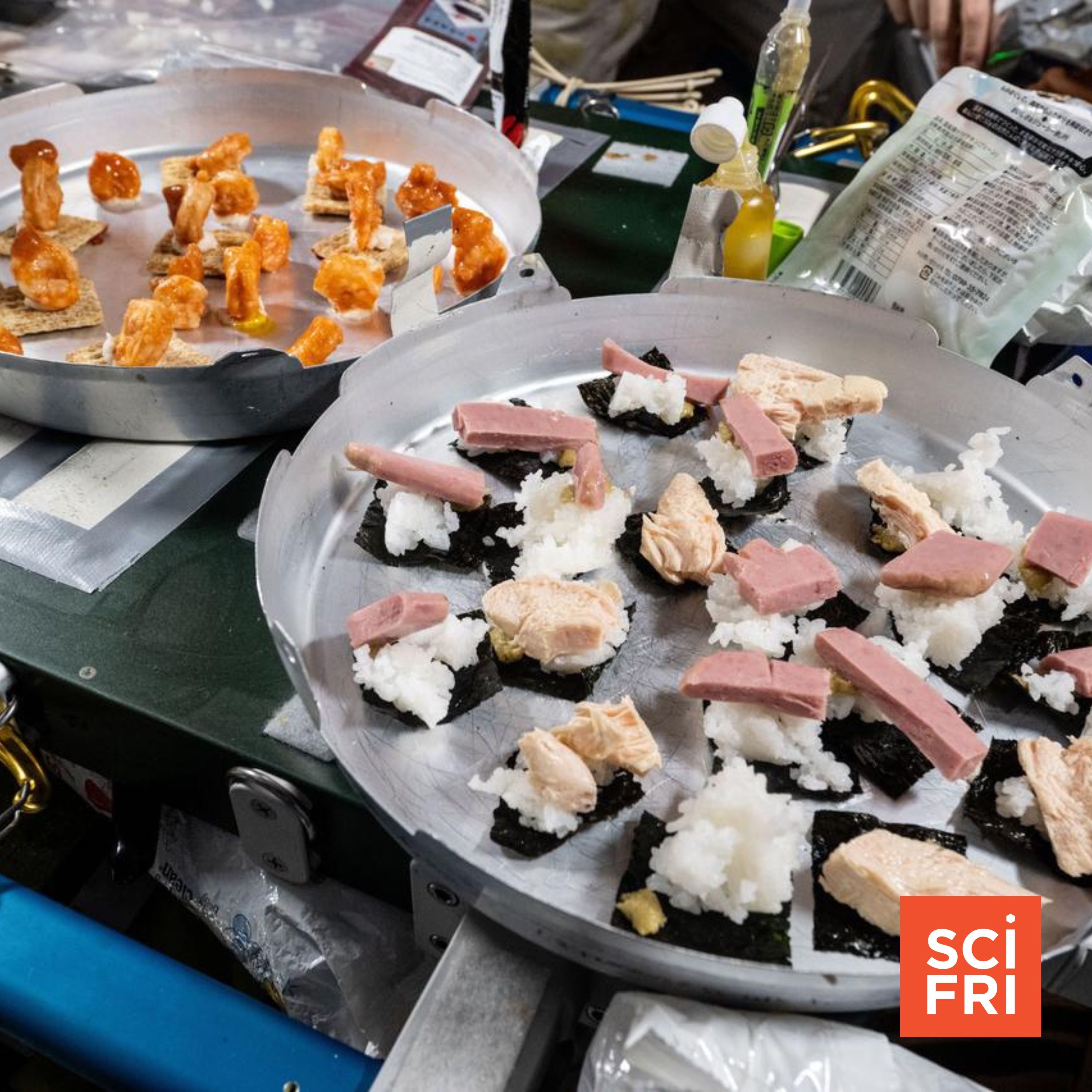
Overview of How can astronaut food be better?
This Science Friday episode explores why astronaut food still lags behind Earth cuisine and what it would take to make meals more enjoyable on long missions to the Moon and Mars. Host Flora Lichtman speaks with retired NASA astronaut Clayton Anderson and Houston chef David Skinner about the challenges of eating in space, why astronauts often crave bold flavors, and how scent, texture, and presentation could transform the space dining experience.
Key takeaways
-
Space food is designed for function first, flavor second.
- NASA prioritizes nutrition, safety, weight, and shelf stability.
- Taste and visual appeal have historically been less important than calories and practicality.
-
Astronauts lose some taste and smell in microgravity.
- Fluid shifts in space can make sinuses feel congested, similar to having a head cold.
- Because flavor perception is muted, astronauts often prefer strong, pungent foods.
-
Shrimp cocktail is a surprisingly popular astronaut favorite.
- Its horseradish gives a strong sinus-clearing kick.
- When rehydrated properly, it can be genuinely tasty in space.
-
Condiments are essential.
- NASA sends lots of sauces and flavor boosters to help otherwise bland meals taste better.
- Bold add-ons like mustard or spicy sauces can make a big difference.
-
Long-duration missions will require more than “fuel.”
- For a trip to Mars, food may need to support not just nutrition, but also morale, comfort, and psychological well-being.
Ideas for better astronaut meals
Flavor and aroma matter more than we think
David Skinner argues that space food should engage all senses, not just taste. He describes how restaurants can alter lighting, music, and smell to change the dining experience, and suggests NASA could use:
- Scent packets to simulate the aroma of foods and environments
- Carefully chosen flavor pairings to boost perception
- Textural tricks so food feels familiar even in a compact form
Compact, high-impact food design
Skinner’s restaurant work focuses on packing maximum flavor into a small bite—something especially useful in space where weight and volume matter.
Examples he mentioned:
- A BLT-style tomato that tastes and feels like a full sandwich bite
- Encapsulated dishes like French onion soup in a single bite-sized sphere
A “solar system” menu for Mars
Skinner imagined a futuristic space meal made of floating edible spheres, arranged like a miniature solar system. Each sphere could represent a different course, making the meal:
- Easy to eat in microgravity
- Visually fun
- More memorable and comforting
Why this matters for Mars missions
Clayton Anderson emphasizes that NASA is excellent at the technical side of space travel, but future missions also need to address the mental and emotional side of living in isolation for months.
His main point:
- Food can be a powerful tool for comfort, routine, and morale
- Smell, memory, and sensory experience could help astronauts cope with stress and homesickness
- “Big impact, low weight” solutions will be crucial for deep space travel
Notable insights
- “Nobody eats astronaut ice cream” — Clayton Anderson dismisses the iconic novelty food as more gimmick than real space meal.
- Strong flavors like horseradish, mustard, and spicy condiments are popular because they cut through muted taste in space.
- Food isn’t just sustenance on a Mars mission; it may be a key part of psychological survival.
Listener prompt
The episode closes by asking listeners:
- What food would you want on a trip to Mars?
- What meal never gets old for you?
- What food brings you comfort and why?
Bottom line
Astronaut food may improve dramatically if designers think beyond nutrition and start treating meals as a full sensory and emotional experience. For future Moon and Mars missions, the best space food may be the kind that tastes good, smells familiar, feels satisfying, and helps astronauts feel human.