Overview of Help! This new dwarf planet needs a name
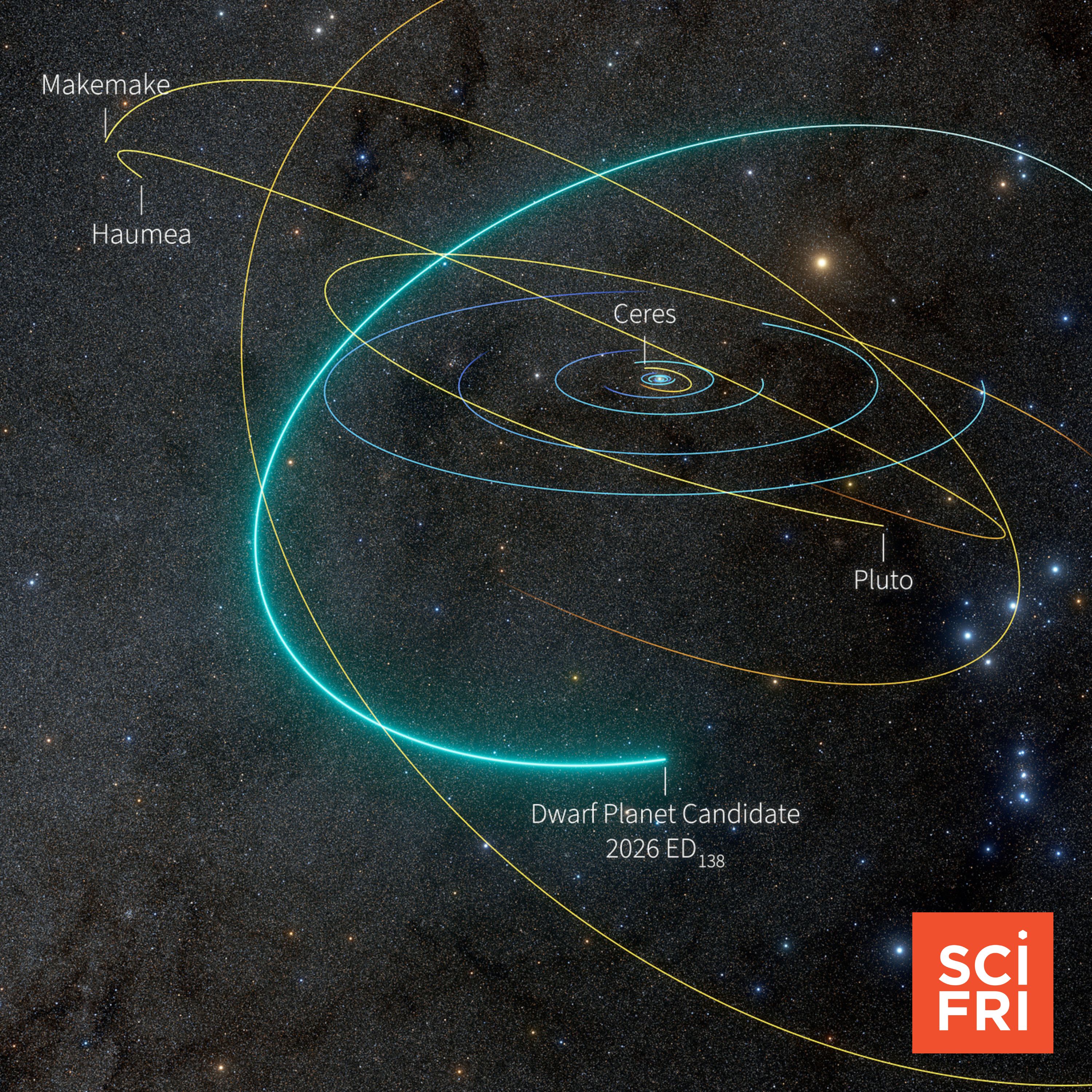
Science Friday discusses the likely discovery of a new dwarf planet beyond Neptune in the Kuiper Belt, currently designated 2026 ED138. The segment features astronomer Dr. Matthew Holman, who explains how the object was found, what scientists know about it so far, why it has been so hard to detect, and why naming it is now part of the conversation.
Discovery and what scientists know
- The object was spotted by the Vera Rubin Observatory.
- It is considered a likely dwarf planet, but researchers still need additional measurements to confirm its true size and nature.
- Scientists currently know:
- It appears fairly red.
- Its estimated diameter is somewhere between 600 and 1,500 kilometers.
- It is smaller than Pluto (about 2,400 kilometers across).
How scientists confirm a dwarf planet
Holman explains that discovery is only the first step. To confirm whether an object is truly a dwarf planet, scientists need to determine whether gravity has made it spherical.
Methods used to measure size
- Thermal infrared observations: measure heat emitted by the object to estimate its size.
- Occultations: track when the object passes in front of background stars to infer its dimensions.
Why brightness alone is not enough
- The light seen from the object is reflected sunlight.
- A bright object could be:
- a large, dark body, or
- a smaller, highly reflective body
- Scientists need more data to distinguish between those possibilities.
Why it was only found now
Holman says 2026 ED138 likely went undetected for so long for two main reasons:
- It is positioned in the southern sky, making it harder or impossible for many northern observatories to see.
- For about 25 years, it has been moving across the Milky Way, where dense star fields make moving objects much harder to identify.
What its color may mean
- Its red color suggests it may not have the fresh icy frost seen on larger dwarf planets like Pluto.
- That does not mean it is necessarily non-icy overall—the surface may be red while the interior could still be icy.
- Scientists do not yet know its density or mass, so its composition remains uncertain.
How many more objects may be out there?
Holman suggests there may still be:
- 1 to 3 similarly bright objects left to discover in the Kuiper Belt
- potentially many more, fainter objects that are even farther away and harder to detect
He notes that brightness drops off quickly with distance, making distant objects dramatically harder to see.
Naming the new dwarf planet
A major theme of the segment is the search for a better name than 2026 ED138.
Naming ideas discussed
- Holman says names for distant outer-solar-system objects have often come from:
- creation gods
- mythological figures from different cultures
- He mentions suggestions tied to:
- Wampanoag creation traditions
- groups in Chile
- themes of hiddenness or something recently revealed
The show’s call for listener ideas
- The program invites listeners to suggest names.
- The underlying theme Holman likes is:
- something hidden for a long time that has now come into view
- a symbol of hope and the fact that the solar system still holds surprises
Key takeaway
This segment highlights both the excitement and caution of scientific discovery: astronomers may have found a new dwarf planet, but they still need more data to confirm it. Beyond the science, the story underscores a larger idea—that the outer solar system remains full of unexplored objects, and naming this one is part of bringing it into the public imagination.