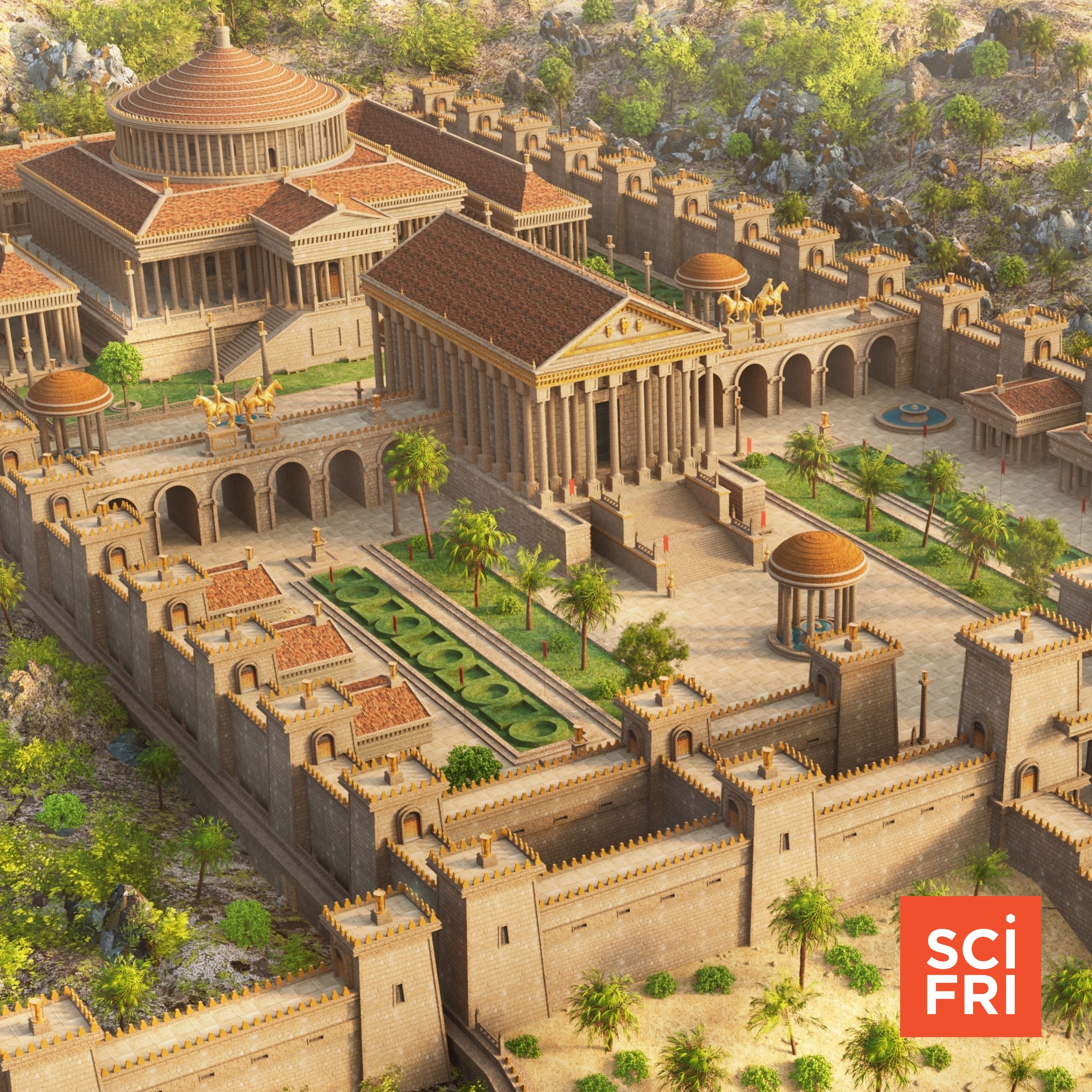
Overview of Did the fire at the Library of Alexandria set humanity back?
This Science Friday episode explores the loss of historical knowledge through the lens of the Library of Alexandria, one of the ancient world’s most important centers of learning. Ira Flatow speaks with author Sam Kean, whose book The Museum of Lost Things examines famous losses in history and what they reveal about how fragile knowledge can be. The discussion moves from the destruction of texts in Alexandria to surprising examples of rediscovered ancient technology, showing that the history of science and knowledge is far less linear than we often assume.
Key Discussion Points
The Library of Alexandria and the loss of knowledge
- The Library of Alexandria likely contained an enormous portion of the known world’s writing, including works from Greek, Roman, Persian, Middle Eastern, and possibly even Chinese sources.
- A fire in 48 BC, during Julius Caesar’s war in Alexandria, almost certainly occurred, but the full fate of the library remains uncertain.
- It’s unclear whether the main library was destroyed outright, rebuilt, or gradually declined through neglect after the Roman era.
How much was actually lost?
- Very little from the original library survives with certainty.
- Most famous ancient texts, like The Iliad, The Odyssey, Aristotle, and Plato, survived through other transmission chains.
- One surviving papyrus fragment is believed to have come from the library itself, based on a catalog list that would not have existed elsewhere.
Ancient knowledge may have been more advanced than we think
- Kean points out that the ancients built steam engines long before the modern industrial era.
- He argues that if this knowledge had been preserved and spread more effectively, technological development might have advanced much faster.
- The loss of knowledge may have caused long interruptions in progress rather than a simple, continuous timeline.
Notable Examples Discussed
The Antikythera mechanism
- Described as the world’s first computer, this ancient Greek mechanical device was used to predict astronomical events such as eclipses.
- It was discovered by chance by sponge divers near a Greek shipwreck.
- At first it looked like junk and might have been thrown away, but closer inspection revealed it contained intricate gears and extraordinary engineering.
- Its existence shows that advanced mechanical technology existed in antiquity, even if it was nearly forgotten.
Lost artifacts and accidental discoveries
- The episode notes that ancient papyri are sometimes recovered from mummies or from reused materials.
- New technologies such as infrared imaging and AI-assisted reading can sometimes recover burned or obscured text.
- This keeps open the possibility that more lost works may still be found.
Peking Man and rethinking ancient interpretation
- Kean mentions the lost Peking Man fossils as another major example of historical loss.
- He also references the idea that ancient people may have encountered dinosaur fossils or unusual carvings and interpreted them through their own cultural frameworks.
- This challenges modern assumptions that ancient people always lacked awareness of deep history or extinct creatures.
Main Takeaways
Knowledge is fragile
- History is full of losses caused by fire, war, neglect, and simple decay.
- Even major centers of learning can vanish if knowledge is concentrated in one place.
Preservation matters as much as invention
- If information is copied and distributed widely, it is more likely to survive.
- A centralized archive is powerful, but also vulnerable.
History is nonlinear
- Progress does not always move steadily forward.
- Civilizations can lose advanced knowledge and later rediscover it centuries afterward.
Archaeology is increasingly careful
- Modern researchers are paying more attention to context, not just headline artifacts.
- Small clues in soil, pollen, and surrounding material can help reconstruct what is missing.
Closing Thought
The episode’s broader message is that human knowledge has always been vulnerable to disappearance, and what survives today may be only a fraction of what once existed. Rather than seeing history as a simple march of progress, Kean encourages listeners to view it as a cycle of discovery, loss, and rediscovery.