Overview of Bizarre exoplanet clouds + Counting insects with weather radar
This Science Friday episode explores two unusual ways scientists are using technology to “see” the invisible: first, by detecting rock clouds on a distant exoplanet using transit spectroscopy with the James Webb Space Telescope, and second, by repurposing U.S. weather radar to estimate how many insects are flying overhead. Together, the segments show how modern observation tools are revealing surprising details about planets beyond our solar system and the living atmosphere above our own.
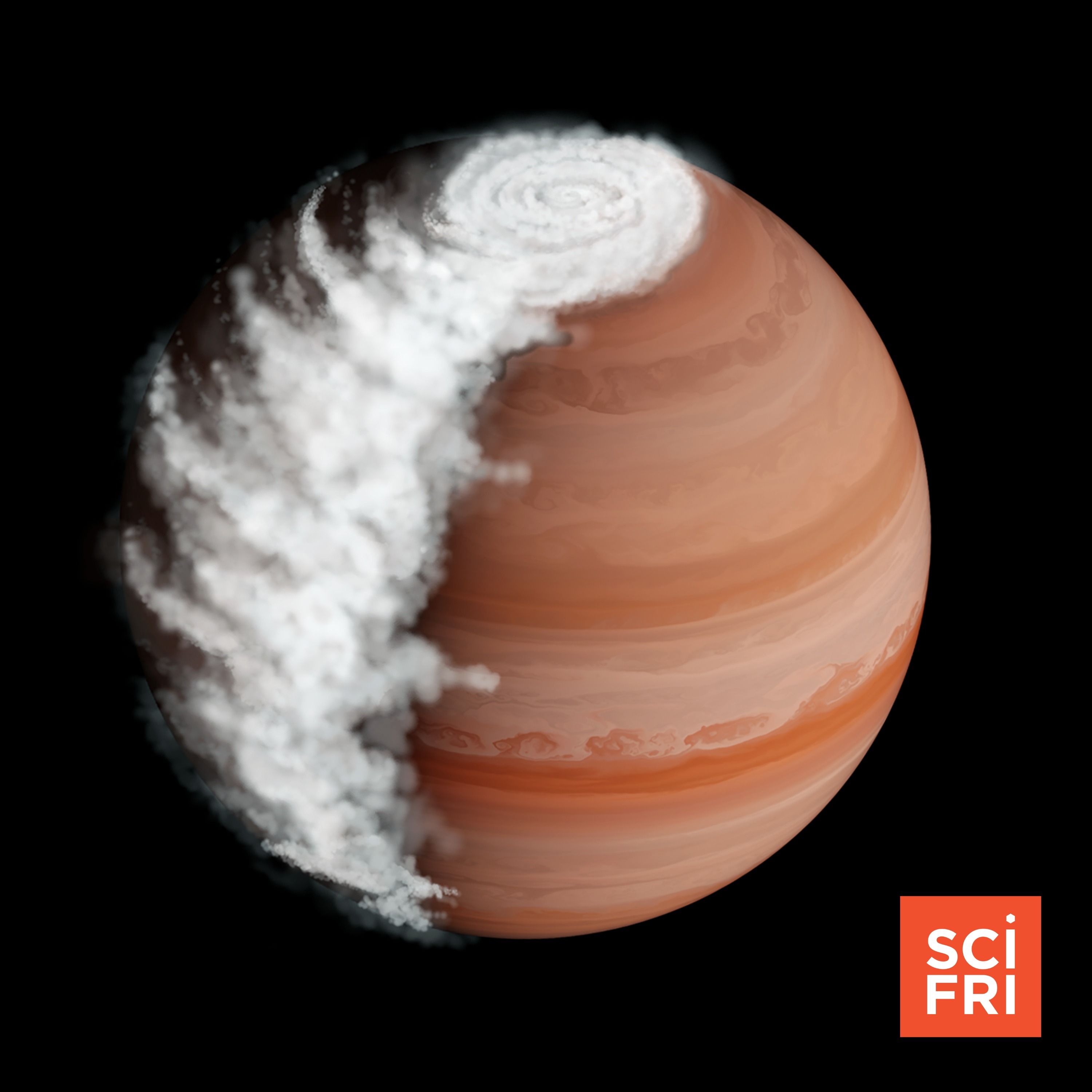
Bizarre Exoplanet Clouds: Rock Clouds on a Hot Jupiter
What scientists found
- Astronomers studied a hot Jupiter about 700 light-years away.
- Using the transit method—watching a star dim as a planet passes in front of it—they detected clouds in the planet’s atmosphere.
- The unusual part: these clouds are made of rocky material that can vaporize at extremely high temperatures and then condense into tiny particles.
What these clouds are like
- The planet’s atmosphere reaches about 1,500 Kelvin.
- At those temperatures, materials we think of as rock on Earth can exist as vapor.
- As the atmosphere cools, they condense into micron-sized particles, like tiny grains of sand or quartz crystals.
- The clouds are found very high in the atmosphere, even above the stratosphere and into the mesosphere, which was surprising because heavy particles were expected to fall lower.
Why the clouds stay aloft
- The high-altitude rock clouds suggest strong turbulent mixing in the planet’s atmosphere.
- This mixing keeps the particles suspended instead of letting them settle out quickly.
An interesting asymmetry
- The planet appears to be:
- Cloudy on the morning side
- Clear on the evening side
- The evening side is hotter, so the clouds can’t form there.
- The guest compared it to a morning fog that “burns off” later in the day.
Why this matters
- The James Webb Space Telescope can observe continuously for long periods and collect enough light quickly enough to catch the brief ~10-minute window needed for this measurement.
- Studying these clouds helps scientists:
- Separate cloud signals from atmospheric chemistry
- Infer how planets form and evolve
- Improve cloud modeling, which also matters for understanding Earth’s weather and climate
Key insight
- Clouds are not just a nuisance for astronomers; they may be one of the best clues to understanding both exoplanet atmospheres and the physics of clouds in general.
Counting Insects with Weather Radar
What the researchers did
- Scientists analyzed weather radar data across the contiguous United States over a 10-year period (2011–2021).
- They used radar originally designed for meteorology to estimate the amount of airborne insect biomass.
How many insects are in the air?
- On average, there were about 4.3 insects per square meter in the air.
- Extrapolated across the contiguous U.S., that comes out to roughly 100 trillion insects above us on a warm summer day.
What radar can and can’t tell us
- Radar can detect dense swarms or concentrations of insects high in the sky.
- It cannot identify species.
- The method is best for measuring:
- Abundance
- Broad spatial patterns
- Seasonal movement
- To determine which insects are present, researchers need to combine radar with local surveys or citizen science.
Major findings
- The team expected to find broad insect declines, but instead found that continental-scale insect abundance was fairly stable over the decade.
- That stability likely reflects a mix of:
- Species declining
- Other species increasing
- So the overall number can look steady even if the community is changing a lot.
Where insects are most and least abundant
- Insect-rich areas: the Gulf Coast and regions over the Great Plains, where conditions favor long-distance insect flight.
- Insect-poor or declining areas: places with
- Strong winter warming
- High levels of development
- Major land-use change
Migration vs. local activity
- In fall, many radar signals come from migrating insects moving to escape cold weather.
- In summer, much of the signal reflects local insects rising into the air and flying high.
Why this matters
- The study highlights radar as a powerful, standardized tool for long-term insect monitoring.
- It may help scientists detect future changes over larger time spans and better understand the so-called insect apocalypse.
Big Takeaways
- Exoplanets can have rock clouds: extreme temperatures can create atmospheres unlike anything on Earth, yet still governed by familiar cloud physics.
- JWST is opening new observational windows: it can catch short-lived transit events and separate atmospheric signals more precisely than Hubble.
- Weather radar is a surprisingly useful ecological tool: it can quantify huge numbers of insects across an entire continent.
- Both studies improve modeling:
- Exoplanet cloud studies help planet formation research
- Insect radar studies help track biodiversity and environmental change
Notable Insights
- “Clouds” are a universal feature, but not always made of water.
- The atmosphere of an exoplanet can be shaped by extreme mixing and temperature gradients.
- Radar can reveal biology in the sky, not just storms.
- A stable total insect count does not necessarily mean healthy ecosystems—species-level changes may still be dramatic.