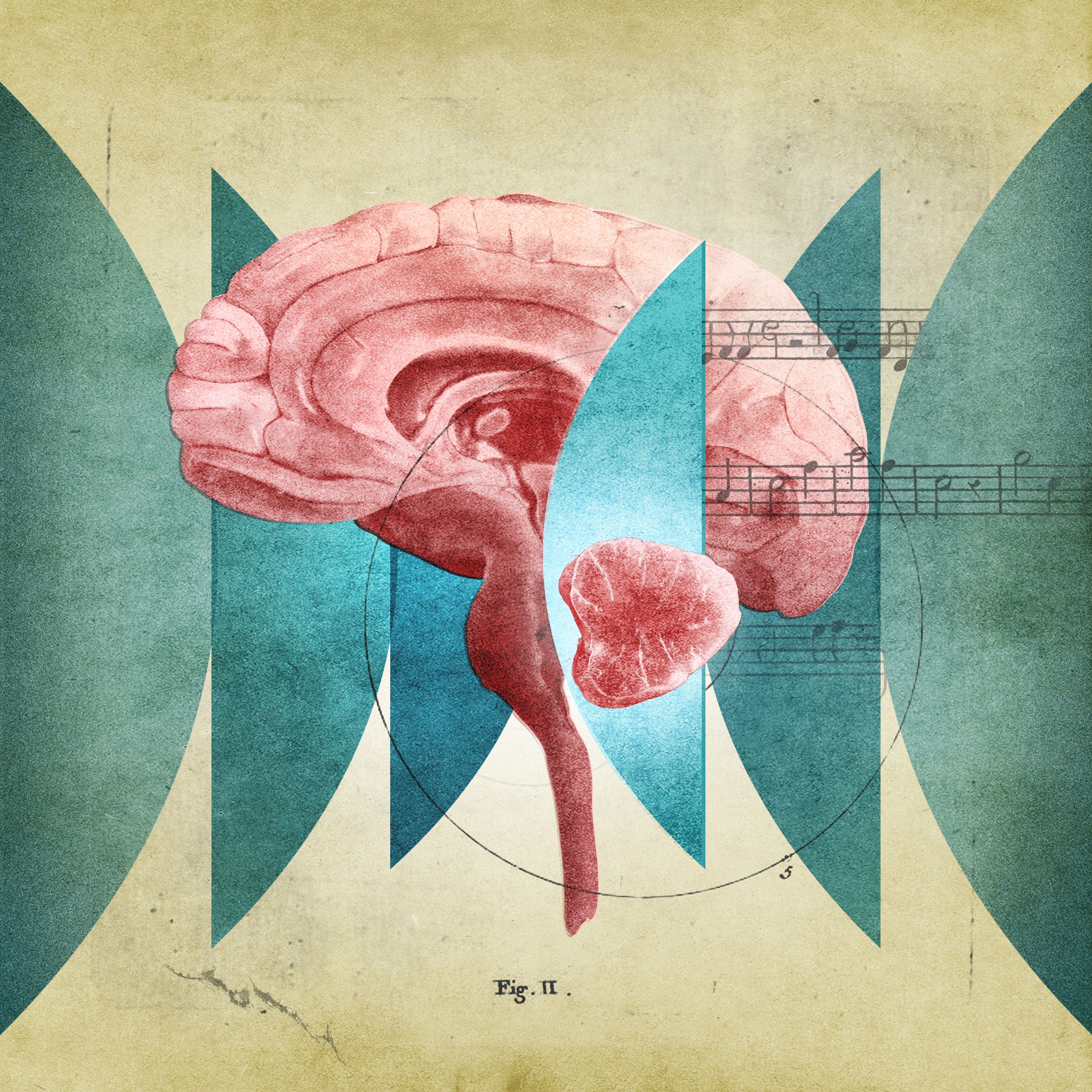
Overview of Song of the Cerebellum (Radiolab — WNYC Studios)
This Radiolab episode follows reporter Rachel Gross’s personal experience of a cerebellar stroke and uses her story to reframe how scientists now think about the cerebellum. Historically dismissed as a “little motor-only” part of the brain, current research shows the cerebellum is massively connected to the neocortex and involved in timing, sequencing, prediction across movement, language, cognition, and emotion. The episode mixes clinical case studies, evolutionary data, lab tracing work, and recovery strategies to argue the cerebellum is central to what makes thought and behavior fluid and social.
Main narrative — Rachel Gross’s story (concise)
- Rachel, a 35-year-old science journalist, experienced sudden breakdowns in coordinated speech and writing, slurred speech, and clumsy running after a week of odd symptoms.
- Hospital CT showed a bleed in the back of her brain; doctors diagnosed a cerebellar cavernoma and recommended surgery. A portion of her cerebellum was removed.
- Motor recovery (walking, writing spirals) largely returned, but she continued to experience:
- Timing/coordination problems in singing (karaoke)
- Persistent word-finding blocks and changes in the feel of spontaneous conversation
- Emotional “overshoots” (laughing too loudly, altered affect)
- A profound sense that her effortless self-expression had changed
- She pursued rehab strategically: voice lessons, practicing karaoke, working with speech pathology, and joining a stroke-survivor choir (Measure by Measure). Motivation and meaningful practice were emphasized as keys to recovery.
- A small, human epilogue: her altered karaoke performance led to meeting someone who DM’d her—an intimate, hopeful coda.
Science explained
Anatomy and connectivity
- Cerebellum = “little brain,” tucked under posterior cortex; about the size of a fist but highly folded and packed with neurons.
- It sits in its own membrane pocket and is richly interconnected with the neocortex through bidirectional pathways (tracer studies in rhesus monkeys showed cortical inputs to the cerebellum and returns to cortex).
- Many modern neuroimaging studies historically ignored or cropped out the cerebellum; some MRI setups even fail to cover it.
Evolutionary perspective
- Comparative work across primates shows cerebellum and cerebrum generally evolve together, but in apes (and especially humans) the cerebellum expanded rapidly—sometimes faster than the cortex.
- Although smaller than the neocortex in volume, the cerebellum contains roughly 80% of the brain’s neurons, meaning it’s hugely neuron-dense.
- Much of the enlarged human cerebellum is connected to non-motor (cognitive/emotional) cortical areas.
Function — what the cerebellum actually does
- Classic view: motor coordination, timing, smoothing movements (supported by WWI observations and lesion studies showing ataxia, dysmetria).
- Modern view: the cerebellum applies similar computational principles (sequencing, timing, prediction, error correction) to non-motor domains:
- Language production (timing and sequencing of utterances; contributes to fluency and word selection)
- Cognitive organization and planning (organizing idea sequences, decision timing)
- Emotion regulation and social attunement (calibrating emotional responses, “overshoot/undershoot” behaviors)
- Clinical examples: patients with cerebellar lesions can show aphasia-like symptoms, problems with planning, disinhibited or blunted affect—described in the episode as a “cerebellar cognitive affective syndrome.”
Key takeaways
- The cerebellum is far more than a motor control module: it’s deeply involved in timing, sequencing, and prediction across action, language, thought, and emotion.
- Damage to the cerebellum can produce subtle but profound changes in personality, speech fluency, emotional regulation, and one’s felt sense of self—not just clumsiness.
- Evolutionary and anatomical evidence supports a central, integrative role for the cerebellum in the human brain.
- Recovery leverages neural plasticity—motivation, meaningful practice, and targeted training (speech therapy, singing/choir, purposeful tasks) are crucial for rehabilitation.
Practical implications / recommendations (for listeners)
- If you or someone you know develops sudden coordination, speech, writing, or cognitive changes, seek immediate medical evaluation (strokes and bleeds require urgent care).
- Rehabilitation should be task-specific and motivating. Strategies that worked for Rachel include:
- Speech-language pathology for timing/fluency work
- Singing practice and voice lessons (singing requires complex coordination the cerebellum supports)
- Group music/choir participation for social attunement and motivation
- Repeated, meaningful practice (not just generic “exercises”) to engage plasticity
- Expect emotional complexity: regaining function may be as much about reconstructing a sense of self as about physical skills.
Notable quotes (selected)
- “The cerebellum is doing the same thing for our cognitive processes as it's doing for our body.”
- “Most of the human cerebellum has nothing to do with motor control.”
- “There is no point at which…we can recognize some magical transition from movement to thought—they're continuous with each other.”
People and studies mentioned
- Rachel Gross — reporter and stroke survivor (hosted segments).
- Jeremy (D.) Schmahmann — neurologist (cerebellar researcher; described patient cases and circuitry).
- Robert Barton — evolutionary biologist (comparative evolution of cerebellum).
- Henrietta Leiner — early advocate of cognitive role for cerebellum (historical note).
- David Eagleman — neuroscientist focused on plasticity and recovery (motivation for rehab).
- Speech pathologist Alison Hilger — on complexity of singing.
- Rhesus monkey tracer studies demonstrated cortico-cerebellar highways.
Further listening/reading
- Radiolab episode referenced: “Damn It, Basal Ganglia” (for another overlooked brain structure).
- Rachel Gross’s book: Vagina Obscura (mentioned as her prior work).
- Clinical literature on “cerebellar cognitive affective syndrome” and Jeremy Schmahmann’s research for deeper reading.
Credits: this summary reflects the Radiolab episode “Song of the Cerebellum” (WNYC Studios), reported by Rachel Gross; production and participants as credited in the episode.