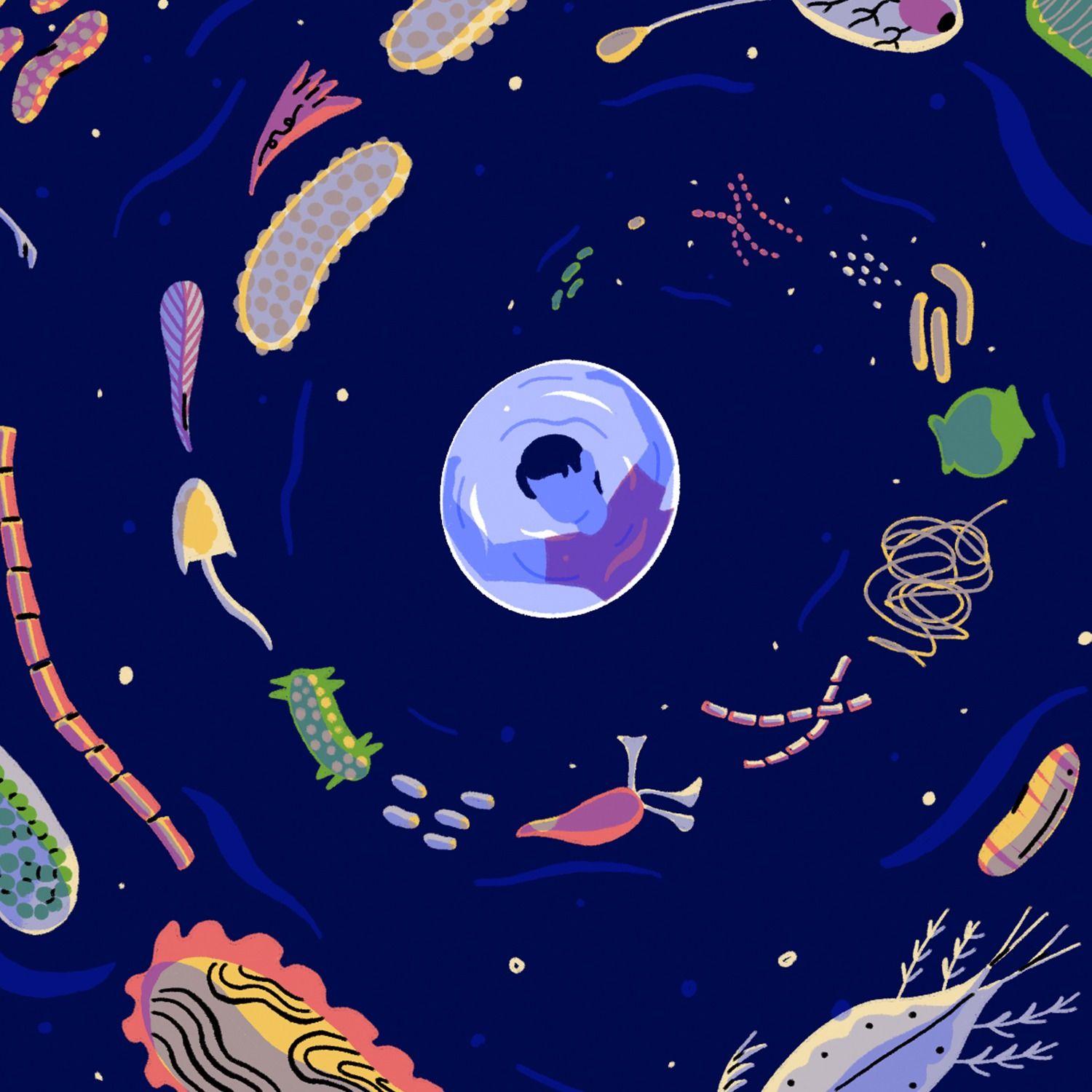
Overview of Life in a Barrel (Radiolab)
This episode frames a three-way “cage match” between order and chaos in biology. Three short stories—each reported by a different producer—ask whether life (from tiny lab ecosystems to mass extinctions to the origin of life) is ruled by predictable order or by deep contingency and chance. The episode mixes field/lab stories, a landmark computer experiment on fossil data, and origin-of-life debates to explore scientific and philosophical implications for conservation, meaning, and how we think about life itself.
Segment 1 — The Barrel That Refused to Settle (Rostock, Germany)
- Setup: Ecology professor Reinhard (Herkloss in the transcript) ran an innocuous experiment decades ago that left a 100-liter barrel of Baltic brackish water untouched under light as a control.
- Surprise: Years later the “control” barrel still teemed with phytoplankton, zooplankton and bacteria. Reinhard tracked it week-to-week for years.
- Finding: Instead of settling into a stable, predictable equilibrium (the “line” or the “circle”/cycle of life), species abundances swung wildly. Populations would dominate for many generations and then crash—sometimes never to return.
- Analysis: The data fit chaotic dynamics—not randomness per se but systems that are short-term predictable and long-term unpredictable. Elisa Benincà (theoretical ecologist) helped analyze the dataset and characterized it as chaos: you can forecast briefly, but not far ahead.
- Reactions & replication: Reinhard published in Nature and faced pushback (what does chaos mean for restoration ecology?). Hendrik Schubert repeated the experiment with more barrels; some showed chaos, some did not—suggesting chaos can appear but is not universal or always the same.
- Implication raised by hosts: If ecosystems can spontaneously shift in unforeseeable ways, conservation and restoration have different stakes—either more urgent (because order isn’t guaranteed) or more fraught (because outcomes are uncertain).
Segment 2 — The Computer That Simulated Extinction (Woods Hole, 1972)
- Background: A small group of paleontologists and ecologists (including Stephen Jay Gould, Tom Schopf, and David Raup in the telling) fed fossil-range data into early computers and then asked a deliberately simple question: what if speciation and extinction were essentially chance processes?
- Experiment: They simulated many lineages where, each time-step, a lineage either persisted, speciated, or went extinct—with those outcomes chosen at random.
- Result: The random simulations produced branching/extinction patterns strikingly similar to the real fossil record of marine invertebrates.
- Interpretations and schools of thought:
- Stephen Jay Gould: emphasized contingency—evolutionary history is path-dependent and “accidental”; paleontology gains explanatory weight.
- David Raup: argued for a mixed view—extinction is influenced by both “bad genes” (fitness) and “bad luck” (external events).
- Tom Schopf (Schopf/Schopf in the transcript): pushed a stronger randomness view—species as particles, extinction largely stochastic.
- Current status: The issue remains unresolved. Extinction dynamics likely include both selective pressures and external stochastic events (climate swings, impacts), and simulations revealed the power of chance in shaping macroevolutionary patterns.
- Takeaway: Fitness matters, but chance events and historical contingency can dominate long-term outcomes. The result is philosophically discomfiting for narratives of progress, but scientifically rich.
Segment 3 — How Life Began: Soup, Space, or Vents?
- The Miller–Urey experiment (1952): Stanley Miller’s electrical-spark experiment on a reducing gas mixture produced amino acids—dramatic laboratory support for ideas of prebiotic chemistry and the “primordial soup.”
- Limits of the soup story: Amino acids are only the first steps. Making life needs many additional stages (RNA/DNA, membranes, replication machinery), and a simple soup lacks structure to guide complex assembly.
- Alternatives:
- Directed panspermia (Francis Crick): the controversial idea that life was seeded intentionally by extraterrestrials—raises more questions than answers but highlights skepticism about a purely spontaneous Earth-origin story.
- Extraterrestrial delivery: meteorites carry amino acids and some nucleotide components—space chemistry contributes ingredients but still doesn’t solve organization into living systems.
- Hydrothermal vents (Nick Lane and others): vents offer steady energy gradients, chemical feedstocks, and mineral structures that could scaffold protocell formation. Vents provide both chemistry and structure (natural compartments, charge gradients) that resemble features of living cells—offering an ordered setting for life to emerge.
- Framing: The origin story can be told as chaotic (random lightning in a soup, panspermia) or as geologically ordered (structured vent environments). Both views carry different emotional and philosophical resonances: loss of a tidy origin vs. belonging to planetary processes.
Main takeaways
- Chaos vs. order is not binary. Biological systems exhibit a mixture: short-term predictability, long-term unpredictability, and contexts where structure emerges from planetary processes.
- Chance plays a major role in extinction and ecological dynamics—sometimes as important as selection or deterministic forces.
- The origin of life remains contested; laboratory chemistry, extraterrestrial inputs, and geological structures (like hydrothermal vents) each contribute pieces of the puzzle.
- Scientific findings about contingency and chance have emotional and ethical implications: they can be disquieting (nihilism) or liberating (equal worth, humility), and they reframe conservation arguments (intervention may be vital because order isn’t guaranteed).
Notable quotes & insights
- “Chaos is high predictability on the short run, but cannot be predicted in the long term.” — paraphrase from theoretical ecologist Elisa Benincà explaining chaos.
- “I never have seen a stable state.” — Reinhard, describing the barrel’s dynamics.
- “99.9% of all things that have ever existed on Earth have gone extinct.” — reminder used by a host to frame the ubiquity of extinction.
- From the fossil-simulation work: random models can reproduce macroevolutionary patterns seen in the fossil record—suggesting that stochasticity is consequential.
Practical implications / Recommendations
- Conservationists and restoration ecologists should account for contingency: protect redundancy and diversity to buffer against unpredictable shifts.
- Scientists and communicators should resist simple narratives of inevitability or progress—acknowledge uncertainty and the role of chance.
- For curious listeners: this episode recommends curiosity and scientific humility—embracing complexity rather than seeking a tidy moral/teleological story.
Credits & further reading
- Reporters/producers: Latif Nasser, Lulu Miller, Matt Kielty, Heather Radke, Candice Wong (episode compiled from 2022 reporting).
- Key scientific figures discussed: Reinhard (Herkloss in episode), Hendrik Schubert, Elisa Benincà, Stanley Miller, Stephen Jay Gould, Tom Schopf, David Raup, Nick Lane.
- Suggested follow-ups:
- Read about the Miller–Urey experiment and its modern critiques.
- Look into hydrothermal vent origin-of-life research (Nick Lane’s work is a good starting point).
- Explore the paleo literature on contingency and mass extinction (Gould’s essays, Raup’s books).
Credits: This summary is based on Radiolab’s “Life in a Barrel” episode (WNYC Studios).