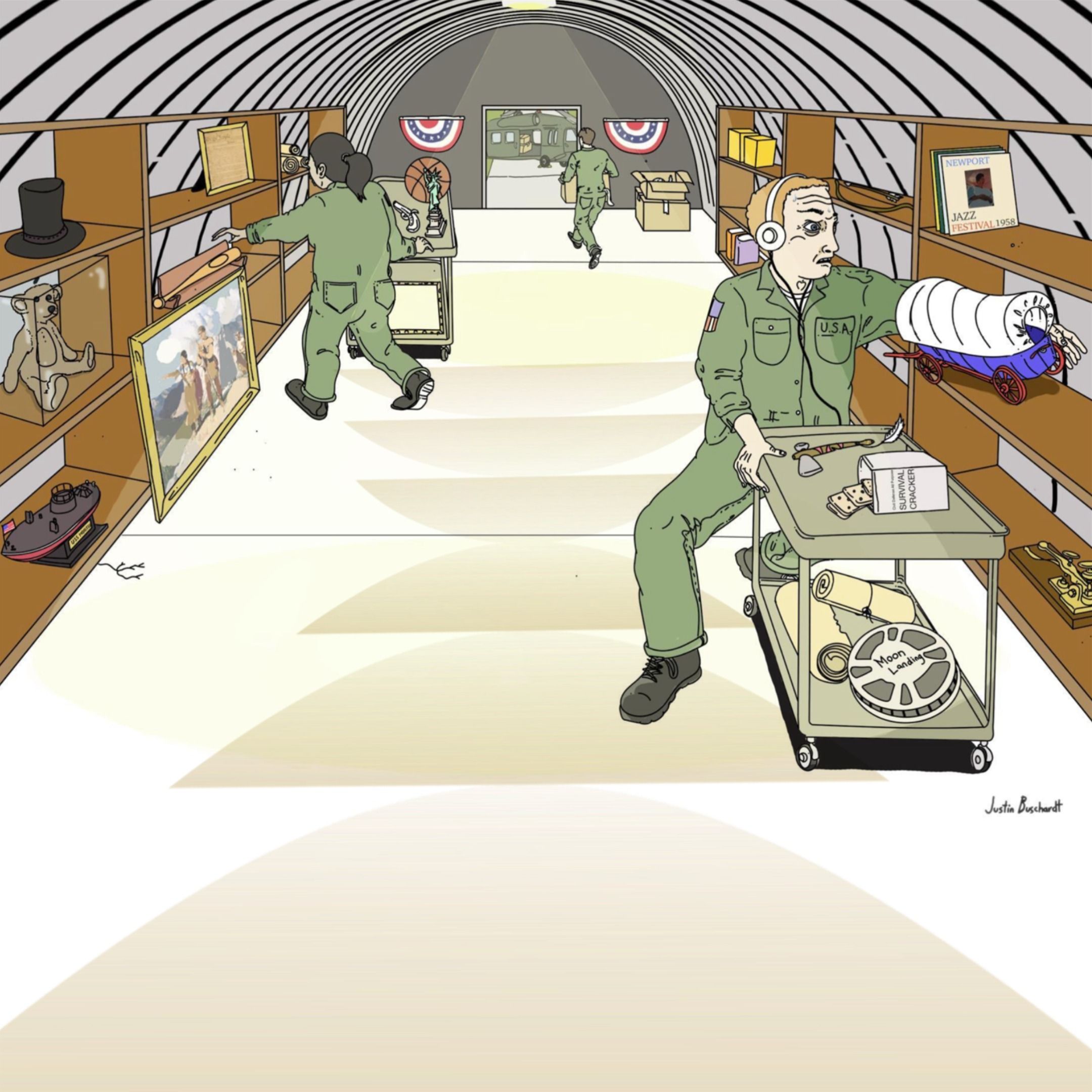
Overview of Atomic Artifacts
This Radiolab episode explores a little-known Cold War-era U.S. government project: planning for how America would survive, administratively and symbolically, after a nuclear attack. What starts as a story about a mysterious ID badge and a mountain bunker becomes a larger reflection on what counts as “America” — not just in terms of institutions and infrastructure, but in terms of shared symbols, values, and identity.
The Secret Doomsday Plan
The story begins when historian and journalist Garrett Graff finds a government ID badge with two sets of directions on the back: one to an office in Arlington, and one that leads, via satellite maps, to a road that seems to end inside a mountain in rural Virginia.
That discovery leads to the revelation that, during the 1950s and 1960s, the U.S. government quietly built a detailed post-nuclear-war continuity plan:
- National parks would become refugee camps.
- The Post Office would help register the dead and track survivors.
- The Department of Agriculture stocked massive quantities of survival crackers.
- The IRS planned how taxes would still be collected.
- The Federal Reserve hid cash in a mountain bunker, including shrink-wrapped $2 bills.
- Only a relatively small number of federal officials would be saved to keep government functioning.
The core idea was not to save every person, but to preserve America as an idea.
The Artifacts Chosen to Represent America
Because the government had only one helicopter reserved for rescuing objects, a task force selected a tiny set of items meant to carry American identity forward after catastrophe.
The known list included:
-
The Charters of Freedom
- The Declaration of Independence
- The Constitution
- The Bill of Rights
-
Four additional artifacts
- A log from the USS Monitor
- Abraham Lincoln’s medical records after his assassination
- The Japanese surrender documents from World War II
- A painting of Lewis and Clark’s westward journey
These choices suggest a theme of national endurance through crisis, sacrifice, and reinvention — though they also feel narrow, old-fashioned, and exclusionary in hindsight.
The Modern Reconsideration: What Would We Save Now?
Simon Adler then tries to update the question for the present day by asking Americans what objects should be preserved today to represent the country more fully.
Responses ranged from conventional to unexpected:
- Veterans at American Legion posts mostly favored familiar patriotic items like the Constitution, flags, and war-era surrender documents.
- Museum workers and historians proposed:
- The Star-Spangled Banner flag
- Iwo Jima or Fort Sumter flags
- Photographs by Ansel Adams and Edward Weston
- The Administrative Procedure Act
- The Alcoholics Anonymous Big Book
- A recording from the 1958 Newport Jazz Festival featuring Mahalia Jackson
That jazz recording stood out because it captured both American artistry and a rare image of racial integration and shared public space.
The Strongest Pushback: Maybe the Nation Itself Is the Wrong Frame
Several voices challenged the premise entirely.
Jill Lepore’s critique
Her view was that after an apocalyptic event, the real question is not which artifacts survive, but:
- Who are we that we did this to each other?
She argues that trying to preserve national symbols after self-destruction may simply preserve the same nationalism that caused the disaster.
Arlo Ironcloud’s perspective from the Lakota Nation
A powerful counterpoint comes from Arlo Ironcloud of KILI Radio on the Pine Ridge Reservation. He notes that Indigenous communities have already endured devastation akin to apocalypse, and that their traditions are not anchored in rigid written texts.
Key contrast:
- U.S. identity often relies on fixed documents and institutions.
- Lakota identity is adaptive, living, and passed down through story and memory.
He even says he would burn the Constitution, Bill of Rights, and Declaration of Independence rather than preserve them unchanged.
The Episode’s Ultimate Takeaway
The episode gradually shifts from a quirky historical mystery into a deeper meditation on national identity, memory, and what makes a society feel worth rebuilding.
Main conclusion:
The one thing that kept surfacing across interviews was not a legal document or military relic, but the Apollo moon missions — especially the images, audio, and symbolism of humans achieving something extraordinary together.
Why Apollo?
- It represents shared purpose
- It reflects collective achievement
- It shows America doing something transcendent at a time of deep division
- It offers a hopeful model of what the country can be when it works together
The episode ends on a note of aspiration: perhaps what Americans really want preserved is not just a set of objects, but the memory of a moment when the country aimed high and did something that felt bigger than itself.