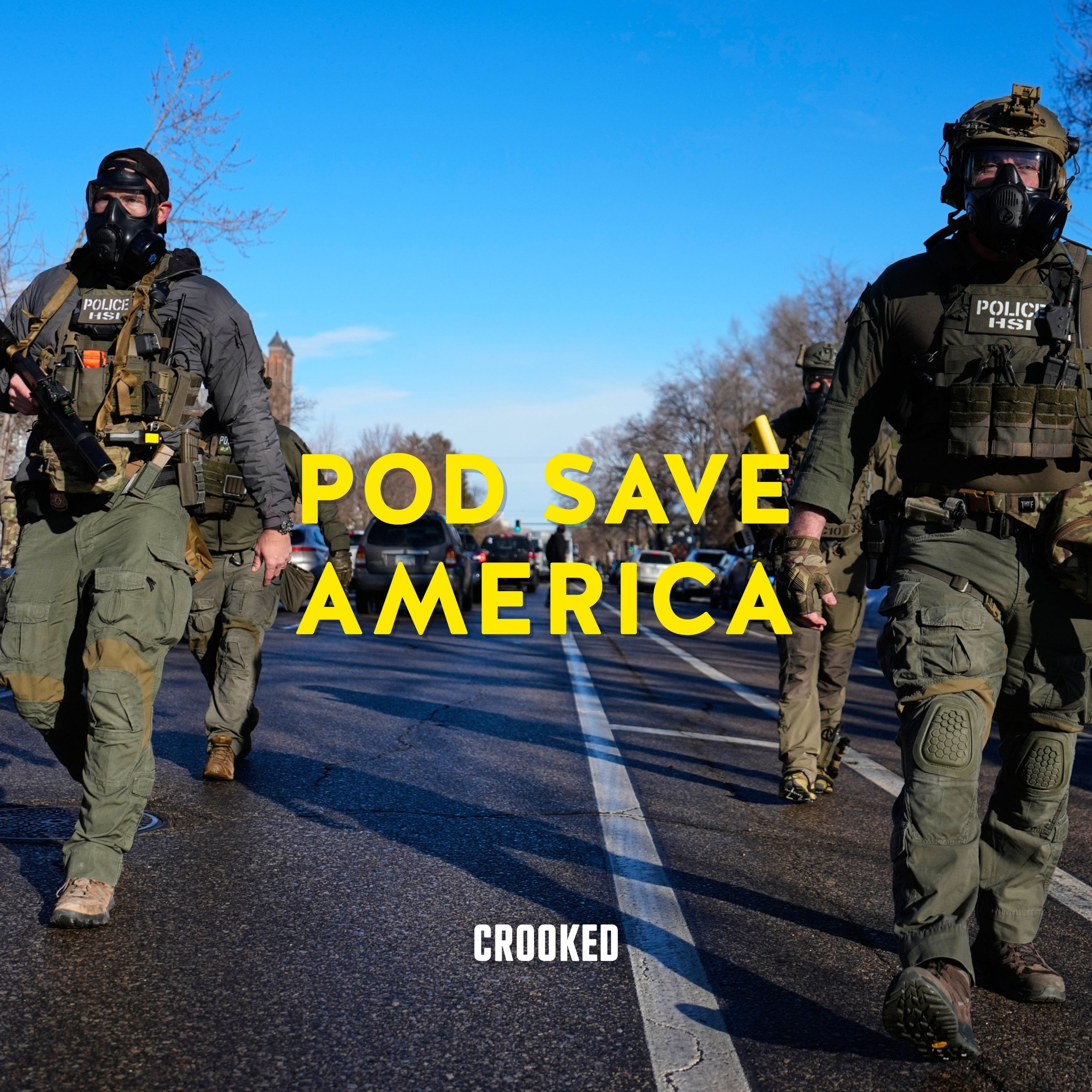
Overview of ICE's Reign of Terror (Pod Save America — Crooked Media)
This episode of Pod Save America (hosts Jon Favreau and Dan Pfeiffer) centers on the federal crackdown in Minneapolis after a federal agent shot Renée Good, the administration’s aggressive use of ICE/DHS forces, and the political, legal, and policy fallout. The hosts cover: violent federal tactics on U.S. soil; resignations and politicized investigations at the Justice Department; polling and public reaction; the intra‑Democratic debate over funding and whether to “abolish ICE” or pursue sweeping reform; foreign-policy chaos (Greenland, Venezuela, Iran); and an interview with Senator Ruben Gallego about how to rein in ICE and what Democrats should do next.
Main topics covered
- Minneapolis: federal agents (ICE/DHS) deployed in large numbers after the shooting of Renée Good; protests, tear gas, flashbangs, mass detentions and alleged assaults; Trump threatens to invoke the Insurrection Act.
- Justice Department: several federal prosecutors resigned after reports DOJ sought to investigate Good’s widow rather than the shooter; FBI raid on Washington Post reporter Hannah Natanson’s devices in a leak probe.
- Public reaction and polling: broad awareness of the Minneapolis shooting and majority opposition to the federal response; public largely views ICE presence as making cities less safe.
- Democratic strategy and funding: debate over withholding or conditioning DHS appropriations, limits of a shutdown to stop ICE, and political feasibility of abolishing ICE vs. major reform.
- Foreign policy oddities: Trump’s push to “buy/invade” Greenland, meetings with foreign ministers and allied responses; U.S. brokered Venezuelan oil sale held in Qatari accounts and plans to use private contractors to secure Venezuelan oil; posture toward Iran and possibility of military action.
- Interview with Sen. Ruben Gallego: practical reform proposals for DHS/ICE, legislative and political tactics, and views on Greenland and housing policy.
Key takeaways
- The Minneapolis deployment is framed as a paramilitary occupation: hosts and guests describe federal forces acting with intimidation tactics (masked agents, warrantless detentions, use of gas) and argue the response from the White House is politically motivated and escalatory.
- DOJ politicization: decisions to investigate the victim’s family rather than the shooter, plus raids on reporters, are presented as alarming abuses of federal power and threats to press freedom.
- Polling cuts against the administration: multiple national polls show significant majorities think the shooting was unjustified, oppose ICE’s tactics, and believe ICE presence reduces city safety — an important political vulnerability for the administration.
- Funding leverage is complicated: withholding DHS funding may be politically tempting, but precedent shows ICE can continue operations via mandatory funding or other mechanisms even during shutdowns; careful targeting and conditional appropriations are needed to affect ICE’s behavior.
- Abolish ICE vs. reform: hosts and Sen. Gallego lean toward radical, enforceable reform rather than simply a slogan-driven abolish campaign. Practical proposals include requiring warrants, demilitarizing agents (no masks), ending quotas, firing abusive agents, redirecting budget to services, and designing a focused deportation force for dangerous criminals.
- Foreign-policy chaos undermines alliances and priorities: the Greenland episode and other actions (Venezuela oil sales, pressure on Mexico) are portrayed as distracting, risky, and potentially damaging to NATO and regional stability.
Notable quotes / moments
- “The President of the United States dispatched a mass paramilitary force loyal to him to invade and occupy an American city.” — characterization of the Minneapolis deployment.
- “If you tell people: ‘An ICE agent shot an unarmed woman in the face three times and the agency is investigating her widow instead of the shooter’ — people would think that is fucking nuts.” — on the public reaction to DOJ choices.
- Sen. Gallego on reform: “You would not be able to deport anybody without a warrant… right‑size the amount of people… get rid of the quotas… take off the masks.”
Senator Ruben Gallego — core points from the interview
- Strongly condemns federal paramilitary tactics in Minneapolis as lawless, racially profiling, and terrorizing communities.
- Supports using congressional levers to constrain ICE/DHS operations — through appropriations or targeted constraints — but recognizes practical limits (some ICE funding is mandatory).
- Concrete proposals: require warrants for arrests, end quotas and warrantless raids, demilitarize agents (no masked “goon squad” behavior), fire agents who abuse rights, and push comprehensive immigration reform that pairs humane enforcement with a pathway to citizenship.
- Greenland: met with Danish and Greenland officials — allies say bases and cooperation are possible without ceding sovereignty; Gallego introduced a bill requiring congressional authorization before any action in Greenland.
Political and policy implications
- Short term: Democrats have political leverage because public opinion tilts against ICE and the administration’s handling; careful strategy could translate public outrage into policy constraints.
- Tactical limits: a DHS funding standoff may not halt ICE operations because of prior funding structures and executive discretion; Democrats must design appropriations or oversight that actually constrains operational behavior.
- Strategic opportunity: the episode argues the best long-term remedy is comprehensive immigration reform — reframe from reactionary crisis management to a durable policy solution that reduces the space for future abuses.
Recommended actions and signals for Democrats (as discussed)
- Push targeted appropriations and oversight measures that limit ICE’s ability to act like a militarized occupying force (warrants requirement, use-of-force restrictions, transparency and reporting).
- Pursue accountability: investigations and firings where agents violated law or policy; protect journalists and resist DOJ overreach into reporting.
- Build a 2028 platform with a clear, specific vision for humane enforcement + comprehensive immigration reform rather than relying on slogans alone.
- Keep pressuring allied countries and Congress to resist executive adventurism on foreign-policy whims (e.g., Greenland).
Quick summary
This episode frames the current federal actions in Minneapolis and elsewhere as a dangerous turning point: aggressive, politicized federal enforcement; DOJ abuses; and foreign-policy distractions all compound into a crisis that public opinion largely rejects. The hosts and Sen. Gallego call for concrete, enforceable reforms to DHS/ICE, better congressional oversight, and a longer-term push for comprehensive immigration reform to prevent recurrence.