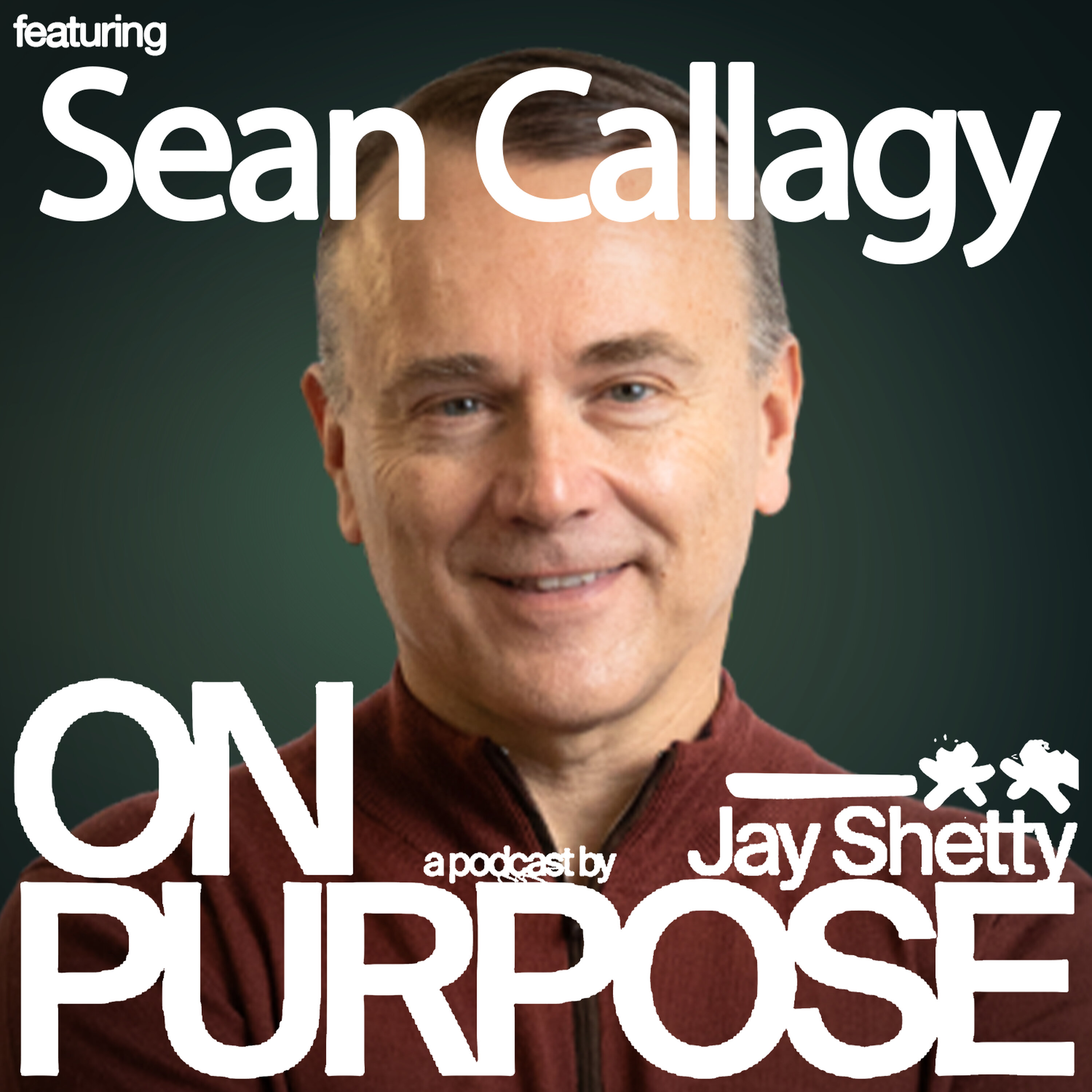
Overview of On Purpose — Sean Callagy: The #1 Skill That Controls Your Income (Use THIS 90/10 Rule to Build Trust and Create More Opportunities)
Jay Shetty interviews entrepreneur, speaker and founder Sean Callagy (Unblinded). Sean shares his personal story (born with retinitis pigmentosa, former athlete, attorney turned entrepreneur), and teaches a practical framework for influence, trust-building and scaling businesses ethically. The conversation centers on one core claim: mastering the ability to cause “yes” (influence) is the single human skill that unlocks income, opportunity and freedom — and it can be learned deliberately using simple daily practices and systems.
Key takeaways
- Influence (the ethical ability to make others say “yes”) is the highest-leverage, learnable superpower that controls income and opportunity.
- The 90/10 listening rule: in early conversations listen 90% of the time and speak 10% — ask open-ended questions and reflect heart-level meaning.
- Immediate biochemistry matters: microdose endorphins 12x/day (short bodyweight movements for 60 seconds) to shift mindset and performance.
- To scale a business, focus on exponentially increasing the quantity and quality of sales meetings — marketing and influence > merely being excellent at delivery.
- Integrity framework for influence: 1) be transparent to relevant truth; 2) add more value than you receive; 3) the promise must do what it claims.
- Master AI yourself: Sean argues AI will rapidly change marketing and sales; learn and integrate it rather than delegating it.
Sean Callagy — personal story & framing
- Background: athletic youth, diagnosed with progressive vision loss (retinitis pigmentosa), became an attorney to avoid being “blind and broke.”
- Turning point: left a law firm to start his own practice, learned influence and public speaking, joined Tony Robbins’ Platinum Partnership, scaled firms and speaking career.
- Life ethos: “unblinded” = helping people see limiting beliefs and choose freedom; places love, contribution and integrity at the center of influence.
- Example of impact: scaled businesses, built teams, charitable work (e.g., giving away toys), skis and surfs after vision loss — an “example of possibility.”
Practical frameworks & tactics you can use immediately
90/10 Listening Rule (week-structured practice)
- Week 1: In every conversation, listen 90% / speak 10%. Ask open-ended questions (who, what, when, where, why, how). Reflect back: “What I’m hearing you say is… Am I hearing you correctly?”
- Week 2: Shift to ~66% listening. After deep listening, offer a short, humble share: “May I share a couple things that may or may not resonate?”
- Weeks 3–4: Begin proposing co-creation — suggestions, follow-ups, next steps. Focus on being the “mouse that takes the thorn out of the lion’s foot” (solve the immediate pain).
Daily/24-hour actions
- Put endorphins in your body 12x/day for 60 seconds (push-ups, squats, crunches, or for limited mobility: facial muscles, finger movements) to change biochemistry and focus.
- Try level-5 listening in your next meeting: reflect the heart behind what someone says, not just surface facts.
Selling, marketing and offers
- Before scaling: ensure your offer has margin and residual revenue, and you genuinely believe in it.
- Build an ecosystem: speak to groups of ideal clients (e.g., professional associations) and deliver value first — don’t lead with a pitch.
- One-sentence scaling rule: exponentially grow the quantity and quality of your sales meetings.
Leadership & company-building essentials
- Leadership triangle for scaling:
- Loyalty to the stated mission (not to person).
- Masterful competence in the job role (marketing/sales competence is toughest to find).
- Aligned empowerment — people must run the plays you agree on and not recreate their jobs.
- Owner vs operator: build systems and marketing that create predictable sales meetings so you can be an owner (time freedom) rather than an operator.
- Don’t let team members unilaterally recreate their job roles; set clear standards and boundaries.
Integrity-centered influence: simple rules
- Three-part integrity test for any offer:
- Transparent to relevant truth.
- Intention to add more value than you receive.
- The product/service does what you say it will.
- Target the right audience — offer complexity and timeline should match the buyer (e.g., advanced, longer-term programs aren’t for 25-year-olds expecting immediate wealth).
AI and the future of marketing/sales (Sean’s position)
- AI will dramatically change marketing and sales — reduce human constraint, enable massive parallel split-testing and content generation.
- Practical counsel: master AI yourself; don’t outsource your AI competence to others. Use AI to scale outreach, personalization, and testing.
- Sean describes building ActEye “beings” to run simultaneous marketing/webinar/competition tests at scale — his firm’s approach to using AI to surpass human marketing limits.
- Warning: many white‑collar roles (associates, marketers, legal associates) will be affected; adapt by learning AI-driven marketing and influence.
Mindset & identity work
- Identity reset: you are not limited to the title you have — choose the identity of “a person who adds value” and re-skill around that.
- Limiting beliefs to challenge:
- “Money requires suffering” → reframe to ethics + influence = freedom.
- False modesty: don’t underplay your unique capacity to create value.
- Don’t accept cynicism disguised as “realism.”
- Practical: pick small, consistent actions (endorphins, listening practice, weekly outreach) to rebuild identity through behavior.
Notable quotes
- “Influence is the only human attainable superpower.”
- “Value and money are all about replacement cost, period.”
- “Put endorphins in your body 12 times a day.”
- “Exponential growth comes from the quantity and quality of sales meetings.”
Rapid Q&A highlights (Sean’s one-sentence answers)
- Best advice he heard: Influence is the only human attainable superpower.
- Worst advice: Take advice from people who haven’t produced the results you want.
- Hardest accomplishment: Building a scaled business that allowed him to attend almost every one of his children’s 1,000+ sporting events.
- What he used to value but no longer does: The approval of others.
- One law he’d impose: Never call yourself a “realist” when you’re really a cynic.
Action plan — 24 hours, 30 days, 1 year
- Next 24 hrs:
- Do 12 x 60-second micro-movements (endorphin microdoses).
- Practice 90/10 listening in your next conversation.
- Next 30 days:
- Week-by-week listening routine (90% → 66% → propose/co-create).
- Book one small speaking opportunity or a short 15-minute talk (community center, senior home, clinic).
- Track number and quality of your sales/intro meetings — aim to increase both.
- Next 12 months:
- Master a basic AI workflow for marketing/outreach; implement split-tests and automation you control.
- Build one repeatable ecosystem (e.g., speaking → onboarding → referral loop) that increases regular sales meetings.
- Decide whether you want to become owner vs operator and design systems to enable that.
Who benefits most from this episode
- Early-stage founders, sales and marketing leaders, entrepreneurs who want to scale ethically.
- Professionals feeling stuck or considering quitting a job — provides a stepwise, low-risk approach.
- Anyone who wants concrete daily practices to build presence, influence and confidence.
If you want the core practical prescription boiled down: microdose endorphins daily, practice deep listening (90/10), deliberately increase the quantity & quality of sales meetings, sell with integrity (three-part test), and learn AI to scale your influence.