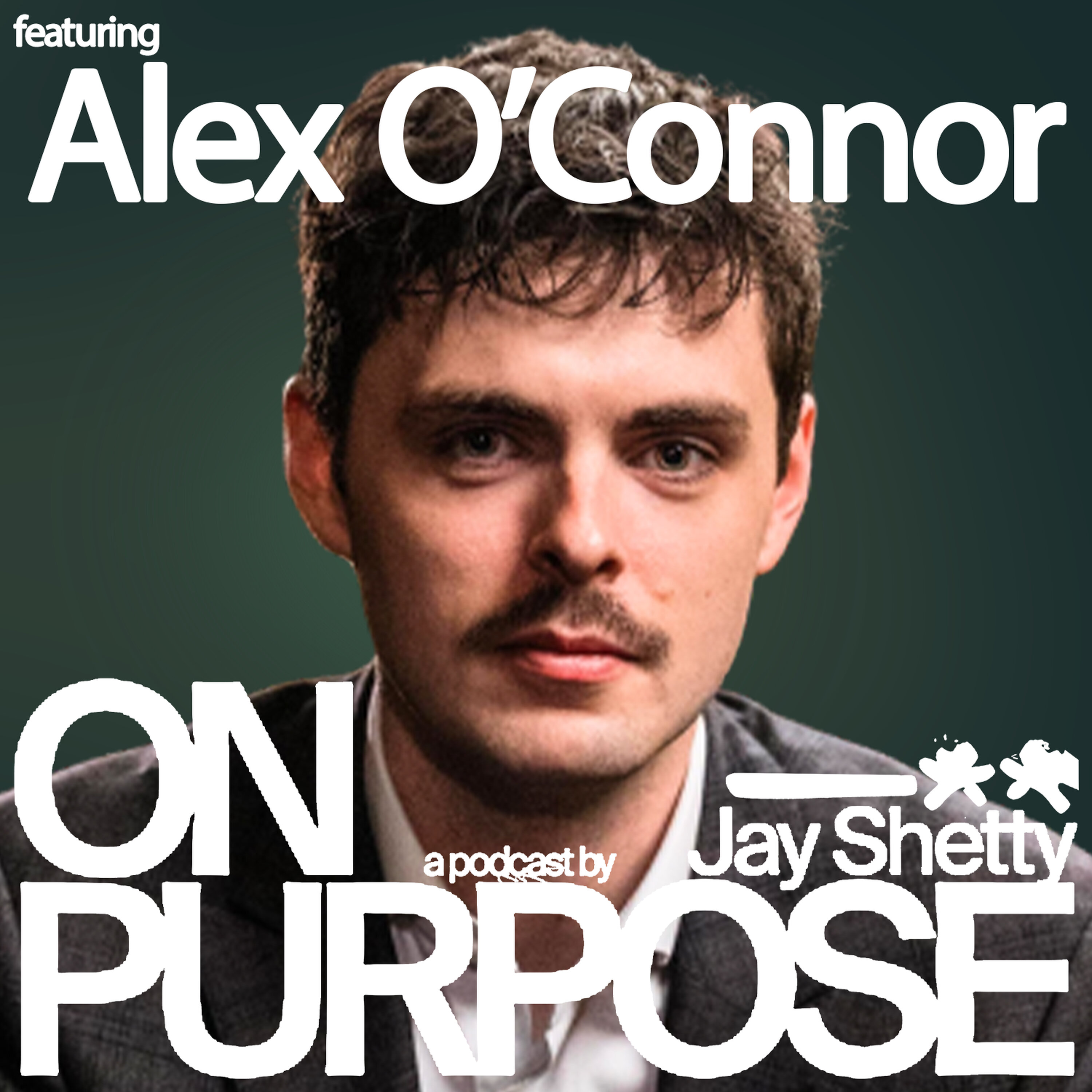
Overview of Alex O’Connor: #1 Shift That Stops Endless Overthinking (FINALLY Get Unstuck)
This episode of On Purpose features Jay Shetty in conversation with philosopher and creator Alex O’Connor about how to think more clearly, stop overidentifying with school or debate culture, and make peace with uncertainty. The discussion moves from Alex’s rebellious school years and Oxford path to deeper questions about science, consciousness, Indian philosophy, free will, the self, and why death feels so unsettling. A major throughline is Alex’s argument that science is powerful at describing reality, but may not be able to fully explain consciousness or the origin of existence itself.
Key Takeaways
-
School performance is not the same as intelligence or potential.
- Alex shares how he initially failed his A-levels, then later turned things around and got into Oxford.
- His point to young people: not doing well in school does not mean you lack ability or future options.
-
Find what you’re good at and what you actually enjoy.
- He encourages people to identify their strengths as early as possible, even if they’re nontraditional.
- Not everyone is cut out for the same path, and there are many ways to learn, study, and build a career.
-
Science is not the same as explanation in the deepest sense.
- Alex argues science excels at mathematical description and mechanism, but not necessarily the “why” behind reality.
- He uses examples like gravity, Newton, and Feynman to say science explains how things behave, not why there is something rather than nothing.
-
Consciousness remains the deepest mystery.
- He rejects the idea that subjective experience is simply identical to brain activity.
- He leans toward philosophical views like idealism and is deeply influenced by Indian traditions, especially Advaita Vedanta.
-
Much of human reasoning is post hoc.
- Alex discusses split-brain research and the idea that the left brain often rationalizes actions after the fact.
- This supports his view that people often think they act from pure logic when intuition and emotion are doing a lot of the work.
-
Death is frightening because it confronts us with the end of selfhood.
- He connects his views on consciousness and the self to why death can feel so unnatural.
- His own thinking gives him some consolation, though he is clear that he doesn’t claim certainty.
Childhood, School, and Oxford
Rebellious but Curious
Alex describes growing up near Oxford and being a mildly disruptive student:
- skipping class,
- wearing the wrong shoes/uniform,
- arguing with teachers,
- spending time in music and recording studios.
He says this rebellious streak may have helped draw him toward debate, philosophy, and the “theater” of argument online.
Failing and Recovering
A notable story is his early academic failure:
- He got three U’s in his first A-level attempt.
- He later redid them, worked harder, and earned grades strong enough to go to Oxford.
His message is reassuring rather than inspirational-cliché:
- exams matter,
- but they are not the end of your life,
- and there are always alternative routes.
Philosophy, Science, and the Limits of Explanation
Science as Description, Not Ultimate Explanation
One of the episode’s biggest ideas is Alex’s distinction between:
- describing reality mathematically,
- and explaining why reality exists at all.
He argues:
- physics describes matter and its interactions,
- but presupposes matter already exists,
- so it may not answer foundational metaphysical questions.
The “Why” Question
Alex emphasizes that people often confuse:
- “how does it work?” with
- “why is there anything like this in the first place?”
He suggests science may eventually refine more details, but it may never fully answer questions like:
- Why is there something rather than nothing?
- Why does consciousness exist?
- What is consciousness, really?
Not a “God of the Gaps” Argument
He is careful to say this is not simply:
- “science can’t explain it, therefore God.”
Instead, he leaves open the possibility of other non-scientific explanations, including philosophical ones, without rushing to a religious conclusion.
Consciousness, the Self, and Indian Philosophy
Why Advaita Vedanta Matters to Him
Alex says his interest in Indian thought came through consciousness and the philosophy of mind, not through generic “spirituality.”
- He was drawn to Advaita Vedanta, which explores non-duality and the idea that apparent division is illusory.
- He sees it as a profound philosophical tradition, not just a religion in the way people casually use the word “Hinduism.”
The Self May Be Less Solid Than We Think
He discusses:
- the possibility that the self is an illusion,
- the idea that consciousness may be more fundamental than matter,
- and the notion that individual identity is not as straightforward as it seems.
Split-Brain Studies
A major example he returns to is split-brain patients:
- one hemisphere may perceive something while the other does not,
- the person may still give a confident explanation,
- which suggests the brain often confabulates reasons after the fact.
This supports his broader argument that:
- we are less rational and unified than we think,
- and “I know why I did that” is often a story the brain tells itself.
Death and the Good Life
Why Death Feels Unnatural
Alex explains that death feels so disturbing because it seems to threaten:
- consciousness,
- identity,
- and the continuity of self.
He notes that some traditions, especially Advaita, would say:
- the true self is eternal,
- and what ends is only the illusion of the individual self.
On the “Good Life”
When asked how he would explain a good life, Alex is cautious:
- he says it depends on what “good” means,
- and admits he doesn’t think he has a fully settled answer.
Still, he suggests possible indicators include:
- contentment,
- calm,
- reduced stress,
- confidence in one’s decisions.
Debates, Ego, and How to Think Better
Why He Says No to More Debates
Alex says debates can become ego-driven and too performative. His view:
- debates can be entertaining and useful,
- but they often reward spectacle over truth,
- and they consume a lot of preparation time.
He compares them to:
- a boxing match,
- or a chess game, where performance in that moment does not necessarily equal deeper truth.
Better Thinking Starts With Awareness
A recurring piece of advice is to:
- step back from your own certainty,
- pay attention to whether you’re just rationalizing,
- and try to recover more intuitive, holistic thinking instead of over-relying on abstract logic.
Best Advice, Final Thoughts, and Fun Closing Answer
Best Advice He’s Received
- “Enjoy it.”
- Alex says this advice helped him realize that important moments are often ruined by overthinking and future-tripping.
One Law for the World
His playful answer:
- No pop music in fancy restaurants.
- He believes the atmosphere of a carefully designed space is ruined when generic pop music is blasted over it.
Notable Quotes / Ideas
- “Science is in the business of describing things mathematically.”
- “There’s very few things people can be certain of.”
- “Pay attention when you are convinced that you know why you’re doing something.”
- “The self does not exist” — a key theme tied to both philosophy and consciousness.
- “Enjoy it” — his simplest life advice.
Main Takeaway
Alex O’Connor’s core message is that people should be much more humble about what they think they know. School, science, identity, and even our own reasons for acting are all more limited and uncertain than we usually admit. Rather than pretending to have total answers, he argues for curiosity, philosophical openness, and a willingness to explore consciousness, selfhood, and meaning without forcing everything into a neat or purely scientific framework.